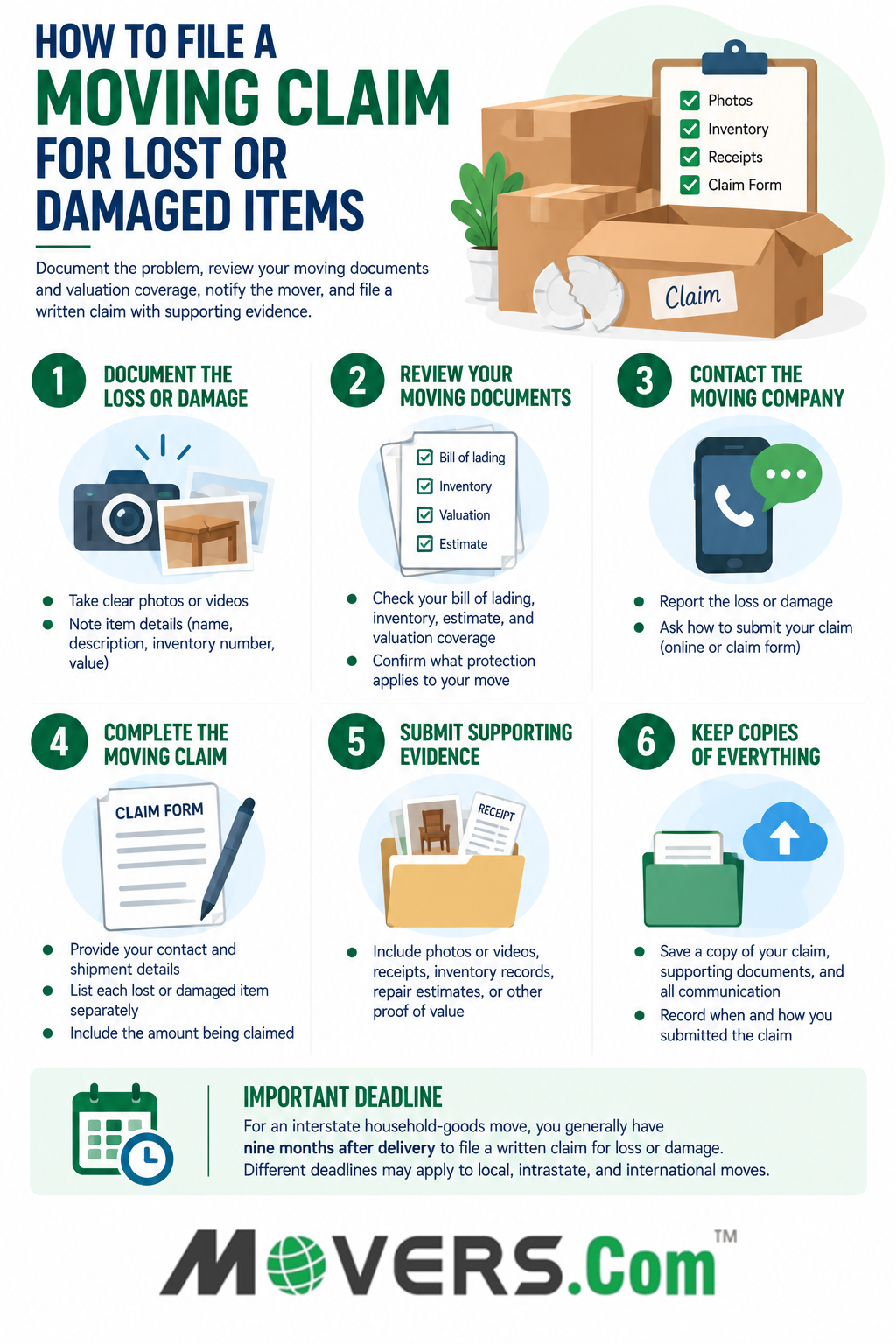
If a moving company loses or damages your belongings, document the problem, review your moving documents and valuation coverage, notify the mover, and file a written claim with supporting evidence.
Include photos, inventory records, receipts or other proof of value, and repair estimates when applicable. Keep copies of everything you submit.
For an interstate household-goods move, you generally have nine months after delivery to file a written claim for loss or damage. Different deadlines may apply to local, intrastate, and international moves.
What to Do if Your Belongings Are Damaged During a Move
Document damaged belongings as soon as you discover the problem and before making repairs or disposing of the items.
Take these steps:
- Inspect your belongings. Check furniture, boxes, appliances, and other items for visible damage after delivery.
- Take photos or videos. Document the damage from multiple angles and keep the original files when possible.
- Check your inventory and delivery documents. Compare the damaged items with the shipment records from your move.
- Keep damaged items when practical. The mover may request additional documentation or an inspection.
- Notify the moving company. Report the damage and ask how to submit your claim.
Avoid repairing, replacing, or disposing of damaged belongings before checking the mover's claim requirements when practical.
What to Do if a Moving Company Loses Your Stuff
If something is missing after delivery, check your shipment inventory and delivery documents and notify the moving company as soon as possible.
Confirm that all boxes and furniture were unloaded and check whether the missing item may have been packed inside another box or container.
Record the item's:
- Name and description.
- Inventory number, if available.
- Approximate age and value.
- Identifying details.
If the item remains missing, include it in your written claim along with receipts, photos, purchase records, or other evidence of ownership and value when available.
How to File a Moving Claim
A moving claim should identify what was lost or damaged, explain the loss or damage, and include the documentation needed to evaluate your claim.
Step 1: Document the Loss or Damage
Take clear photos or videos of damaged belongings and record information about missing items.
For each affected item, note:
- Item name and description.
- Nature of the loss or damage.
- Inventory number, when available.
- Approximate age.
- Purchase price or value, when known.
- Repair information, when applicable.
Keep this information organized so it can be submitted with your claim.
Step 2: Review Your Moving Documents
Review the paperwork associated with your move before filing the claim.
Depending on the move, relevant documents may include:
- Bill of lading.
- Shipment inventory.
- Moving estimate.
- Valuation selection or coverage information.
- Delivery documents.
- Receipts or other proof of value.
Your valuation selection can affect the mover's liability for lost or damaged belongings, so confirm what protection applied to your shipment.
Step 3: Contact the Moving Company
Contact the mover and ask how it handles loss and damage claims, including whether claims can be submitted online or through a specific claim form.
For an interstate household-goods move, a loss or damage claim generally must be filed in writing within nine months after delivery. If the shipment wasn't delivered, the filing period generally runs from a reasonable time after the shipment should have been delivered.
A written interstate claim doesn't necessarily have to be submitted using the mover's own claim form, although following the company's claims process may make the claim easier to process.
Step 4: Complete the Moving Claim
Provide the requested information as accurately and specifically as possible.
Your claim should generally identify:
- Your contact and shipment information.
- Pickup and delivery information.
- Each lost or damaged item.
- Inventory numbers, when available.
- The nature of the loss or damage.
- The amount being claimed.
- Supporting documentation.
If several belongings were affected, list each item separately rather than describing everything as one general loss.
Step 5: Submit Supporting Evidence
Provide documentation that helps establish the identity, condition, ownership, value, or repair needs of the affected belongings.
Supporting evidence may include:
- Photos or videos of the damage.
- Photos showing the item's condition before the move, when available.
- Shipment inventory records.
- Purchase receipts or order confirmations.
- Product information.
- Repair estimates.
- Written communication with the mover.
Not every claim requires every type of document. Provide the strongest evidence you reasonably have and follow the applicable claim instructions.
Step 6: Keep Copies of Your Claim
Keep copies of:
- Your completed claim.
- Supporting documents.
- Photos and videos.
- Receipts and repair estimates.
- Emails and other written communication.
- Confirmation that the claim was submitted.
Record when and how you submitted the claim so you can track its progress and follow up when necessary.
What Happens After You File a Moving Claim?
After you submit a moving claim, the mover will review your claim and supporting evidence before accepting, settling, or denying it.
The moving company may:
- Request additional documents or information.
- Ask for additional photos or other evidence.
- Inspect a damaged item.
- Review a repair estimate.
- Determine whether the loss or damage is covered.
- Offer a settlement or deny the claim.
For an interstate household-goods claim, the carrier generally must acknowledge receipt of the claim within 30 days and pay, decline, or make a firm compromise settlement offer within 120 days after receiving it.
If additional time is needed, federal rules provide for periodic status updates while the claim remains unresolved.
How Does Valuation Coverage Affect a Moving Claim?
The valuation option selected for your move can affect the mover's liability when belongings are lost or damaged.
For interstate household-goods moves, the two primary liability options are Full Value Protection and Released Value.
Full Value Protection
Under Full Value Protection, the mover may generally choose to:
- Repair the damaged item.
- Replace it with a similar item.
- Provide a cash settlement based on the cost of repair or the item's current market replacement value.
Specific terms and rules for items of extraordinary value can affect the mover's liability, so review your moving documents carefully.
Released Value Protection
Released Value provides more limited protection. For interstate moves, the mover's liability under this option is generally limited to 60 cents per pound per article.
For example, if a 20-pound item is lost or damaged:
20 pounds × $0.60 = $12
The mover's liability may therefore be only $12 under Released Value, even if the item was worth considerably more.
Local and intrastate moves may be subject to different valuation requirements, so check the coverage that applied to your move.
What if the Moving Company Damages Your Home?
If movers damage your home or other property during the move, document the damage immediately and notify the moving company.
Take photos or videos of damaged:
- Floors.
- Walls.
- Doors or trim.
- Stairs or railings.
- Other parts of the property.
Record when and where the damage occurred and ask the moving company how property-damage claims should be submitted and what documentation it requires.
Don't assume that the valuation coverage for your household-goods shipment applies to damage to your home in the same way. Ask the mover how the specific property damage will be handled.
What if Your Moving Claim Is Denied?
If the moving company denies your claim, review the reason carefully and compare the decision with your moving documents and supporting evidence.
You can:
- Review the mover's explanation for the denial.
- Check whether important documentation was missing.
- Provide additional evidence when appropriate.
- Ask whether the mover offers reconsideration or another dispute process.
- Keep further communication in writing.
For interstate household-goods moves, movers must offer a neutral arbitration program for certain disputes involving loss or damage.
For claims of $10,000 or less, the mover generally must participate in arbitration when the customer requests it. For claims above $10,000, arbitration generally requires both parties to agree.
You can also submit a complaint about an interstate mover or broker to FMCSA. However, an FMCSA complaint does not mean the agency will resolve your individual damage claim or recover compensation for you.
What if International Movers Damage Your Items?
International moving claims can follow different procedures depending on the mover, carrier, transportation method, destination, contract, and coverage selected.
If belongings are lost or damaged during an international move:
- Document the loss or damage as soon as possible.
- Review your shipping and delivery documents.
- Check the coverage that applied to the shipment.
- Notify the appropriate mover or carrier.
- Follow the claim instructions in your contract or transportation documents.
- Pay close attention to the applicable claim deadline.
Don't assume that the deadlines or valuation rules for a U.S. interstate household-goods move also apply to an international shipment.
Bottom Line
If a moving company loses or damages your belongings, document the problem immediately, review your moving documents and valuation coverage, and submit a written claim with supporting evidence.
Keep copies of your claim and related records, and pay close attention to applicable filing deadlines.
Editor's Note
Our comparison reviewed by our Moving Industry Analyst team is based on publicly available pricing, customer reviews, and regular moving scenarios.
Moving claim requirements can vary by type of move, mover, valuation coverage, and applicable regulations. Review your moving documents and the mover's claim instructions before submitting a claim.
Get expert moving tips and compare movers for free at Movers.com.
You can get free moving quotes from licensed and insured movers, compare moving companies near you, and plan your move with confidence using our step-by-step moving guides and checklists.
Whether you're planning a local move, a long-distance relocation, or need help with packing and loading, Movers.com connects you with trusted moving professionals and practical tools to make moving easier and more affordable.
Questions? Talk to our moving specialists.