Living without a car is possible in several U.S. cities thanks to reliable public transportation, walkable neighborhoods, and bike-friendly streets. Many of these cities also make it easy to commute, shop, and handle daily errands on foot, by bike, or by public transit.
This guide compares 10 of the best U.S. cities where you can live without a car, highlighting each city's public transportation, walkability, bike infrastructure, and overall lifestyle to help you decide if a car-free move is right for you.
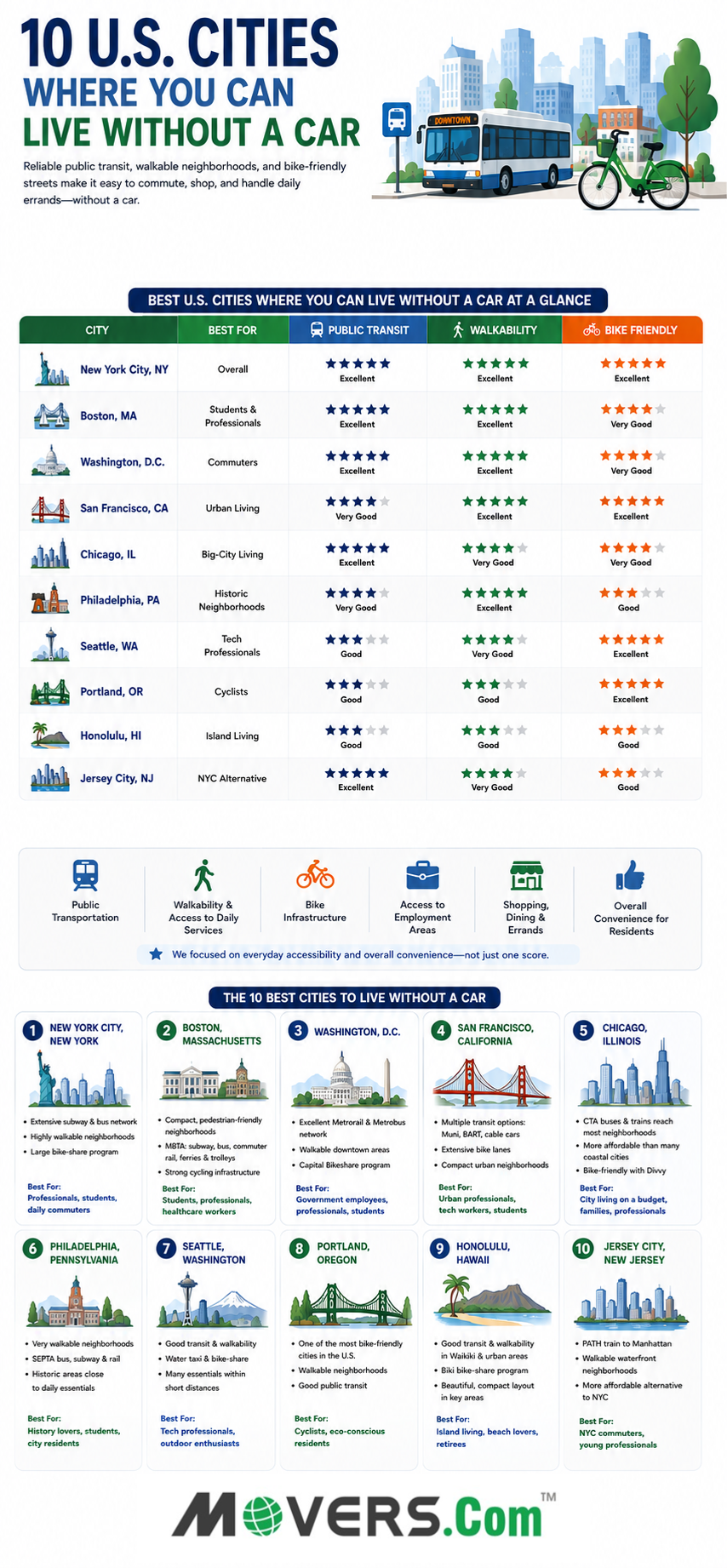
Best U.S. Cities Where You Can Live Without a Car at a Glance
| City |
Best For |
Public Transit |
Walkability |
Bike Friendly |
| New York City, NY |
Overall |
Excellent |
Excellent |
Excellent |
| Boston, MA |
Students & Professionals |
Excellent |
Excellent |
Very Good |
| Washington, D.C. |
Commuters |
Excellent |
Excellent |
Very Good |
| San Francisco, CA |
Urban Living |
Very Good |
Excellent |
Excellent |
| Chicago, IL |
Big-City Living |
Excellent |
Very Good |
Very Good |
| Philadelphia, PA |
Historic Neighborhoods |
Very Good |
Excellent |
Good |
| Seattle, WA |
Tech Professionals |
Good |
Very Good |
Excellent |
| Portland, OR |
Cyclists |
Good |
Good |
Excellent |
| Honolulu, HI |
Island Living |
Good |
Good |
Good |
| Jersey City, NJ |
NYC Alternative |
Excellent |
Very Good |
Good |
How We Chose These Cities
No single ranking system was used because transportation quality, walkability, and neighborhood accessibility vary within every city. We considered public transportation, walkability, bike infrastructure, access to daily services, employment areas, and overall convenience for residents without cars.
We focused on everyday accessibility rather than one walkability or transit score.
1. New York City, New York
New York City is widely considered the easiest city in the United States to live without a car. Its extensive subway system, bus network, commuter rail services, and highly walkable neighborhoods allow millions of residents to rely on public transportation every day.
Walking is often the fastest way to travel through many parts of Manhattan, while Citi Bike provides thousands of shared bicycles throughout the city for short trips.
Why It Stands Out
- Extensive subway and bus network
- Highly walkable neighborhoods
- Large bike-sharing program
- Easy access to shopping, restaurants, parks, and entertainment
Best For
- Professionals
- Students
- Daily commuters
- Residents who prefer walking
Things to Consider
- High housing costs
- Crowded public transportation during peak hours
- Limited parking if you own a vehicle
Bottom Line: If your goal is to eliminate car ownership entirely, New York City offers the strongest combination of public transportation, walkability, and everyday convenience.
2. Boston, Massachusetts
Boston is one of the most walkable cities in the United States and offers an excellent public transportation system for residents who choose not to own a car. Many neighborhoods are compact, making it easy to walk between work, restaurants, grocery stores, parks, and entertainment.
The Massachusetts Bay Transportation Authority (MBTA) operates subways, buses, commuter rail, ferries, and trolley services throughout the metropolitan area.
Why It Stands Out
- Compact, pedestrian-friendly neighborhoods
- Reliable subway and commuter rail system
- Strong cycling infrastructure
- Home to major universities and healthcare centers
Best For
- College students
- Young professionals
- Healthcare workers
- Daily commuters
Things to Consider
- Winter weather can make walking and biking more challenging
- Housing costs remain relatively high
Bottom Line: Boston combines excellent public transportation with one of the country's most walkable urban layouts, making it an ideal city for living without a car.
3. Washington, D.C.
Washington, D.C. offers one of the nation's best public transportation systems, allowing many residents to commute without driving. The Metrorail and Metrobus network connects major neighborhoods, while bike-share programs and extensive sidewalks make getting around simple and convenient.
Many government offices, museums, restaurants, shopping districts, and cultural attractions are located within walking distance of Metro stations.
Why It Stands Out
- Extensive Metrorail and Metrobus network
- Highly walkable downtown neighborhoods
- Capital Bikeshare program
- Easy access to employment and attractions
Best For
- Government employees
- Professionals
- Students
- Frequent public transit users
Things to Consider
- Housing costs can be high
- Rush-hour Metro trains may become crowded
Bottom Line: Washington, D.C. is an excellent choice for commuters who want reliable public transportation and easy access to work, shopping, dining, and entertainment.
4. San Francisco, California
San Francisco is one of the easiest West Coast cities to navigate without a car thanks to its compact neighborhoods, extensive public transportation, and strong cycling culture. Although the city's famous hills can make walking more demanding, many residents rely on transit, biking, or walking for their daily commute.
Public transportation includes Muni buses, Muni Metro light rail, BART, historic cable cars, and regional commuter services.
Why It Stands Out
- Excellent walkability
- Multiple public transportation options
- Extensive bike lane network
- Compact urban neighborhoods
Best For
- Urban professionals
- Tech workers
- Students
- Residents who enjoy walking
Things to Consider
- High cost of living
- Steep hills in many neighborhoods
- Some transit routes may become crowded during peak commuting hours
Bottom Line: If you're looking for a West Coast city where a car is optional, San Francisco offers one of the country's strongest transportation networks.
5. Chicago, Illinois
Chicago combines excellent public transportation with more affordable big-city living than many coastal metropolitan areas. The Chicago Transit Authority (CTA) operates an extensive network of trains and buses, making it possible to reach most neighborhoods without driving.
Many communities also offer grocery stores, schools, restaurants, parks, and entertainment within walking distance.
Why It Stands Out
- Extensive CTA train and bus network
- Walkable neighborhoods
- Growing bike lane network
Generally lower housing costs than several major coastal cities
Best For
- Families
- Professionals
- Students
- Budget-conscious city residents
Things to Consider
- Cold winters
- Longer transit times in some neighborhoods
- Winter weather may limit cycling
Bottom Line: Chicago offers an excellent balance of affordability, public transportation, and walkability, making it one of the best large U.S. cities for living without a car.
6. Philadelphia, Pennsylvania
Philadelphia is one of the most walkable cities in the United States, making it easy for many residents to commute, shop, and enjoy daily life without owning a car. Its compact downtown, reliable public transportation, and growing bike network provide convenient alternatives to driving.
SEPTA operates buses, subways, trolleys, and regional rail services that connect Center City with surrounding neighborhoods and suburbs.
Why It Stands Out
- Highly walkable downtown neighborhoods
- Extensive SEPTA transit network
- Growing bike lane system
- Rich history and cultural attractions
Best For
- Professionals
- Students
- History enthusiasts
- Daily commuters
Things to Consider
- Parking can be expensive in central neighborhoods
- Transit service varies by neighborhood
Bottom Line: Philadelphia offers an excellent combination of walkability, public transportation, and relatively affordable housing compared with many other major East Coast cities.
7. Seattle, Washington
Seattle offers reliable public transportation, expanding light rail service, and excellent cycling infrastructure, allowing many residents to comfortably live without a car. Neighborhoods such as Downtown, Capitol Hill, and South Lake Union provide easy access to work, restaurants, grocery stores, and entertainment.
King County Metro buses, Link light rail, ferries, and streetcars provide multiple transportation options throughout the city.
Why It Stands Out
- Expanding Link light rail system
- Reliable public transportation
- Excellent bicycle infrastructure
- Walkable urban neighborhoods
Best For
- Tech professionals
- Students
- Environmentally conscious residents
- Urban commuters
Things to Consider
- Higher housing costs
- Hilly terrain in some neighborhoods
- Frequent rainy weather
Bottom Line: Seattle is an excellent choice for people looking for a modern city with reliable public transportation and a strong cycling culture.
8. Portland, Oregon
Portland is widely recognized as one of America's most bicycle-friendly cities and offers dependable public transportation for residents who prefer not to own a vehicle. Compact neighborhoods make walking and cycling practical for commuting, shopping, and recreation.
TriMet buses, MAX Light Rail, and the Portland Streetcar connect many residential and commercial districts throughout the city.
Why It Stands Out
- Extensive bike lane network
- Reliable light rail and bus service
- Walkable neighborhoods
- Strong sustainability focus
Best For
- Cyclists
- Young professionals
- Students
- Outdoor enthusiasts
Things to Consider
- Transit service may be less frequent outside the city center
- Wet winters may affect cycling
Bottom Line: If cycling is your preferred way to travel, Portland can be a strong option in the United States for living without a car.
9. Honolulu, Hawaii
Honolulu offers a walkable urban core, an extensive public bus system, and year-round outdoor living, making it possible for many residents to live comfortably without owning a car. Areas such as Waikiki, Ala Moana, and Downtown Honolulu provide convenient access to beaches, shopping, restaurants, and everyday services.
TheBus, Honolulu's public transportation system, serves much of the island and is widely used by both residents and visitors.
Why It Stands Out
- Extensive public bus network (TheBus)
- Year-round walking weather
- Walkable urban neighborhoods
- Bike-friendly waterfront areas
Best For
- Retirees
- Remote workers
- Beach lovers
- Residents seeking an active outdoor lifestyle
Things to Consider
- Higher cost of living
- Limited housing availability
- Island geography limits travel options
Bottom Line: Honolulu combines an extensive bus network with walkable urban neighborhoods, making car-free living practical for many residents.
10. Jersey City, New Jersey
Jersey City is one of the best alternatives to New York City for people who want to live without owning a car. PATH trains, NJ Transit buses, ferries, and walkable neighborhoods provide convenient access to both Jersey City and Manhattan.
Many residents choose Jersey City because it offers excellent transit access while remaining close to New York City's employment, shopping, and entertainment opportunities.
Why It Stands Out
- Direct PATH train access to Manhattan
- Excellent public transportation
- Walkable neighborhoods
- Expanding network of protected bike lanes
Best For
- New York commuters
- Professionals
- Households that live near PATH or light rail stations
- People seeking an alternative to New York City
Things to Consider
- Housing costs continue to rise
- Some neighborhoods have better transit access than others
Bottom Line: Jersey City offers many of the conveniences of New York City while allowing many residents to comfortably live without owning a car.
Is Living Without a Car Right for You?
Living without a car can reduce your monthly expenses and simplify your daily routine, but it works best in cities with reliable transportation and walkable neighborhoods.
Living Without a Car May Be Right If You:
- Live near public transportation
- Work in the city
- Walk or bike regularly
- Want to lower transportation costs
- Prefer a more environmentally friendly lifestyle
- Live close to grocery stores and essential services
You May Still Want a Car If You:
- Live in the suburbs
- Frequently travel outside the city
- Need to transport large or heavy items
- Commute to areas with limited public transportation
What Makes a City Easy to Live in Without a Car?
Cities that support a car-free lifestyle usually share several important features:
- Reliable public transportation
- Walkable neighborhoods
- Safe sidewalks and pedestrian infrastructure
- Protected bike lanes and bike-share programs
- Grocery stores, healthcare, and daily services nearby
- Access to jobs, schools, and entertainment
- Rideshare and taxi services for occasional trips
These features make it easier to complete everyday tasks without relying on a personal vehicle.
Bottom Line
Living without a car can help reduce expenses related to fuel, insurance, maintenance, parking, and vehicle ownership while encouraging a more active lifestyle. However, your experience depends largely on where you live. Cities with reliable public transportation, walkable neighborhoods, and strong cycling infrastructure make it much easier to commute, shop, and enjoy everyday life without owning a vehicle.
Before relocating, compare housing costs, transit coverage, service frequency, walkability, and your daily travel needs.
Consider the neighborhood, not just the city. Walkability and transit access can vary significantly from one neighborhood to another.
Movers.com helps you compare licensed and insured movers, request free moving quotes, and explore expert moving guides to plan your move with confidence.
Editor's Note
This guide was reviewed by the Movers.com Moving Industry Analyst team using publicly available transportation resources, walkability data, bicycle infrastructure information, and common residential moving scenarios.
Public transportation routes, schedules, walkability, bicycle infrastructure, and housing costs may change over time. Always research the specific neighborhood you're considering, since accessibility can vary significantly within the same city.
Get expert moving tips and compare movers for free at Movers.com.
You can compare licensed and insured movers, request free moving quotes, and plan your move with confidence using our step-by-step moving guides, relocation resources, and moving checklists.
Whether you're moving to a busy downtown neighborhood or relocating across the country, Movers.com helps you connect with trusted moving professionals and practical tools to make your move easier and more affordable.
Questions? Talk to our moving specialists.