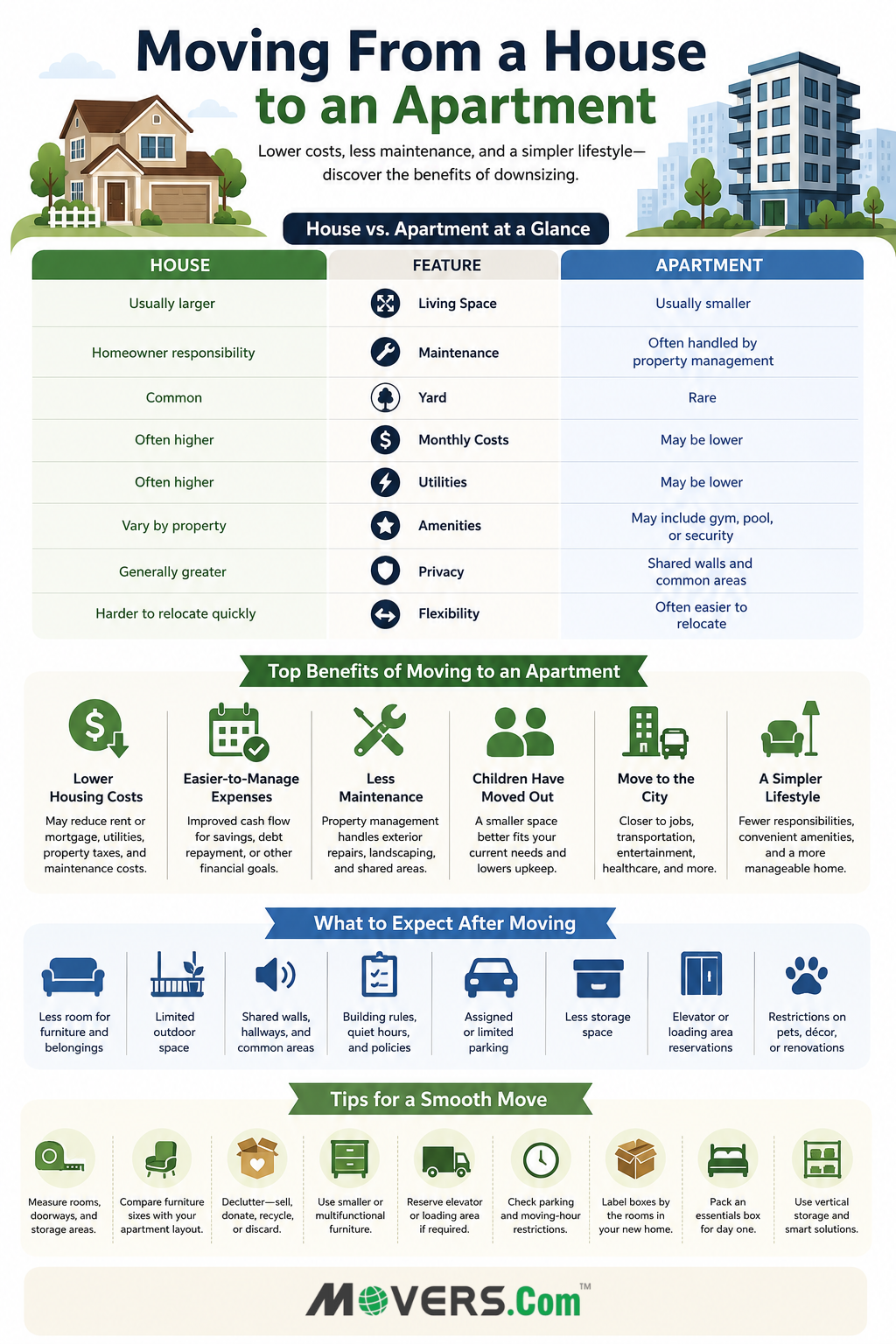
Moving from a house to an apartment can lower housing costs, reduce maintenance, and simplify your lifestyle, but it also means adjusting to less space and shared living. Whether downsizing is the right choice depends on your budget, family needs, lifestyle, and long-term goals.
This guide explains the benefits of moving from a house to an apartment, what to expect after downsizing, and practical tips to make the transition easier.
| Feature |
House |
Apartment |
| Living space |
Usually larger |
Usually smaller |
| Maintenance |
Homeowner responsibility |
Often handled by property management |
| Yard |
Common |
Rare |
| Monthly costs |
Often higher |
May be lower |
| Utilities |
Often higher |
May be lower |
| Amenities |
Vary by property |
May include a gym, pool, or security |
| Privacy |
Generally greater |
Shared walls and common areas |
| Flexibility |
Harder to relocate quickly |
Often easier to relocate |
What Are the Benefits of Moving From a House to an Apartment?
Moving from a house to an apartment can reduce housing expenses, eliminate many maintenance responsibilities, and make daily life more manageable. Many people downsize after retirement, when their children move out, when relocating to a city, or when they simply want a smaller and more convenient home.
Lower Housing Costs
Lower housing expenses are one of the main reasons people downsize from a house to an apartment. Depending on your location, moving to an apartment may reduce mortgage or rent payments, utility bills, property taxes, maintenance costs, and other household expenses.
Downsizing may be especially helpful if you are dealing with:
- A job loss or reduced income
- Higher property taxes
- Rising utility bills
- Expensive home repairs
- Changes in the housing market
- Retirement or a fixed income
Apartment living is not always cheaper in every market, so compare the complete monthly cost before deciding. Include rent, utilities, parking, renter’s insurance, amenity fees, and any storage expenses.
Easier-to-Manage Monthly Expenses
Downsizing may improve your monthly cash flow by reducing housing-related costs. Any savings can be used to pay down debt, build an emergency fund, increase retirement savings, or cover other important expenses.
However, the financial benefit depends on your local housing market and the apartment you choose. A luxury apartment in a major city may cost more than a modest house in a smaller community.
Less Maintenance
Apartment living usually requires less maintenance than owning a house. Property management commonly handles exterior repairs, landscaping, roof maintenance, and shared-area upkeep.
You may still be responsible for cleaning your unit and reporting repair problems, but you generally will not need to spend as much time or money maintaining the property.
Your Children Have Moved Out
Once children move out, many homeowners find that they no longer need as much living space. Empty bedrooms, large yards, and extra storage areas may become expensive and time-consuming to maintain.
Moving into a smaller apartment can better match your current needs while reducing upkeep and housing costs.
Moving From the Suburbs to the City
Moving to a city often means choosing an apartment because houses may be less available and more expensive in urban areas.
Apartment living may also provide easier access to:
- Workplaces
- Public transportation
- Restaurants
- Healthcare
- Shopping
- Entertainment
- Cultural activities
However, city apartments may have higher rents, limited parking, smaller rooms, and additional building rules.
A Simpler Lifestyle
Some people move into an apartment because they want fewer responsibilities and a more manageable home. A smaller space can encourage you to keep only the belongings you use and value.
Apartment communities may also offer convenient amenities such as security, fitness centers, pools, package rooms, and shared outdoor spaces.
Apartment Living After a House: What to Expect
Apartment living after a house often requires adjusting to smaller living spaces, shared walls, and community rules, but many people appreciate the lower maintenance and added convenience.
Common adjustments include:
- Less room for furniture and belongings
- Limited outdoor space
- Shared walls, hallways, and common areas
- Building quiet hours and community policies
- Assigned or limited parking
- Less storage space
- Elevator or loading-area reservations
- Restrictions on pets, decorations, or renovations
Pay particular attention to pet policies, guest parking, move-in hours, and any fees for reserving elevators or loading docks.
Tips for Moving From a House to an Apartment
Planning early can make downsizing easier and help you avoid moving items that will not fit in your new home.
- Measure every room, doorway, hallway, and storage area.
- Compare your furniture dimensions with the apartment layout.
- Measure stairwells and elevator doors, not just the rooms.
- Sell, donate, recycle, or discard items you no longer need.
- Replace oversized furniture with smaller or multifunctional pieces.
- Ask whether you need to reserve an elevator or loading area.
- Review parking and moving-hour restrictions.
- Label boxes according to the rooms in your new apartment.
- Pack an essentials box for the first day and night.
- Use vertical storage, under-bed storage, and wall-mounted shelves.
- Avoid paying to move items that you plan to discard later.
How to Downsize From a House to an Apartment
Start by sorting your belongings one room at a time. Decide what you need, what will fit, and what is worth paying to move.
Create four categories:
- Keep
- Sell
- Donate
- Discard or recycle
Measure your new apartment before deciding which furniture to keep. Pay special attention to doorways, elevators, staircases, and narrow hallways.
Choose multifunctional furniture when possible, such as:
- Storage beds
- Folding tables
- Sleeper sofas
- Nesting tables
- Ottomans with storage
- Wall-mounted desks
Plan the apartment layout before moving day. This helps movers place furniture correctly and reduces the need to rearrange heavy items later.
Is Downsizing Right for You?
| Downsizing May Be Right If... |
You May Prefer a House If... |
| You want lower housing costs |
You need more living space |
| You want less maintenance |
You want a large private yard |
| You are retiring |
You have a growing family |
| Your children have moved out |
You need extensive storage |
| You travel frequently |
You regularly host large gatherings |
| You want a simpler lifestyle |
You need multiple work or hobby rooms |
| You are relocating to a city |
You prefer greater privacy |
Takeaway
- Downsizing can reduce housing costs and free up monthly income.
- Apartment living usually requires less maintenance.
- A smaller home may suit retirees, empty nesters, city residents, and frequent travelers.
- Decluttering before packing can lower moving costs.
- Measuring furniture and planning the layout can prevent space problems.
- Review apartment rules, parking, storage, and elevator access before moving.
Bottom Line
Downsizing from a house to an apartment can simplify your lifestyle, reduce housing expenses, and eliminate many maintenance responsibilities. Before moving, compare your total housing costs, evaluate how much space you need, and make sure the apartment supports your long-term goals.
Downsizing can also be an emotional transition, especially if you're leaving a family home you've lived in for many years. Give yourself time to adjust to the smaller space and new routine.
Decluttering early, measuring your furniture, reviewing building rules, and hiring experienced movers can help make the transition smoother and less stressful.
At Movers.com, you can compare licensed and insured movers, request free moving quotes, and use practical moving guides and checklists to plan your move with confidence.
Editor's Note
This guide was reviewed by the Movers.com Moving Industry Analyst team using publicly available housing, relocation, and downsizing resources, along with common residential moving scenarios.
The benefits and costs of moving from a house to an apartment vary depending on your financial situation, lifestyle, local housing market, and long-term goals. This guide provides general information to help you evaluate whether downsizing is the right choice for your next move.
Get expert moving tips at Movers.com.
Compare licensed and insured movers, request free moving quotes, and explore step-by-step moving guides, checklists, and practical resources to help you move with confidence.
Questions? Talk to our moving specialists.