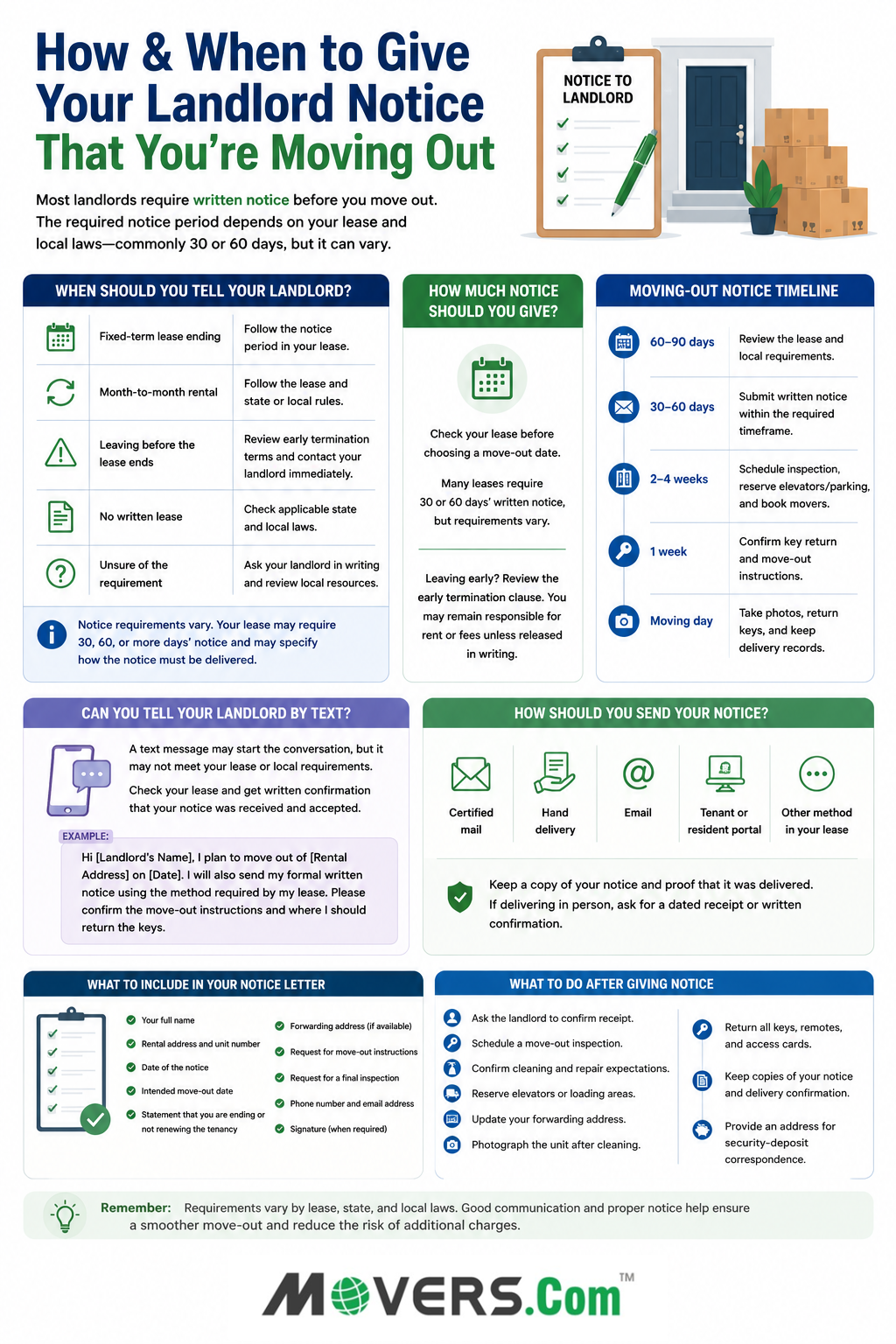
You should usually notify your landlord in writing before moving out, but the required notice period depends on your lease and applicable state or local laws. Many rental agreements require 30 or 60 days' notice, although some require more or less time and may specify how notice must be delivered.
Start by reviewing your lease for the notice period, approved delivery method, move-out date requirements, and early termination terms. Giving proper written notice can help you avoid additional rent, lease penalties, and disputes about your move-out date.
This guide explains when to tell your landlord you are moving, how to give notice, what to include in your letter, and whether a text message is enough.
If you're unsure how much notice is required, always follow your lease first and then confirm any applicable state or local tenant-notice laws.
When Should You Tell Your Landlord You Are Moving Out?
| Rental situation |
General guidance |
| Fixed-term lease ending |
Follow the notice period in your lease |
| Month-to-month rental |
Follow the lease and state or local notice rules |
| Leaving before the lease ends |
Review early termination terms and contact your landlord immediately |
| No written lease |
Check applicable state and local tenant-notice laws |
| Unsure of the requirement |
Ask your landlord in writing and review local tenant resources |
Important: Notice requirements vary. Your lease may require 30, 60, or more days’ notice and may specify how the notice must be delivered.
How Much Notice Should You Give Your Landlord?
Check your lease before choosing a move-out date. Many leases require tenants to provide written notice before leaving, commonly 30 or 60 days in advance. However, the exact requirement may differ depending on your rental agreement, tenancy type, state law, and local regulations.
Do not assume that your lease automatically ends without notice. Some fixed-term leases require advance notice of non-renewal, while month-to-month rentals generally require notice based on the lease and applicable law.
If you plan to leave before the lease expires, review the early termination clause. You may remain responsible for rent, fees, or other obligations unless the landlord agrees to release you from the lease.
Moving-Out Notice Timeline
| Time before moving |
What to do |
| 60–90 days |
Review the lease and local requirements |
| 30–60 days |
Submit written notice within the required timeframe |
| 2–4 weeks |
Schedule your move-out inspection, reserve elevators or loading areas if required, and book your movers. |
| 1 week |
Confirm key return and move-out instructions |
| Moving day |
Take photos, return keys, and keep delivery records |
Can You Tell Your Landlord You Are Moving Out by Text?
A text message may be useful for starting the conversation, but it may not satisfy your lease or local notice requirements. Many leases require written notice delivered through a specific method, such as email, a resident portal, certified mail, or hand delivery.
Check your lease before relying on a text message. Even when your landlord accepts notice by text, ask for written confirmation that the notice was received and accepted.
Example:
Hi [Landlord’s Name], I plan to move out of [Rental Address] on [Date]. I will also send my formal written notice using the method required by my lease. Please confirm the move-out instructions and where I should return the keys.
How Do You Tell Your Landlord You're Moving Out?
After reviewing your lease, notify your landlord using the delivery method required by the lease.
The best way to notify your landlord that you are moving out is with a written notice. It creates a clear record of your move-out date and helps prevent misunderstandings.
Include the following information in your move-out notice letter:
- Your full name
- Rental property address and unit number
- Date of the notice
- Intended move-out date
- Statement that you are ending or not renewing the tenancy
- Forwarding address, if available
- Request for move-out instructions
- Request for a final inspection
- Phone number and email address
- Signature, when required
How Should You Send Your Move-Out Notice?
Follow the delivery method stated in your lease. Depending on the property, notice may be accepted through:
- Certified mail
- Hand delivery
- Email
- A tenant or resident portal
- Another method listed in the lease
Keep a copy of the notice and proof that it was delivered. If you deliver it in person, ask for a dated receipt or written confirmation.
You can use the following template as a starting point and customize it to meet your lease requirements.
Sample Move-Out Notice Letter
[Your Full Name]
[Current Rental Address and Unit Number]
[City, State, ZIP Code]
[Email Address]
[Phone Number]
[Date]
[Landlord or Property Manager’s Name]
[Property Management Company, if applicable]
[Address]
Dear [Landlord or Property Manager’s Name],
Please accept this letter as formal notice that I intend to move out of the rental property at [Rental Address and Unit Number] on [Move-Out Date].
This notice is being provided according to the terms of my lease. Please confirm the move-out procedures, including the final inspection, cleaning requirements, key return, and any other steps I need to complete.
My forwarding address for future correspondence and the return of my security deposit is:
[Forwarding Address]
Please contact me at [Phone Number] or [Email Address] if you need any additional information.
Sincerely,
[Your Name]
[Signature, if submitting a printed letter]
Sample Move-Out Notice Email
Dear [Landlord or Property Manager’s Name],
I am writing to provide formal notice that I plan to move out of [Rental Address and Unit Number] on [Move-Out Date], according to the notice requirements in my lease.
Please confirm that you received this notice and provide the move-out instructions, including cleaning requirements, the final inspection process, and key return details.
My forwarding address is:
[Forwarding Address]
Please contact me at [Phone Number] or [Email Address] if you need any additional information.
Thank you,
[Your Name]
TIP: Keep your move-out notice clear, professional, and consistent with your lease requirements. Save a copy for your records.
What If You Are Moving Out Before Your Lease Ends?
Moving out does not automatically end your financial obligations under a fixed-term lease. Review your lease for early termination fees, notice requirements, subletting rules, and any circumstances that may allow the lease to end early.
Contact your landlord as soon as possible and request any agreement in writing. Depending on the lease and local law, you may remain responsible for rent until the unit is re-rented or the lease expires.
What to Do After Giving Notice
- Ask the landlord to confirm receipt.
- Schedule a move-out inspection.
- Confirm cleaning and repair expectations.
- Reserve elevators or loading areas.
- Update your forwarding address.
- Photograph the unit after cleaning.
- Return all keys, remotes, and access cards.
- Keep copies of your notice and delivery confirmation.
- Provide an address for security-deposit correspondence.
If applicable, ask when you can expect your security deposit or an itemized deduction statement, as timelines vary by state.
Conclusion
Giving your landlord proper notice is an important step when moving out of a rental property. Review your lease, submit your notice within the required timeframe, and keep a copy for your records. Good communication with your landlord can help make the move-out process smoother and reduce the risk of misunderstandings.
When it's time to move, compare licensed and insured movers, get free moving quotes, and explore expert moving guides at Movers.com to plan your relocation with confidence.
Editor's Note
This guide was reviewed by the Movers.com Moving Industry Analyst team using publicly available rental guidance, standard leasing practices, and common residential moving scenarios.
Notice requirements vary depending on your lease agreement and applicable state or local laws. This guide provides general information to help you prepare for your move and should not be considered legal advice.
Get expert moving tips and compare movers for free at Movers.com.
You can compare licensed and insured movers, request free moving quotes, and plan your move with confidence using our step-by-step moving guides, checklists, and helpful moving resources.
Whether you're moving out of an apartment, relocating to a new rental, or purchasing your first home, Movers.com helps you connect with trusted moving professionals and practical tools to make your move easier.
Questions? Talk to our moving specialists.