When you are moving from one location to another, there are some things that are harder to move than others.
Moving your boat is much different than moving any other type of vehicle. Because of its size and inability to be driven on land.
This process of shipping your boat involves complex planning and procedures.
It requires extra preparation, and it is more expensive than any other kind of specialized move.
Whether you're shipping your boat across town or overseas, it should reach your destination intact.
What’s the Cost to Move a Ship?
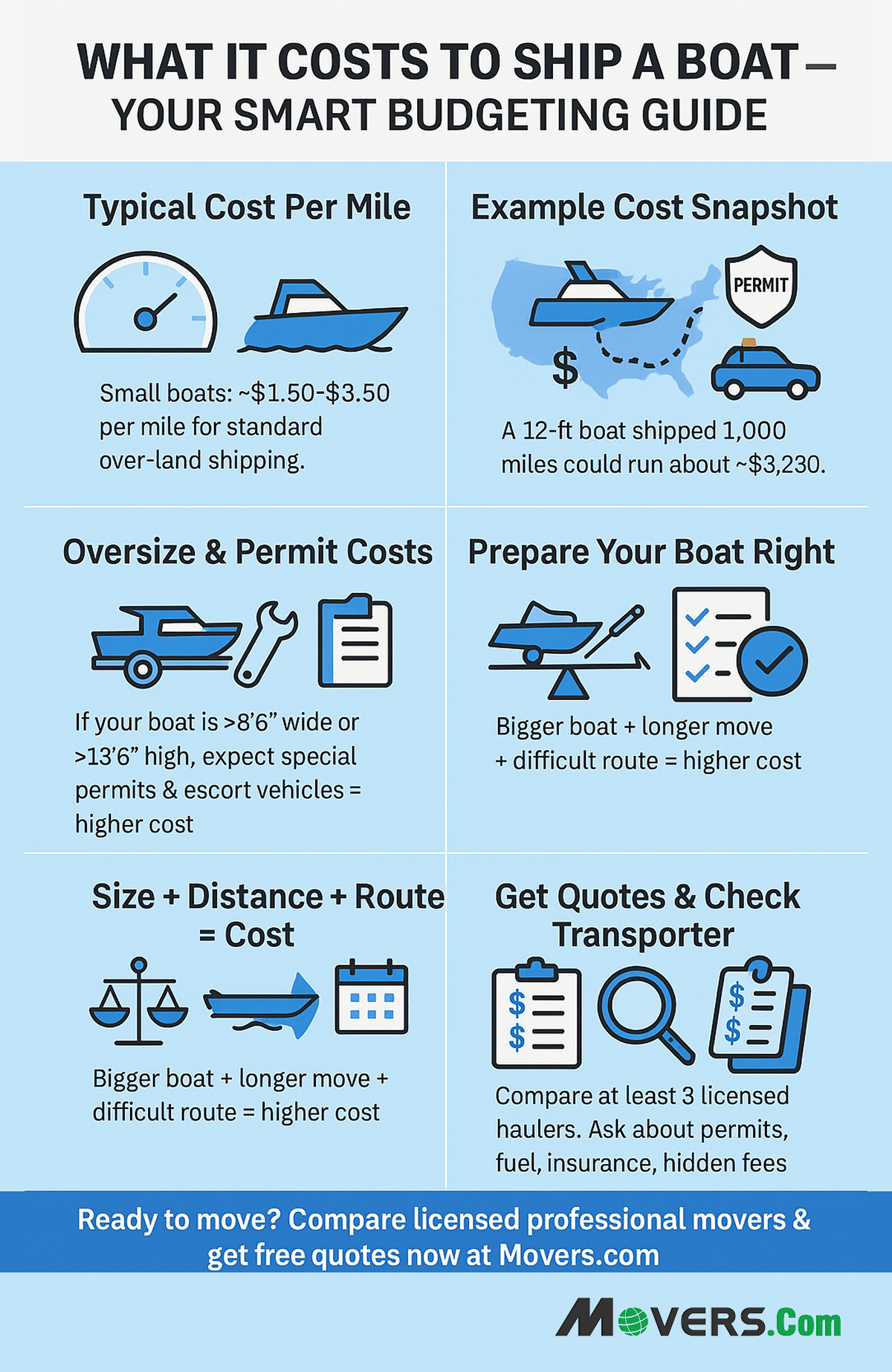
The cost of shipping your boat depends on the size of your boat and the distance it is going to travel.
We created a chart to give you an estimate on how much it will cost to transport your boat.
| Boat size |
Estimated price |
| Smaller than 9' |
$1.50 - $2.50 per mile |
| 9' |
$1.75 - $2.75 per mile |
| 10' |
$2 - $3 per mile |
| 11' |
$2.25 - $3.25 per mile |
| 12' |
$2.50 - $3.50 per mile |
| Greater than 12' |
$2.75 - $3.75 per mile |
With these rough estimates, moving a 9' boat 1000 miles will cost around $2,250 while moving a 12' boat 1000 miles will cost about $3,250.
TIP: Know your boat's measurements and shipping distance before calling a transport company for an estimate.
Plan Ahead to Ship your Boat
The most important thing to remember is that if you have decided to ship your boat, then you must plan for it well ahead of time.
The important thing is that the boat is delivered in the same shape and condition that it was in at the time of the pick-up.
Shipping a boat requires a detailed and careful approach. In some cases, the boatyard professionals will handle your move and take care of everything.
However, keep in mind that if your boat is not prepared according to requirements, then the boat is shipped "as-is," which means that the company is not responsible for damage during transit.
Find a Reliable Boat Shipping Company
Finding a boat shipping company should be approached in the same way that you would search for a moving company.
As with any kind of move, you have to be cautious and compare multiple companies before choosing the best one for your situation.
Moving companies that specialize in shipping boats are a bit harder to come by than your run-of-the-mill moving company, so finding one can be a tedious process.
We suggest getting at least 3 different estimates.
Choose the one which has an all-inclusive pricing policy.
To ensure that you're receiving top-notch service, inquire if the driver and crew have complete working knowledge on all of the ins and outs of boat transportation.
Select the company which has the most experience and has worked with the DOT, boatyards, ports and permit agencies.
This experience is required to ensure that the boat is shipped properly and in a timely manner.
The owner should take care of preparing the boat for the move, which includes taking measurements of the height and width of the boat, so that the shipper can obtain a trailer of the proper size to transport the boat on.
Prepare your Boat for Transit
The next and most important step in moving your boat is to prepare it for transportation.
To do this, remove all of your personal items and anything else that will be thrown around during the move, which can damage the boat.
Some of the items that need to be removed are:
- Cushions or canvas covers
All things inside and outside the boat should be removed prior to the move.
You should also check there is no water anywhere on the boat - not only in the bilge but also in pumps, air conditioners and water systems.
- It is always a good idea to keep at least a fourth of the gas tank full for the move
- Close and secure any hatches by tying them or taping them
- Cabin windows need to be latched and taped from the outside
- Any doors or hatches that need to be locked should be, and the keys should be kept with you at all times
- Provide a spare set for the movers in the event that they need to access the interior areas of the boat
- Pick a marina or boatyard as a loading spot that has at least 14' clearance
- Remove drain plugs from hull and drain all water systems, pumps or air conditioners
- Disconnect batteries and secure the cables away from it to prevent any contact
- Remove any valuable electronics and anchors from the deck -- pad and secure what you can in the cabin
- Secure anything large, like a dinghy, on board and make sure it is well-padded
Protect your Boat During Transit
If you are going to be moving the boat during the winter season, then winterize the exterior of the boat.
You can also purchase a plastic covering or boat wrap to protect it from the elements that it may be exposed to during the move.
Shrink wrapping the boat is more expensive, but it will protect your boat from rain, hail, freezing rain, snow, dust, dirt and bird droppings.
Lastly, conduct a thorough check of your entire boat to make sure that everything is in good condition and that there are no issues that need to be addressed before the move.
It is important that you clean your boat with hot water prior to the move and that you have maintained it up to code.
Otherwise, there is a chance that DOT officers can seize your boat.
TIP: Keep an eye out for zebra mussels, which are an invasive species of mussel that can clog drain scuppers, out-drives and other areas of attachment.
Transport your Boat based on its Style
For wooden boats, it is suggested that the boat be carried out on its own custom cradle.
This is recommended in order to balance out any structural weaknesses. For wooden boats, you also may need to sign a release of liability.
For power boats and speed boats, confirm that the boat's windshield is tough enough to withstand strong winds that it will likely encounter during the move.
Check that the seal and screws on all parts of the boat are tightly fixed.
For international boat moves, there are three types of trailers which can be used to move your boat:
- A flat rack and submersion container
Also remember to take pictures of your boat before you move.
Documenting how your boat looks before you move will help you out if it gets damaged in transit.
You will need proof that your boat was undamaged before the move, and a photo will help ensure that.
Keep all documents safe by filing all of the important moving-related documents.
This includes the bill of lading, insurance coverage policy and any pictures of the boat that you have taken as a proof for insurance.
Know your measurements before finding a boat shipper.
This will be the first question they ask you.
- Overall length: Measured from the tip of the bow to the center of the stern. Include bow pulpits, swim platforms, motor brackets and the length of motors or out drives in the raised position.
- Overall height: Measured from the bottom of the keel to the highest non-removable part of the boat.
- Beam: Measured from the widest point of the boat, including the rub rail.
Takeaway
- Boat shipping needs early planning, accurate measurements, and careful preparation
- Know your boat’s size and the shipping distance before requesting quotes
- Remove all loose, valuable, or fragile items from inside and outside the boat
- Secure doors, windows, hatches, and disconnect batteries before transport
- Choose a boat shipping company with strong experience and all-inclusive pricing
- Use proper protection like shrink wrap, winterization, or custom cradles depending on the boat type
- Take detailed photos before the move to support any potential insurance claim
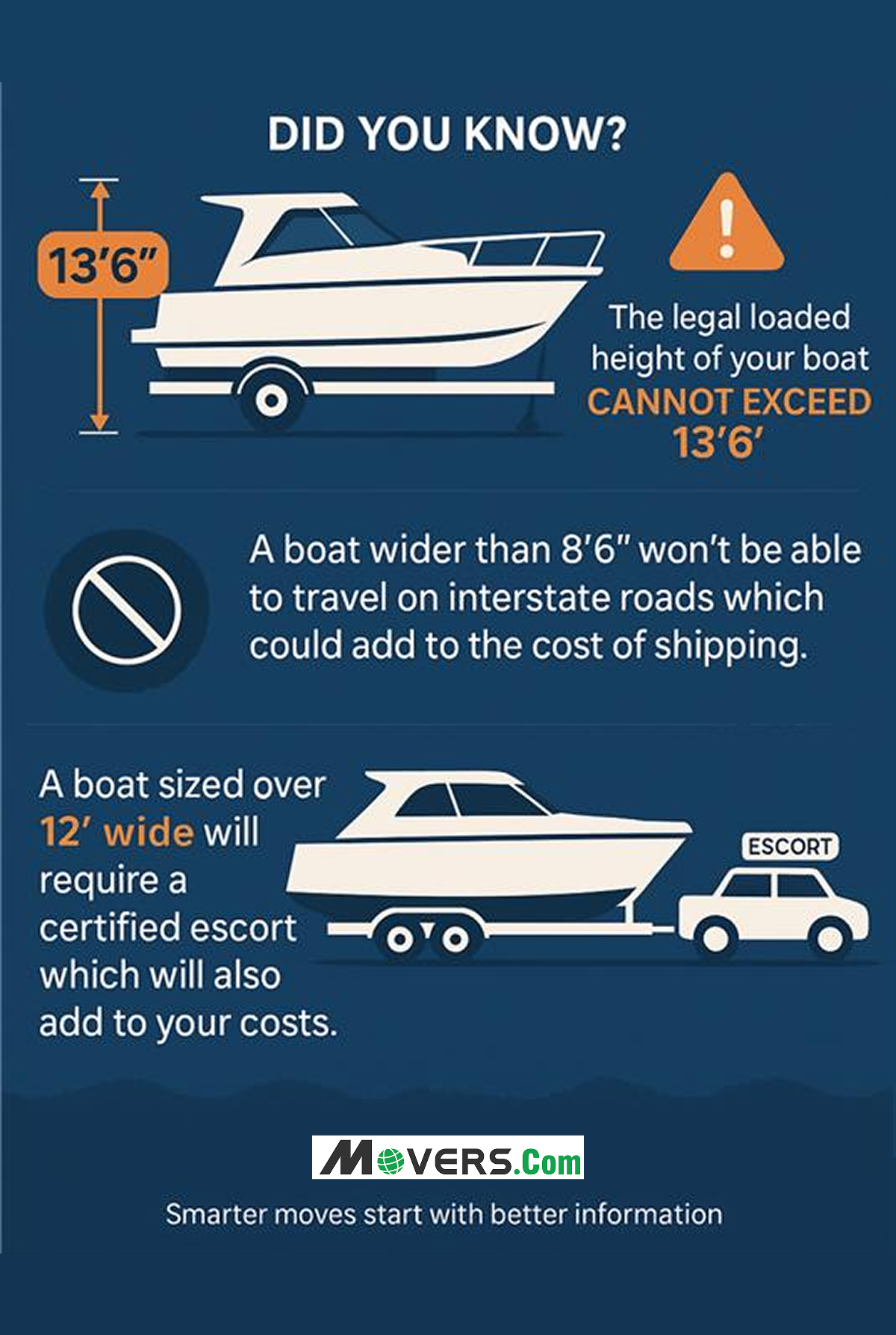
- Understand legal size limits and how they impact cost, routing, and equipment needs
Note
Shipping a boat is a detailed process, and proper preparation protects both your investment and your peace of mind.
Take time to document, measure, and secure everything before the transport crew arrives.
If you need extra help or want to compare estimates, work only with licensed boat transport specialists who understand DOT, port, and permit requirements.
Bottom Line
Talk to our moving specialist to receive moving guidance from start to finish.
Also, get a free moving quote and compare quotes with other moving companies.
For more tips, advice, and information about moving – check out our detailed moving guides. You’ve got everything you need to know about moving with us.