You may be able to ship a car with personal belongings inside, but it depends on the auto transport company's policy. Some carriers allow a limited amount of personal property, while others prohibit it or restrict how much you can pack and where items can be stored.
Personal belongings inside the vehicle may not have the same insurance protection as the vehicle itself. Extra belongings also add weight, which can affect the carrier's loading and overall vehicle-weight limits.
Before packing anything, ask your auto transport company what items are allowed, whether there is a weight limit, where belongings must be stored, and whether personal property is covered during transport.
Can You Ship a Car With Personal Items Inside?
It depends on the auto transport company. Some carriers allow a small amount of personal property inside the vehicle, while others prohibit it or impose specific restrictions.
Carrier policies may specify:
- How much personal property is allowed.
- Where belongings can be placed.
- Whether items must remain in the trunk or cargo area.
- How high items can be packed.
- Which items are prohibited.
- Whether additional charges apply.
Don't assume a specific allowance applies to every auto transport company. For example, a 100-pound personal-item limit may be used by some companies, but it is not a universal rule for every vehicle shipment.
Confirm the carrier's policy before pickup and get important requirements in writing when possible.
Is It Illegal to Ship Personal Items Inside Your Car?
There isn't a universal federal rule giving consumers a specific personal-item allowance when shipping a car. Instead, auto transport companies establish their own policies while complying with applicable transportation and vehicle-weight requirements.
Depending on the carrier, personal belongings may be allowed with restrictions, subject to additional fees, or prohibited entirely.
The safest approach is to follow the specific policy of the company transporting your vehicle rather than assuming personal belongings are automatically permitted.
How Much Can You Pack and Where Should You Put It?
There is no universal personal-belongings allowance that applies to every auto transport company. The amount you can pack and where you can place it depend on your carrier's policy.
Some carriers may:
- Set a maximum weight for personal belongings.
- Require items to stay in the trunk or cargo area.
- Require belongings to remain below the window line.
- Prohibit items from being placed in the driver's area.
- Charge additional fees for extra weight.
Keep permitted belongings securely packed in closed boxes or bags and make sure they don't interfere with vehicle controls or access points.
Don't fill your vehicle with boxes simply because there is available space. Extra weight can affect how the carrier loads vehicles and manages the total weight of the transport truck. If you exceed the carrier's limit, you may be required to remove belongings before pickup.
What Should You Never Leave in a Shipped Car?
Even when a carrier permits personal belongings, some items should stay with you or be transported another way.
Avoid leaving:
- Passports and important documents.
- Prescription medications.
- Irreplaceable or sentimental items.
- High-value electronics.
- Perishable food.
- Flammable or hazardous materials.
- Illegal items.
- Weapons or other restricted items.
Your carrier may prohibit additional items, so review the transport agreement before packing.
Keep anything valuable, essential, difficult to replace, or needed immediately with you rather than inside the shipped vehicle.
Are Personal Items Covered by Auto Transport Insurance?
Don't assume personal belongings inside your car are covered by the auto transport carrier's insurance.
The carrier's insurance generally applies to the vehicle being transported, while coverage for personal property inside the vehicle may be limited or excluded.
Before leaving belongings inside your car:
- Ask whether personal property is covered.
- Ask whether exclusions or coverage limits apply.
- Review the carrier's terms in writing.
- Check whether your own insurance provides applicable coverage.
Even when personal belongings are permitted, avoid leaving valuable or irreplaceable items inside the vehicle.
Can Personal Belongings Increase Car Shipping Costs?
Yes, potentially. Personal belongings add weight to the vehicle, and carriers must manage the total weight of the vehicles and equipment they transport.
Depending on the carrier and the amount of additional weight, you may be charged an extra fee, required to remove excess belongings, or asked to reduce the amount before the vehicle can be transported.
Tell the auto transport company in advance if you plan to leave belongings inside your vehicle so you understand any limits or additional charges before pickup.
How to Pack Personal Items in a Car for Shipping
If your auto transport company allows personal belongings, pack them carefully to reduce movement and avoid damage during transportation.
Follow these steps:
- Confirm the carrier's policy. Ask about weight limits, permitted items, placement requirements, and additional fees before packing.
- Use closed boxes or bags. Secure belongings in sturdy containers rather than leaving loose items inside the vehicle.
- Follow placement requirements. Keep belongings in the trunk or cargo area if required by the carrier. Follow any carrier requirements about keeping belongings below the window line.
- Distribute weight carefully. Avoid concentrating heavy belongings in one area of the vehicle.
- Keep the driver's area clear. Nothing should obstruct the steering wheel, pedals, parking brake, seats, or other vehicle controls.
- Remove valuables and essentials. Keep identification, medications, electronics, jewelry, important documents, and other valuable or irreplaceable items with you.
- Secure everything before pickup. Make sure boxes and bags cannot shift significantly during loading and transportation.
How to Prepare Your Car for Shipping
In addition to removing prohibited or excess belongings, prepare the vehicle itself before the carrier arrives.
Before pickup:
- Remove or secure loose accessories.
- Follow the carrier's instructions regarding the amount of fuel to leave in the tank.
- Disable alarms or provide instructions for disabling them.
- Remove toll tags or transponders if recommended.
- Photograph the vehicle's exterior condition.
- Provide the keys required by the carrier.
- Remove personal items that aren't permitted by the carrier.
The carrier may provide its own vehicle-preparation checklist. Follow those instructions because requirements can vary between transport companies.
Should You Ship Your Car and Belongings Together?
Shipping some belongings inside your car may be convenient when you're relocating across the country, but auto transport is primarily designed to transport the vehicle, not an entire household shipment.
Leaving a small amount of permitted property inside the vehicle may make sense when:
- Your carrier specifically allows it.
- You're staying within the carrier's weight limit.
- You're transporting low-value personal belongings.
- The items can be packed securely in the approved area.
Consider shipping your belongings separately when you have numerous boxes, furniture, valuable items, fragile possessions, or anything prohibited by the auto transport company.
If you need to move a large amount of household property, a moving company, portable moving container, parcel carrier, or freight service may be more appropriate than filling your vehicle with belongings.
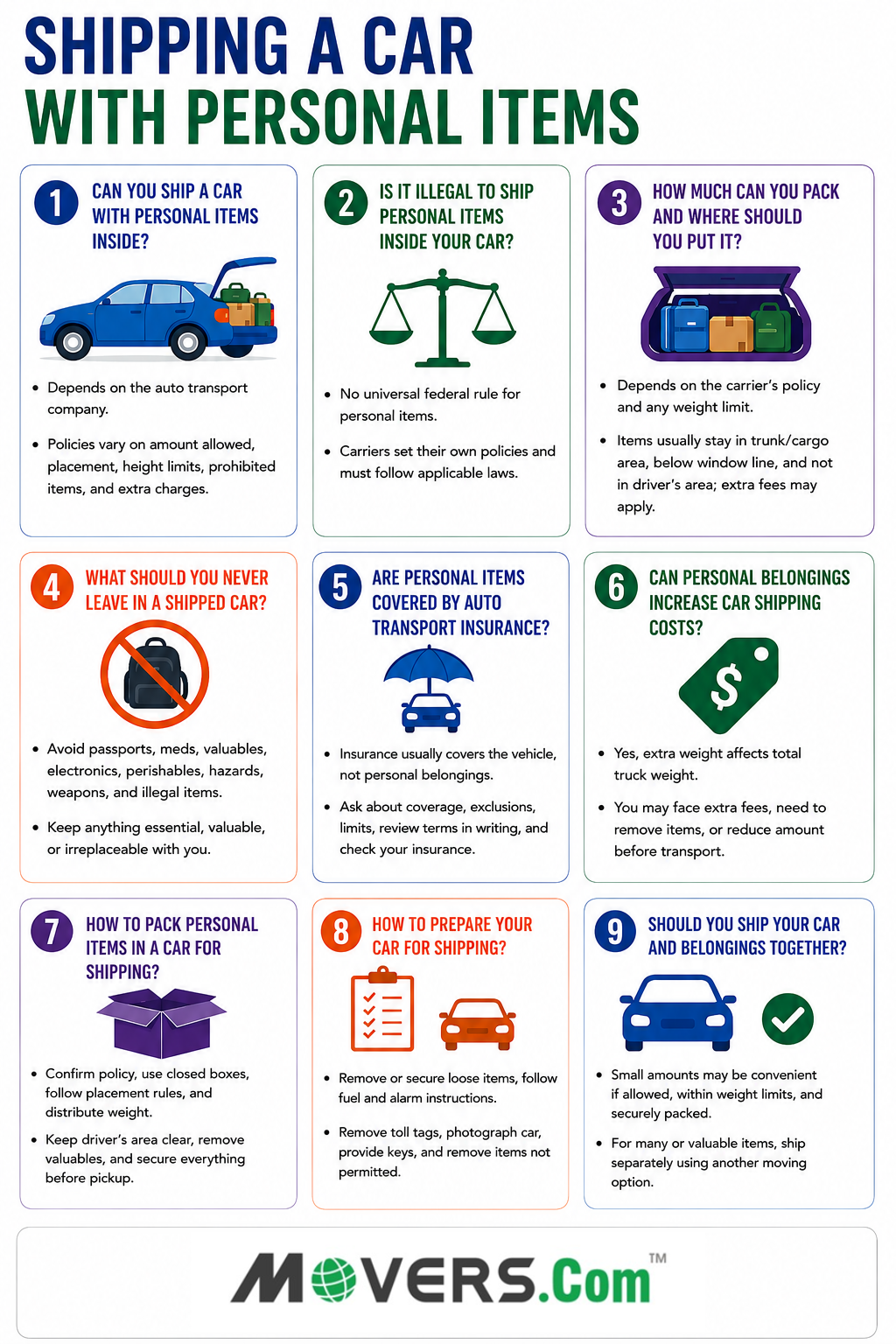 Bottom Line
You may be able to put personal belongings in your car when shipping it, but the rules depend on the auto transport company. There is no universal personal-item allowance that applies to every carrier.
Before packing your vehicle, confirm how much you can bring, where items must be stored, what is prohibited, whether additional fees apply, and whether your belongings have any insurance protection.
Avoid filling the entire vehicle. Keep valuables and essential documents with you, pack permitted belongings securely, and follow your carrier's written requirements before pickup.
Editor's Note
Auto transport policies for personal belongings vary by carrier, route, vehicle, and shipment. Always confirm current requirements directly with your auto transport company before placing personal property inside a vehicle being shipped.
Get expert moving tips and compare movers for free at Movers.com.
You can get free moving quotes from licensed and insured movers, compare moving companies near you, and plan your move with confidence using our step-by-step moving guides and checklists.
Whether you're planning a local move, a long-distance relocation, or need help with packing and loading, Movers.com connects you with trusted moving professionals and practical tools to make moving easier and more affordable.
Questions? Talk to our moving specialists.