People move to new cities for many reasons, including job opportunities, housing costs, family changes, education, lifestyle preferences, and the desire for a fresh start.
But having a reason to move doesn't necessarily mean relocating is the right decision. Consider whether the new city would improve the things that matter most to you, such as employment, housing affordability, family needs, commute, healthcare, and quality of life.
Here are the most common reasons people move and what to consider before deciding.
What Are the 5 Most Common Reasons People Move to a New City?
According to the U.S. Census Bureau, reasons for moving generally fall into categories such as housing, family, employment, and other personal reasons.
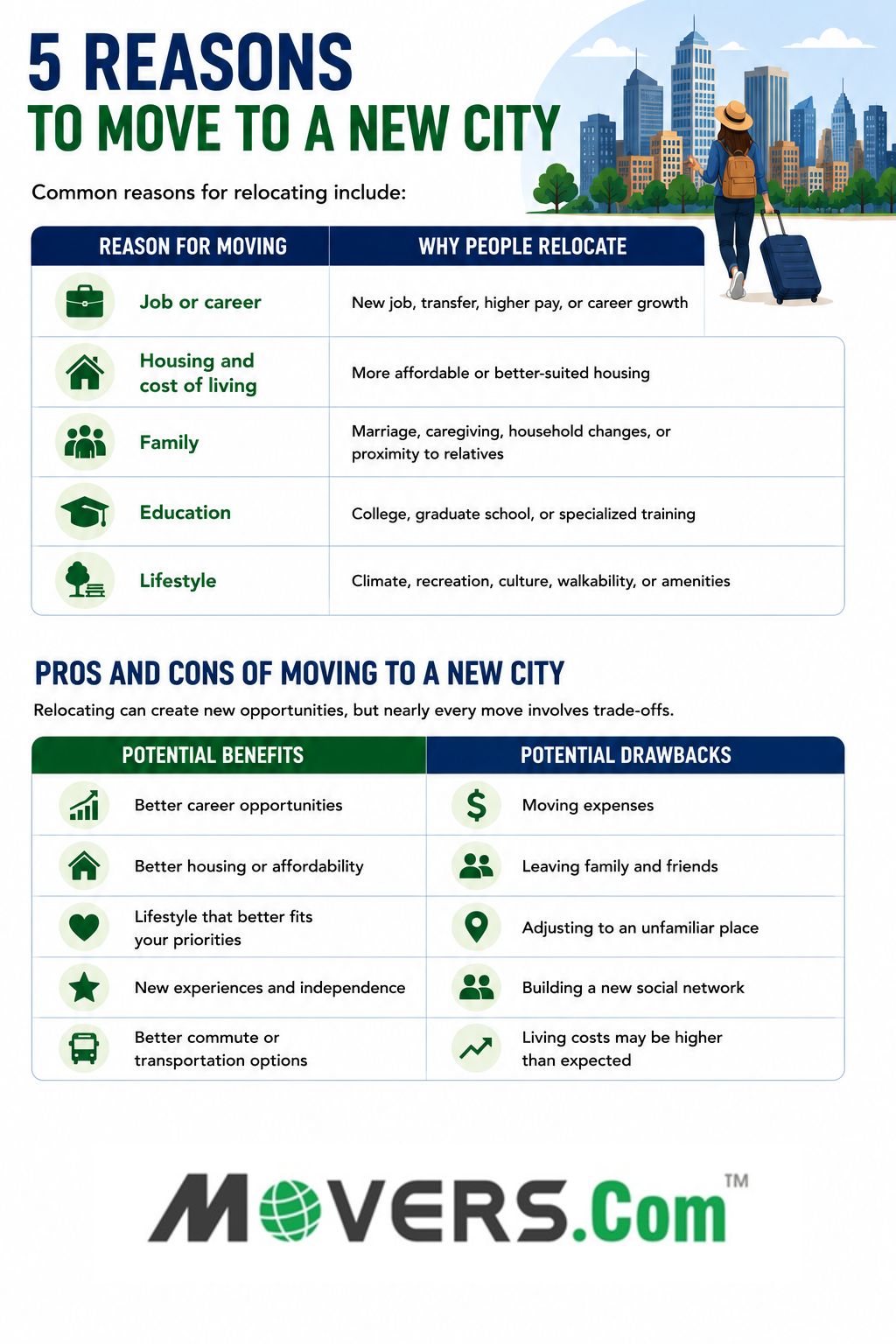
Common reasons for relocating include:
| Reason for Moving |
Why People Relocate |
| Job or career |
New job, transfer, higher pay, or career growth |
| Housing and cost of living |
More affordable or better-suited housing |
| Family |
Marriage, caregiving, household changes, or proximity to relatives |
| Education |
College, graduate school, or specialized training |
| Lifestyle |
Climate, recreation, culture, walkability, or amenities |
The right reason to move depends on your priorities. A city that's attractive for career growth, for example, may not be the right choice if higher housing costs or distance from family outweigh the professional benefits.
1. Moving for a Better Job or Career Opportunity
A new job, transfer, higher salary, or access to better career opportunities can be a strong reason to move to a new city.
However, don't evaluate a job opportunity based on salary alone.
Before relocating for work, compare:
- Expected take-home pay.
- Housing and transportation costs.
- Commute time and cost.
- Job stability.
- Career opportunities beyond your current employer.
- Employer relocation assistance.
A higher salary doesn't necessarily leave you with more disposable income if housing, transportation, taxes, and other living expenses are substantially higher in the new city.
If your employer offers relocation assistance, confirm which expenses are covered and whether reimbursement limits or repayment conditions apply.
2. Moving for More Affordable Housing or a Lower Cost of Living
More affordable housing is another common reason people consider relocating.
Moving to a less expensive area may allow you to reduce monthly housing costs, afford more space, buy instead of rent, or put more money toward savings and other priorities.
However, don't compare housing prices alone.
Consider your total cost of living, including:
- Transportation.
- Utilities.
- Taxes.
- Insurance.
- Groceries.
- Healthcare.
- Childcare, if applicable.
A city with cheaper rent or home prices isn't necessarily cheaper overall. Compare your expected income with your likely monthly expenses before deciding whether the move would actually improve your finances.
3. Moving to Be Closer to Family or Because of a Life Change
Family and household changes are common reasons for moving to a new city.
You may relocate to:
- Live closer to parents, children, or other relatives.
- Move in with a partner or spouse.
- Establish your own household.
- Provide care for a family member.
- Receive more family support.
- Adjust after marriage, separation, or another household change.
Living closer to family can provide practical and personal benefits, but consider how the move will affect employment, housing, finances, and your daily routine.
If caregiving is an important reason for moving, also consider healthcare access, transportation, and other services your family may need.
4. Moving for College or Education
College, graduate school, professional training, or another educational opportunity may require moving to a new city.
Before relocating, consider:
- Tuition and education expenses.
- Housing availability and costs.
- Transportation and commute.
- Part-time employment opportunities.
- Overall cost of living.
If you're moving into a dorm or student apartment, check the school's housing calendar, move-in requirements, and rules before scheduling your move.
5. Moving for a Different Lifestyle
Sometimes the city itself is the reason for moving.
You may want better access to:
- Walkable neighborhoods.
- Public transportation.
- Outdoor recreation.
- Arts, entertainment, and restaurants.
- Parks and green spaces.
- A different climate.
- A faster or slower pace of life.
Before moving primarily for lifestyle reasons, identify what you actually want from your new location.
For example, wanting a walkable neighborhood with reliable public transportation gives you clearer criteria for comparing cities than simply wanting to live somewhere more exciting.
Consider the trade-offs as well. A dense urban neighborhood may provide excellent walkability, restaurants, and entertainment but also have higher housing costs, less space, more noise, or expensive parking.
Should You Move to a New City?
Moving to a new city can make sense when it creates a meaningful improvement in your career, finances, family situation, education, or quality of life.
However, relocation also comes with costs and uncertainty. Consider both the potential benefits and trade-offs before deciding.
| Moving May Make Sense If... |
Reconsider or Research More If... |
| You have a strong career, family, or education reason |
You're primarily reacting to a temporary problem |
| The city fits your budget |
You haven't calculated total living costs |
| It matches your lifestyle priorities |
You know little about its neighborhoods or daily life |
| You can comfortably afford the relocation |
Moving would leave you financially stretched |
You don't need every factor to be perfect. The goal is to determine whether the overall move supports your most important priorities.
What Should You Consider Before Moving to a New City?
Before relocating, research what everyday life is likely to look like in the new city. Focus on the factors that will have the biggest impact on your finances and quality of life.
| Factor |
What to Compare |
| Employment |
Job opportunities, salary, and stability |
| Housing |
Rent or home prices, availability, and neighborhoods |
| Cost of living |
Transportation, utilities, taxes, insurance, and everyday expenses |
| Transportation |
Commute, public transit, parking, and car dependency |
| Healthcare |
Doctors, hospitals, specialists, and insurance networks |
| Family needs |
Schools, childcare, caregiving, and proximity to relatives |
| Lifestyle |
Climate, recreation, culture, walkability, and amenities |
Look at these factors together rather than evaluating a city based on one advantage. Lower housing costs, for example, may be less beneficial if the move also means lower income or substantially higher transportation costs.
Pros and Cons of Moving to a New City
Relocating can create new opportunities, but nearly every move involves trade-offs.
Pros
- Better career opportunities
- Better housing or affordability
- Lifestyle that better fits your priorities
- New experiences and independence
- Better commute or transportation options
Cons
- Moving expenses
- Leaving family and friends
- Adjusting to an unfamiliar place
- Building a new social network
- Living costs may be higher than expected
Which factors matter most depends on your circumstances. Consider whether the overall benefits of relocating outweigh the financial, professional, and personal costs.
What City Should You Move To?
There isn't one best city for everyone.
Start by identifying the three to five factors that matter most to you, such as:
- Career opportunities.
- Housing affordability.
- Overall cost of living.
- Transportation and walkability.
- Healthcare or schools.
- Climate and recreation.
- Proximity to family.
Compare potential cities using the same criteria rather than choosing based solely on rankings, reputation, or one attractive feature.
Once you've narrowed your options, research individual neighborhoods as well. Housing costs, commute times, transportation, and amenities can vary considerably within the same city.
If practical, visit before committing to a move so you can experience the neighborhoods, transportation, commute, and everyday environment yourself.
How to Make Friends When You Move to a New City
Building a social network in a new city can take time, especially if you're moving somewhere without existing friends or family.
Look for activities that create repeated interaction, such as:
- Recreational or sports groups.
- Classes.
- Volunteer organizations.
- Professional groups.
- Community organizations.
- Regular hobby activities.
Seeing the same people regularly can create better opportunities to build relationships than relying only on one-time events.
Staying connected with existing friends and family can also provide support while you establish yourself in your new community.
How to Move to a New City
Once you've decided where to relocate, turn the decision into a practical moving plan.
- Set your moving budget. Account for moving services, transportation, travel, housing deposits, supplies, and initial living expenses.
- Research neighborhoods and housing. Compare affordability, commute, transportation, and access to everyday services.
- Plan employment and income. Know how you'll cover expenses after arriving.
- Compare moving options. Decide whether you'll hire movers, rent a truck, use a moving container, or choose another method.
- Create a moving timeline. Work backward from your target moving date so important tasks aren't left until the last minute.
- Transfer essential services and update your address. Arrange utilities, insurance, medical records when needed, mail forwarding, and other necessary accounts.
For a long-distance relocation, start early enough to compare moving companies and understand your transportation options before committing.
 Bottom Line
Good reasons to move to a new city include better career opportunities, more suitable housing, family needs, education, lifestyle preferences, and the desire for a fresh start.
The right move is one that also works financially and practically. Compare employment, housing, total living costs, transportation, healthcare, and personal trade-offs before deciding whether relocating will genuinely improve your situation.
Editor's Note
Our comparison reviewed by our Moving Industry Analyst team is based on publicly available pricing, customer reviews, and regular moving scenarios.
The considerations in this guide are intended to help people evaluate a potential move within the United States. Housing costs, employment opportunities, taxes, transportation, and other conditions vary significantly by location and can change over time.
Research current conditions in any city you're considering before making a relocation decision.
Get expert moving tips and compare movers for free at Movers.com.
You can get free moving quotes from licensed and insured movers, compare moving companies near you, and plan your move with confidence using our step-by-step moving guides and checklists.
Whether you're planning a local move, a long-distance relocation, or need help with packing and loading, Movers.com connects you with trusted moving professionals and practical tools to make moving easier and more affordable.
Questions? Talk to our moving specialists.