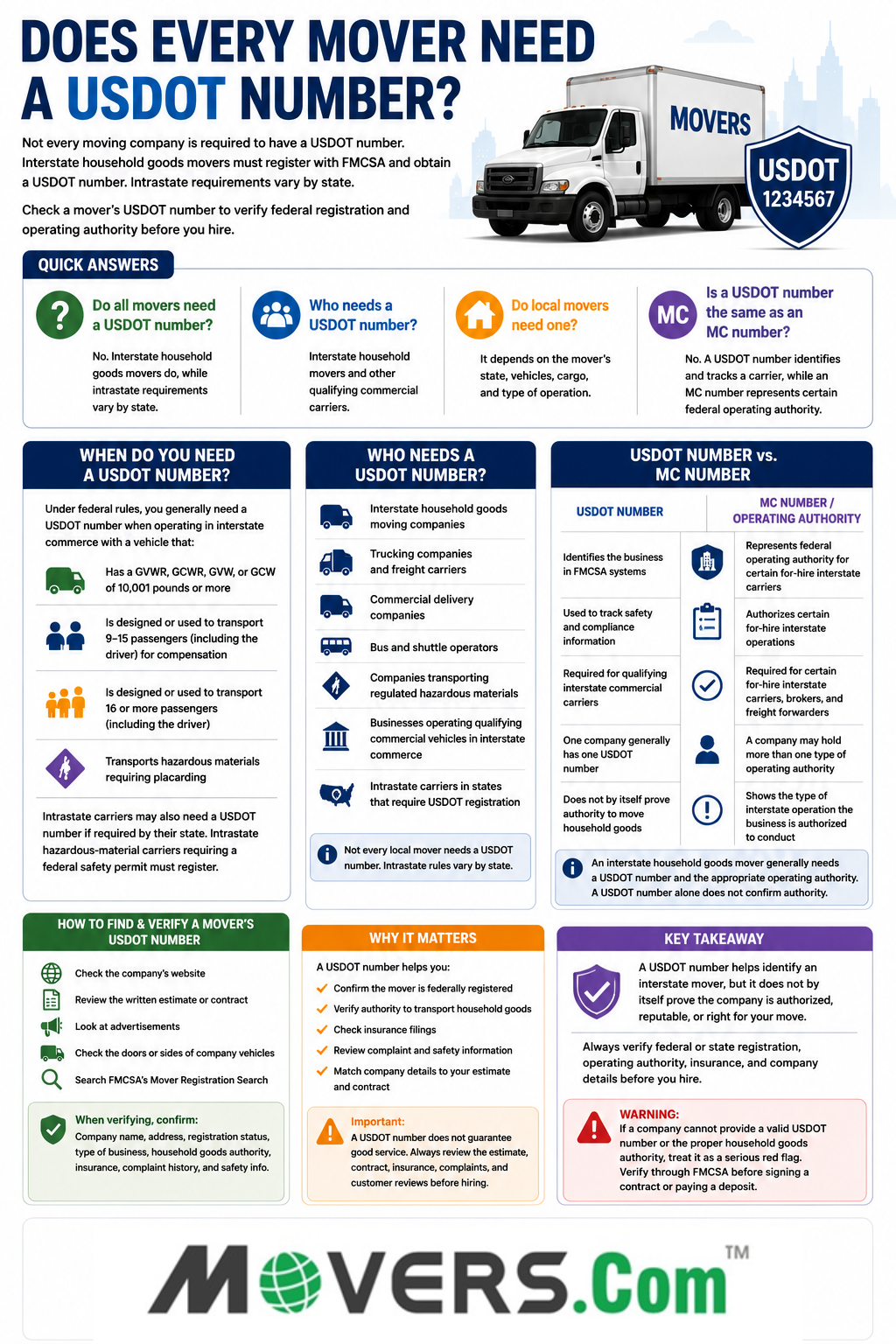
Not every moving company is required to have a USDOT number. For-hire interstate household goods movers must register with FMCSA, obtain a USDOT number, and hold the appropriate operating authority.
If you're hiring a moving company, checking its USDOT number is one of the easiest ways to verify its federal registration and determine whether it has the appropriate authority for your move.
This guide explains who needs a USDOT number, when it is required, how it differs from an MC number, and how to verify a mover before hiring.
| Question |
Answer |
| Do all movers need a USDOT number? |
No. Interstate household goods movers do, while intrastate requirements vary by state. |
| Who needs a USDOT number? |
Interstate household movers and other qualifying commercial carriers.
|
| Do local movers need one? |
It depends on the mover’s state, vehicles, cargo, and type of operation. |
| Is a USDOT number the same as an MC number? |
No. A USDOT number identifies and tracks a carrier, while an MC number represents certain federal operating authority. |
What Is a USDOT Number?
A USDOT number is a unique identification number issued by the Federal Motor Carrier Safety Administration. FMCSA uses it to collect and monitor information about a carrier’s inspections, compliance reviews, crash investigations, audits, and safety record.
Interstate moving companies and other qualifying commercial carriers must register with FMCSA and obtain a USDOT number. Some intrastate carriers must also obtain one under state regulations.
Consumers can use a mover’s USDOT number to locate its federal registration information and check whether the company has the appropriate operating authority for an interstate household move. Additional FMCSA tools can be used to review available insurance, complaint, contact, and safety information.
Tip: Before signing a contract, compare the company name, USDOT number, and MC number (if applicable) on your estimate with the information listed in the FMCSA database to help avoid fraudulent movers.
When Do You Need a USDOT Number?
Whether a USDOT number is required depends on where a company operates, the vehicle’s weight or rating, the number of passengers it carries, the cargo it transports, and applicable state regulations.
Under federal rules, a business generally needs a USDOT number when it operates in interstate commerce and uses a vehicle that:
- Has a gross vehicle weight rating (GVWR), gross combination weight rating (GCWR), gross vehicle weight (GVW), or gross combination weight (GCW) of 10,001 pounds or more
- Is designed or used to transport 9 to 15 passengers, including the driver, for compensation
- Is designed or used to transport 16 or more passengers, including the driver
- Transports hazardous materials in quantities requiring placarding under federal regulations
An intrastate carrier may also need a USDOT number when required by the state where it operates. Intrastate hazardous-material carriers transporting quantities that require a federal safety permit must also register.
Who Needs a USDOT Number?
Businesses that may need a USDOT number include:
- Interstate household goods moving companies
- Trucking companies and freight carriers
- Commercial delivery companies
- Bus and shuttle operators
- Companies transporting regulated hazardous materials
- Businesses operating qualifying commercial vehicles in interstate commerce
- Intrastate carriers in states that require USDOT registration
A company is not required to obtain a USDOT number simply because it owns a business vehicle. The requirement depends on factors such as interstate operations, vehicle weight, passenger capacity, cargo, and state law.
Not every local moving company needs a USDOT number. Intrastate requirements depend on the state where the mover operates.
Do Intrastate Movers Need a USDOT Number?
Some intrastate moving companies need a USDOT number, while others do not. The requirement depends on the rules of the state where the mover operates, the vehicle’s weight or classification, and the type of transportation provided.
Even when a local mover does not need a federal USDOT number, it may still need:
- State operating authority
- A state motor carrier number
- Household goods mover registration
- Commercial vehicle permits
- Required liability and cargo insurance
- Local business licenses
State commercial vehicle regulations may change. Movers should check with the state Department of Transportation, public utilities commission, motor vehicle agency, or other responsible motor carrier authority for current requirements.
Does New York Require a USDOT Number for Intrastate Carriers?
New York requires certain intrastate commercial motor vehicle operators to obtain a USDOT number. The exact requirements depend on the vehicle, cargo, and type of operation. Carriers should confirm current registration and licensing rules with the New York State Department of Transportation or Department of Motor Vehicles.
USDOT Number vs. MC Number
| USDOT Number |
MC Number/Operating Authority |
| Identifies the business in FMCSA systems |
Represents federal operating authority for certain for-hire interstate carriers.
|
| Used to track safety and compliance information |
Authorizes certain for-hire interstate operations |
| Required for qualifying interstate commercial carriers |
Required for certain interstate for-hire carriers, brokers, and freight forwarders |
| One company generally has one USDOT number |
A company may hold more than one type of operating authority |
| Does not by itself prove authority to move household goods |
Shows the type of interstate operation the business is authorized to conduct |
An interstate household goods mover generally needs a USDOT number and the appropriate federal operating authority. A USDOT number alone does not confirm that a company is authorized to transport household goods.
Do You Need an MC Number for Intrastate Operations?
A company operating only within one state generally does not need federal MC operating authority solely for intrastate work. However, it may need state operating authority, a state motor carrier number, or household goods mover registration. MC numbers generally apply to certain for-hire interstate carriers, brokers, and freight forwarders.
Why Does a USDOT Number Matter When Hiring Movers?
A USDOT number gives consumers a way to identify an interstate moving company and locate its federal records.
Using the number, you may be able to check:
- Whether the company’s registration is active
- Whether it is listed as a mover, broker, or another type of business
- Whether it has authority to transport household goods
- Whether required insurance filings appear to be current
- Available complaint information
- Available safety information
- Whether the company name and contact information match your estimate and contract
A USDOT number alone does not guarantee good service or prove that a mover is reputable. FMCSA does not endorse a company based on its registration status or safety data. Customers should also review the written estimate, contract terms, insurance options, complaints, and independent customer feedback.
How Can You Find and Verify a Mover’s USDOT Number?
Interstate movers generally display their USDOT number on company vehicles, estimates, contracts, websites, and other business materials. You may find the number on:
- The moving company’s website
- Its written estimate or contract
- Its advertisements
- The doors or sides of its commercial vehicles
- FMCSA’s Mover Registration Search
You may also ask the company directly for its USDOT and MC numbers.
When checking an interstate mover, verify:
- The legal and trade names
- Business address and phone number
- Registration status
- Type of business, such as carrier or broker
- Household goods operating authority
- Required insurance information
- Available complaint history
- Available safety information
Make sure the information matches the company shown on your estimate and moving contract. A dishonest operator may display another carrier’s USDOT number, so matching the company name, address, and contact details is essential.
If the mover operates only within one state, check its license or registration with the appropriate state agency in addition to searching federal records.
Warning:
If a company offering an interstate household move cannot provide a valid USDOT number or does not have the appropriate household goods authority, treat it as a serious red flag. Verify the company through FMCSA before signing a contract or paying a deposit.
A USDOT number helps identify an interstate mover, but it does not by itself prove that the company is authorized, reputable, or suitable for your move. Before hiring, verify the mover’s federal or state registration, operating authority, insurance information, written estimate, and company details.
Movers.com helps consumers compare moving companies, request free quotes, and access practical guides for local and long-distance moves.
Editor's Note
This guide was reviewed by the Movers.com Moving Industry Analyst team using publicly available information from the Federal Motor Carrier Safety Administration (FMCSA), state transportation agencies, and other official government sources.
USDOT number, operating authority, and intrastate licensing requirements may vary based on the type of carrier, vehicle, cargo, and state of operation. Regulations may also change over time. Always verify a moving company’s registration, operating authority, insurance, and licensing through the FMCSA and the appropriate state agency before hiring.
Get expert moving tips and compare movers for free at Movers.com.
You can request free moving quotes from licensed and insured movers, compare moving companies near you, and plan your move with confidence using our step-by-step moving guides and checklists.
Whether you are planning a local move, a long-distance relocation, or need help with packing, loading, or transportation, Movers.com connects you with trusted moving professionals and practical tools designed to make moving easier and more affordable.
Questions about your upcoming move? Talk to one of our moving specialists.