Moving company licensing requirements depend on where you operate, whether you transport household goods across state lines, and whether you move the goods yourself or arrange transportation as a broker.
A moving company operating only within one state generally must follow that state's intrastate moving-company requirements. Depending on the state, these may include mover registration, operating permits, insurance requirements, tariffs, consumer disclosures, or other rules.
Interstate household goods movers are subject to federal requirements administered by the Federal Motor Carrier Safety Administration (FMCSA). Depending on the operation, requirements can include a USDOT number, appropriate operating authority, required insurance filings, a process-agent designation, and compliance with federal household-goods and motor carrier safety regulations.
Moving brokers have different requirements because they arrange transportation rather than physically transport household goods.
This guide explains the federal and state licensing, registration, and permit requirements to consider when starting or operating a moving company in the United States.
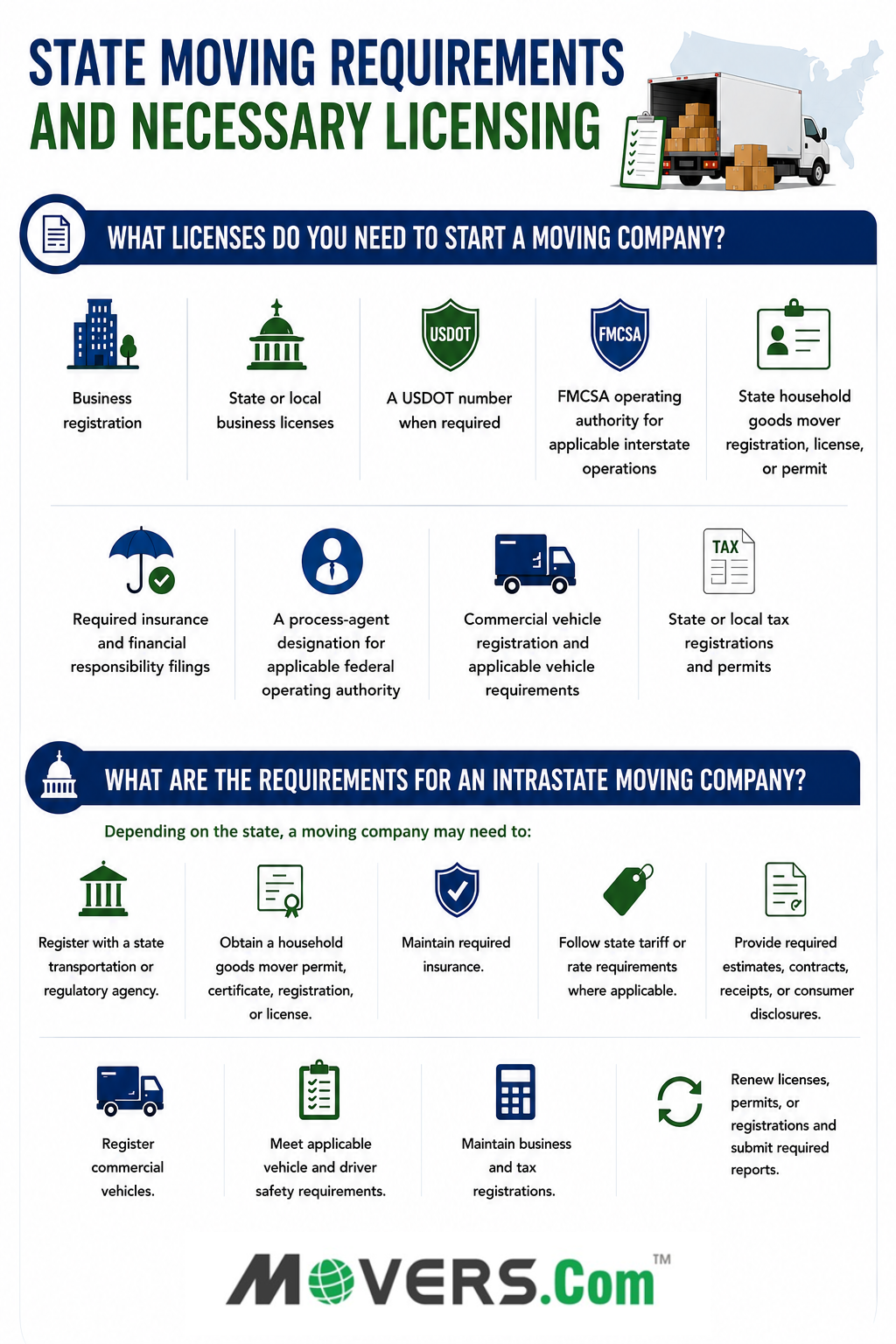
What Licenses Do You Need to Start a Moving Company?
There isn't one universal "moving company license" that allows a business to operate everywhere in the United States.
Depending on your business structure, location, and type of operation, requirements may include:
- Business registration.
- State or local business licenses.
- A USDOT number when required.
- FMCSA operating authority for applicable interstate operations.
- State household goods mover registration, license, or permit.
- Required insurance and financial responsibility filings.
- A process-agent designation for applicable federal operating authority.
- Commercial vehicle registration and applicable vehicle requirements.
- State or local tax registrations and permits.
The first step is determining what type of moving business you plan to operate.
| Type of Moving Business |
Primary Requirements |
| Intrastate moving company |
State and applicable local requirements |
| Interstate household goods mover |
Federal FMCSA requirements plus applicable state and local requirements |
| Interstate household goods broker |
FMCSA broker registration plus applicable state and business requirements |
A mover and a broker aren't interchangeable. A household goods motor carrier physically transports the shipment, while a household goods broker arranges transportation by an authorized motor carrier.
Interstate Moving Company Licensing Requirements
If your company transports household goods in interstate commerce, federal registration and operating requirements may apply.
Interstate household goods movers generally need to address the following requirements before operating.
Get a USDOT Number
The USDOT number is an identifier FMCSA uses to collect and monitor a motor carrier's safety information.
Companies operating qualifying commercial motor vehicles in interstate commerce must register with FMCSA and obtain a USDOT number. Some states also require certain intrastate commercial motor carriers to obtain one.
Don't assume that obtaining a USDOT number alone gives a moving company permission to perform interstate household goods moves. Depending on the operation, separate federal operating authority may also be required.
Apply for the Appropriate FMCSA Operating Authority
For-hire interstate household goods movers generally need the appropriate FMCSA operating authority in addition to applicable USDOT registration.
FMCSA identifies Motor Carrier of Household Goods as a specific type of operating authority. New applicants should use FMCSA's current registration system to apply for the authority required for their operations.
The current FMCSA application fee for permanent operating authority is $300 for each authority requested, and the fee is nonrefundable.
Make sure you apply for authority that matches the services your business actually provides. Operating as a household goods carrier and operating as a broker involve different authority and compliance requirements.
Note: FMCSA launched Motus: USDOT Registration System for motor carriers, brokers, and other registrants in May 2026 as part of its registration modernization. Businesses should follow FMCSA's current Motus registration instructions rather than older guides referencing legacy registration systems.
Meet Federal Insurance Requirements
Interstate household goods carriers must meet applicable FMCSA financial responsibility requirements.
FMCSA requires household goods motor carriers seeking operating authority to have the required insurance filings on file. Household goods carriers are subject to public liability and cargo insurance requirements.
For a for-hire household goods carrier operating vehicles with a GVWR of 10,001 pounds or more, FMCSA currently lists a minimum public liability requirement of $750,000. Household goods carriers are also subject to federal cargo insurance requirements, with minimum coverage of $5,000 per vehicle and $10,000 per occurrence. Requirements can vary based on the vehicle, operation, and authority involved, so verify the current financial responsibility and filing requirements directly with FMCSA.
However, insurance requirements can vary based on the vehicle, operation, and authority involved. Verify the current financial responsibility and filing requirements for your specific operation directly with FMCSA rather than assuming one coverage amount applies to every moving company.
File a BOC-3 Process-Agent Designation
Motor carriers applying for federal operating authority must also satisfy FMCSA's process-agent requirement.
A process agent is a representative upon whom legal process can be served in a state where the carrier operates. The designation is filed with FMCSA using Form BOC-3.
Operating authority isn't granted simply because the initial application has been submitted. Required filings and other conditions must be completed before authority becomes active.
Complete New Entrant Safety Requirements
New motor carriers entering interstate commerce are generally subject to FMCSA's New Entrant Safety Assurance Program.
The new entrant period generally lasts 18 months. During this period, FMCSA monitors the carrier's safety performance and may conduct a safety audit to evaluate compliance with applicable federal safety requirements.
Federal registration is therefore only one part of compliance. Depending on the operation, requirements involving driver qualifications, vehicle inspection and maintenance, hours of service, records, drug and alcohol testing, and other federal motor carrier safety regulations may apply.
What Are the Requirements for an Intrastate Moving Company?
An intrastate move generally involves transportation that remains within one state and is not considered interstate commerce.
Unlike interstate household goods transportation, intrastate moving-company licensing is primarily governed at the state level. There is no single nationwide intrastate moving license.
Depending on the state, a moving company may need to:
- Register with a state transportation or regulatory agency.
- Obtain a household goods mover permit, certificate, registration, or license.
- Maintain required insurance.
- Follow state tariff or rate requirements where applicable.
- Provide required estimates, contracts, receipts, or consumer disclosures.
- Register commercial vehicles.
- Meet applicable vehicle and driver safety requirements.
- Maintain business and tax registrations.
- Renew licenses, permits, or registrations and submit required reports.
The agency responsible for regulating movers also varies. Oversight may fall under a state department of transportation, public utility or service commission, motor vehicle agency, consumer protection agency, or another authority.
Before accepting intrastate moves, verify:
- Whether household goods movers need state authority or registration.
- Which agency regulates movers.
- Current insurance requirements.
- Vehicle and driver requirements.
- Tariff or rate requirements, if applicable.
- Required estimates, contracts, receipts, and consumer disclosures.
- Business and tax registrations.
- Renewal and reporting requirements.
Federal registration alone should not be assumed to authorize a company to perform intrastate household goods moves.
Also remember that having an origin and destination in the same state does not always make a shipment intrastate commerce. A shipment between two locations in the same state may still qualify as interstate transportation in certain circumstances, including when the shipment travels through another state.
What License Does a Moving Broker Need?
A moving broker and a moving company are not the same type of business.
A household goods mover physically transports a customer's belongings. A household goods broker arranges transportation with a motor carrier but isn't authorized to transport household goods under its broker authority.
Interstate household goods brokers must register with FMCSA and comply with separate federal broker requirements.
Requirements generally include:
- Applying for household goods broker authority with FMCSA.
- Paying the applicable FMCSA application fee.
- Maintaining $75,000 in financial security through a BMC-84 surety bond or BMC-85 trust fund.
- Filing a BOC-3 designation of process agent.
- Using interstate movers registered with FMCSA.
- Maintaining required written agreements with the movers they use.
- Clearly disclosing their status as a broker.
- Providing required consumer information and disclosures.
- Following applicable federal household goods broker advertising, estimate, recordkeeping, and consumer-protection requirements.
FMCSA's application processing fee for broker authority is currently $300 and is nonrefundable.
2026 Broker Financial Responsibility Requirements
As of January 16, 2026, updated FMCSA financial responsibility requirements apply to brokers and freight forwarders.
Brokers must maintain $75,000 in financial security through a BMC-84 surety bond or BMC-85 trust fund. Under the updated rules, assets held in a BMC-85 trust must satisfy federal requirements concerning eligible and readily available assets.
If available financial security falls below $75,000 and isn't replenished within seven calendar days, FMCSA can suspend the broker's operating authority.
Household goods brokers also have consumer-protection obligations. They must disclose their broker status, provide specified consumer information, maintain written agreements with the movers they use, and use interstate movers registered with FMCSA.
If your business plans to both arrange moves as a broker and physically transport household goods as a carrier, make sure you obtain the appropriate authority for each activity.
What Permits Do You Need to Start a Moving Company?
The permits and registrations required to start a moving company depend on where the business operates and whether it performs intrastate or interstate moves.
A moving company may need some or all of the following:
| Requirement |
When It May Apply |
| Business registration |
Based on business structure and jurisdiction |
| Local business licenses |
Where required locally |
| USDOT number |
Applicable interstate operations and certain state-regulated operations |
| FMCSA operating authority |
Applicable for-hire interstate operations |
| State mover license or registration |
Based on individual state requirements |
| Insurance filings |
Federal and/or state requirements |
| BOC-3 |
Applicable FMCSA operating authority |
| Broker authority |
When arranging interstate transportation as a broker |
| BMC-84 or BMC-85 |
Brokers subject to federal financial responsibility rules |
| Vehicle registration |
Based on vehicle and jurisdiction |
| Consumer documents and disclosures |
Federal and/or state household goods requirements |
Don't assume that registering the business with a state automatically authorizes it to transport household goods. Business registration, motor carrier authority, mover licensing, vehicle registration, and insurance requirements are separate compliance issues.
What Permits Do You Need to Start a Moving Company in Texas?
Texas has specific requirements for companies transporting household goods for compensation within the state.
A Texas household goods mover generally must:
- Obtain a USDOT number.
- Register as a motor carrier with the Texas Department of Motor Vehicles (TxDMV).
- Maintain the insurance required for its operation.
- Register applicable commercial vehicles.
- Comply with Texas household goods mover rules and consumer-protection requirements.
Texas requires household goods carriers transporting household goods for compensation to register with TxDMV regardless of vehicle weight.
As of August 3, 2026, TxDMV uses the Texas Motor Carrier Credentialing System (TxMCCS) for motor carrier credentialing. It replaced the previous Motor Carrier Credentialing System (MCCS) and eLINC.
Because Texas requirements and administrative procedures can change, verify current registration, insurance, vehicle, and household goods requirements directly with TxDMV before operating.
If the company also performs interstate moves, applicable FMCSA registration and operating-authority requirements apply in addition to relevant Texas requirements.
Can a Moving Company Operate in Multiple States?
Yes, but operating in multiple states can involve both federal and state requirements.
A mover transporting household goods in interstate commerce generally needs the appropriate federal registration and operating authority. However, federal authority doesn't automatically eliminate every state requirement.
Depending on the company's operations, states may still impose requirements involving:
- Business registration.
- Taxes.
- Vehicle registration.
- Intrastate operating authority.
- Insurance.
- Safety requirements.
- Local permits.
- Consumer-protection rules.
A company planning to perform both interstate and intrastate moves should review the requirements in every state where it intends to conduct regulated intrastate operations.
Is a Move Between Two States Always an Interstate Move?
A household goods shipment transported from one state to another is generally an interstate move.
However, interstate commerce isn't determined solely by whether the pickup and delivery addresses are in different states.
A shipment between two locations in the same state may still be considered interstate transportation in certain circumstances, including when the shipment travels through another state.
The overall transportation arrangement and intended movement of the shipment can also affect whether federal interstate requirements apply.
This distinction matters because it can determine whether the mover is subject to FMCSA registration, operating authority, and federal household goods regulations.
Do Moving Company Requirements Vary by State?
Yes. State requirements for intrastate household goods movers can differ significantly.
Some states require specific household goods mover authority, while others regulate movers through transportation, motor vehicle, utility, or consumer-protection agencies.
Requirements may involve:
- State mover registration or operating authority.
- Insurance.
- Vehicle registration.
- Tariffs or rates.
- Written estimates and contracts.
- Consumer disclosures.
- Claims procedures.
- Advertising requirements.
- Renewal and reporting obligations.
Because these rules change, verify the current requirements with the appropriate state regulatory agency before accepting intrastate moves.
How to Verify a Moving Company's License
Consumers should verify a mover's credentials before hiring the company, particularly for an interstate move.
For interstate household goods movers, use FMCSA's official resources to check:
- USDOT registration.
- Operating authority.
- Company identity and contact information.
- Whether the company is identified as a carrier or broker.
- Available safety and registration information.
For intrastate movers, check the appropriate state agency to determine whether the company holds any required state license, permit, certificate, or registration.
A USDOT number by itself shouldn't be treated as proof that a company has all the authority required to perform a particular move.
Moving Company Licensing Checklist
Before starting a moving company, determine which requirements apply to your operation.
Business Requirements
- Register the business entity where required.
- Obtain applicable state and local business licenses.
- Complete required tax registrations.
- Check local permit requirements.
Interstate Carrier Requirements
- Obtain a USDOT number when required.
- Apply for the appropriate FMCSA operating authority.
- Complete required insurance filings.
- File the required process-agent designation.
- Complete applicable New Entrant Safety Assurance Program requirements.
- Follow federal motor carrier safety regulations.
- Follow federal household goods consumer-protection requirements.
Intrastate Carrier Requirements
- Identify the agency regulating household goods movers in your state.
- Obtain required mover registration, license, certificate, or permit.
- Meet state insurance requirements.
- Comply with applicable tariff or rate requirements.
- Provide required estimates, contracts, receipts, and disclosures.
- Meet vehicle and driver requirements.
- Complete required renewals and reporting.
Broker Requirements
- Apply for household goods broker authority when required.
- Maintain the required $75,000 BMC-84 bond or BMC-85 trust.
- File a BOC-3 process-agent designation.
- Maintain written agreements with the interstate movers you use.
- Use movers registered with FMCSA.
- Clearly disclose that your company is acting as a broker.
- Follow federal household goods broker advertising, estimate, recordkeeping, and consumer-protection requirements.
Common Licensing Mistakes to Avoid
Moving businesses can face delays, penalties, or enforcement action when they begin operating before completing the applicable requirements.
Common mistakes include:
- Assuming a USDOT number alone authorizes interstate household goods transportation.
- Confusing a moving broker with a motor carrier.
- Operating before federal authority becomes active.
- Failing to complete required insurance or process-agent filings.
- Assuming federal authority replaces state intrastate requirements.
- Using outdated state licensing information.
- Failing to renew state registrations or permits.
- Advertising services that the company's authority doesn't cover.
- Using interstate movers without verifying their FMCSA registration when operating as a broker.
Verify your operating authority and other required credentials before accepting regulated moves.
Bottom Line
Starting a moving company requires more than registering a business and purchasing a truck.
If you perform interstate household goods moves, you may need a USDOT number, the appropriate FMCSA operating authority, insurance filings, a BOC-3 process-agent designation, and compliance with federal safety and household goods regulations.
If you operate only within one state, state-specific mover licensing, insurance, vehicle, tariff, consumer-protection, and business requirements may apply.
Moving brokers have separate federal requirements, including broker authority and $75,000 in financial security through a BMC-84 bond or BMC-85 trust.
Before accepting customers, verify the current requirements with FMCSA and the appropriate state and local agencies for every type of moving service your company plans to provide.
Editor's Note
Moving company licensing, registration, insurance, and financial responsibility requirements can change. This guide provides general information and isn't legal advice.
Federal requirements should be verified with the Federal Motor Carrier Safety Administration (FMCSA). Intrastate requirements should be confirmed with the appropriate state regulatory agency before starting or expanding a moving business.
Get expert moving tips and compare movers for free at Movers.com.
You can get free moving quotes from licensed and insured movers, compare moving companies near you, and plan your move with confidence using our step-by-step moving guides and checklists.
Whether you're planning a local move, a long-distance relocation, or need help with packing and loading, Movers.com connects you with trusted moving professionals and practical tools to make moving easier and more affordable.
Questions? Talk to our moving specialists.