Renting a U-Haul trailer can be a practical way to move furniture, boxes, equipment, or other belongings without renting a full-size moving truck. But choosing the right trailer involves more than comparing its length and width. You also need to consider its empty weight, maximum load, towing requirements, rental cost, and whether your belongings need protection from the weather.
U-Haul offers enclosed cargo trailers and open utility trailers in several sizes. Each is designed for different hauling needs, and not every trailer is compatible with every vehicle.
This guide compares U-Haul trailer sizes, weights, dimensions, rental costs, loading ramps, and towing requirements so you can make an informed decision before booking.
Quick Answer: Which U-Haul Trailer Should You Rent?
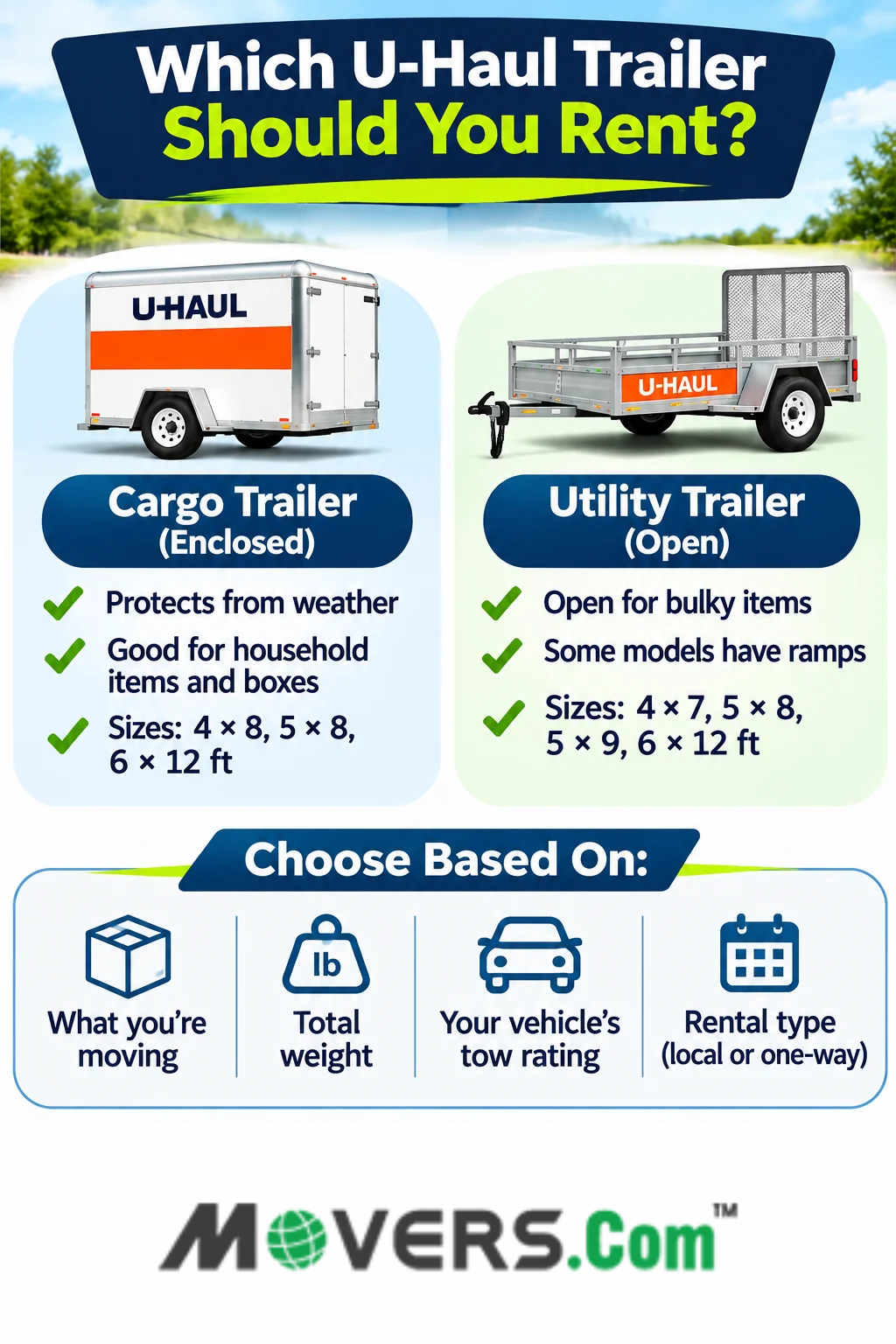
Choose a trailer based on what you are moving, how much it weighs, and what your vehicle can safely tow.
| Your moving needs |
Trailer to consider |
| A few boxes, small furniture, or dorm belongings |
4 × 8 ft cargo trailer |
| Boxes, mattresses, and small apartment furniture |
5 × 8 ft cargo trailer |
| Larger furniture and more household belongings |
6 × 12 ft cargo trailer |
| Tall, bulky, or irregularly shaped items |
Open utility trailer |
| Equipment that needs to be rolled aboard |
Utility trailer with a loading ramp |
| Belongings that need protection from rain and road debris |
Enclosed cargo trailer |
Important: Trailer size alone does not determine whether you can tow it. Check the trailer's empty weight, your estimated cargo weight, your vehicle's tow rating, and U-Haul's vehicle compatibility requirements before making a reservation.
U-Haul Trailer Sizes at a Glance
U-Haul's two main trailer categories are cargo trailers and utility trailers.
Cargo trailers are enclosed and are generally better for household belongings that need protection from weather and road debris. They have fixed interior heights and door openings, so tall furniture may not fit even when there appears to be enough floor space.
Utility trailers have open tops and are better suited to bulky, tall, or irregularly shaped items. Some have loading ramps, making them useful for compatible wheeled equipment. However, items are exposed to the elements and must be properly secured.
The following tables compare common U-Haul trailer models. Specifications are published equipment figures, not estimates of how much your particular vehicle can tow.
U-Haul Cargo Trailer Sizes, Dimensions & Weights
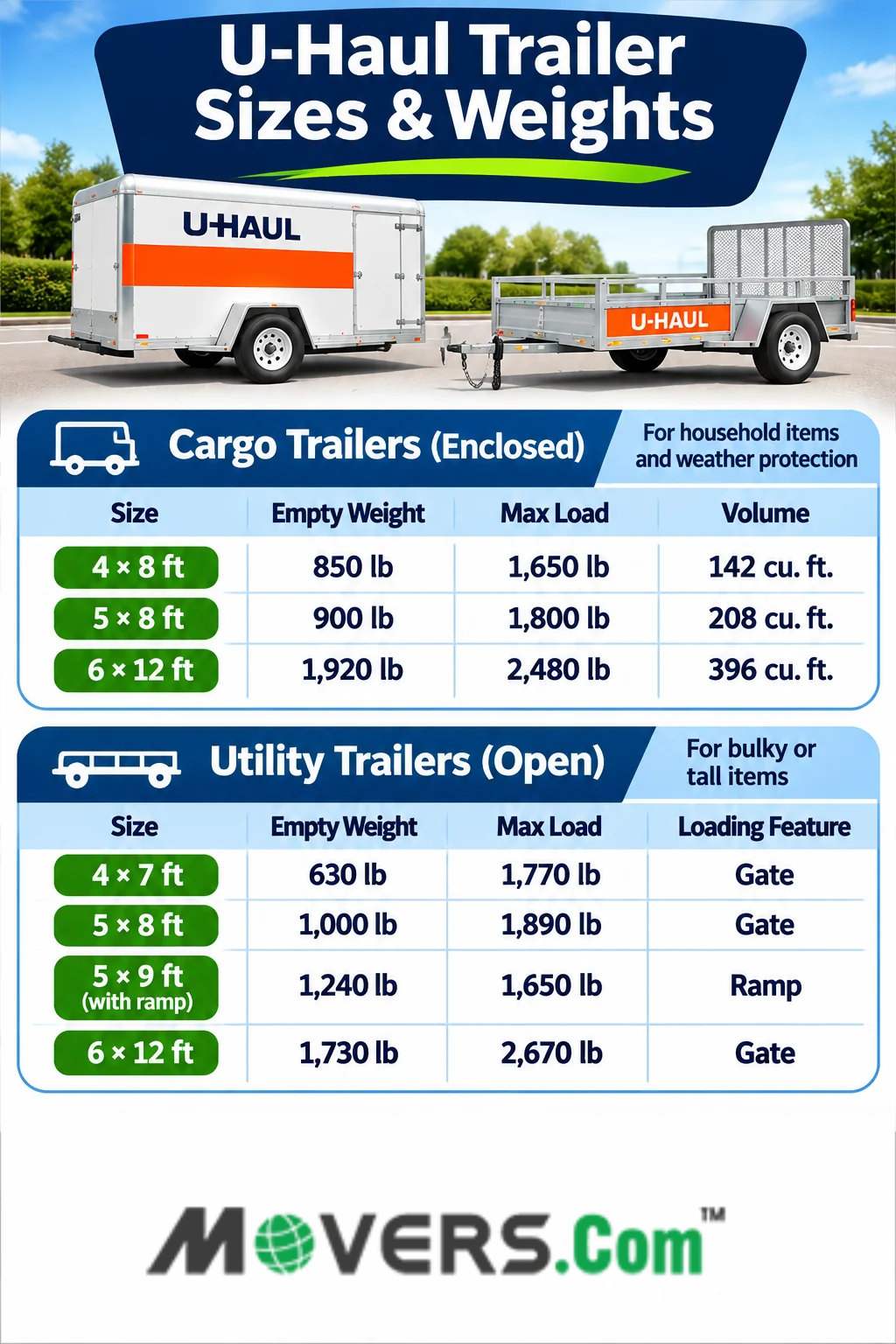
U-Haul's standard enclosed cargo trailer lineup includes 4 × 8, 5 × 8, and 6 × 12-foot models.
| Cargo trailer |
Interior dimensions (L × W × H) |
Empty weight |
Maximum cargo load |
Approx. volume |
| 4 × 8 ft |
8'1" × 4'2" × 4' |
850 lb |
1,650 lb |
142 cu. ft. |
| 5 × 8 ft |
8'1" × 4'8" × 5' |
900 lb |
1,800 lb |
208 cu. ft. |
| 6 × 12 ft |
11'7" × 6' × 5'3" |
1,920 lb |
2,480 lb |
396 cu. ft. |
A 5 × 8-foot cargo trailer with a ramp is also listed in U-Haul's equipment comparison. Confirm its availability and loading-door specifications when booking.
4 × 8-Foot Cargo Trailer
The 4 × 8-foot trailer is the smallest standard enclosed cargo option in this comparison. It is suitable for boxes, small furniture, and limited household belongings.
Its compact dimensions make it useful when you do not need a larger trailer, but the approximately four-foot interior height limits what can stand upright.
5 × 8-Foot Cargo Trailer
The 5 × 8-foot trailer offers more interior height and cargo volume than the 4 × 8-foot model. It may accommodate mattresses, boxes, and smaller pieces of furniture, depending on their actual dimensions.
Check the rear door opening before booking. An item that fits inside the trailer may still be too large to pass through the opening.
6 × 12-Foot Cargo Trailer
The 6 × 12-foot cargo trailer provides the most space among these three standard enclosed options. It can accommodate larger furniture and more household belongings, provided the items fit through the door and remain within the trailer's load capacity.
It also has a substantially higher empty weight, so confirming your vehicle's towing capability is especially important.
U-Haul Utility Trailer Sizes & Weights
Utility trailers have open cargo areas and are often used for furniture, equipment, building materials, and other bulky loads.
| Utility trailer |
Empty weight |
Maximum cargo load |
Loading feature |
| 4 × 7 ft |
630 lb |
1,770 lb |
Fold-down gate |
| 5 × 8 ft |
1,000 lb |
1,890 lb |
Fold-down gate |
| 5 × 9 ft |
1,240 lb |
1,650 lb |
Loading ramp |
| 6 × 12 ft |
1,730 lb |
2,670 lb |
Fold-down gate |
| 6 × 12 ft with ramp |
2,290 lb |
3,710 lb |
Loading ramp |
Important: Check the actual trailer's weight limits.
U-Haul lists a maximum cargo load of 3,710 pounds for its 6×12 utility trailer with ramp. However, this is the trailer's published equipment capacity, not necessarily the amount you are permitted to tow.
During reservation, confirm the allowed cargo weight for your specific vehicle and trailer combination. Before loading, check the trailer's identification or capacity label and the allowed cargo weight stated in your rental contract. Follow the lowest applicable limit.
If you are using the loading ramp, also check its separate weight rating. A trailer's maximum cargo capacity does not mean its ramp can safely support the same weight.
The 6×12-foot utility trailer with a ramp may have different published maximum-load figures depending on the equipment specification. Before reserving, ask U-Haul to confirm the maximum cargo load and gross vehicle weight rating (GVWR) for the specific trailer you will receive. Before loading, check the trailer's identification or capacity label and follow the applicable weight limits. Do not assume the ramp-equipped model has the same capacity as the standard 6×12 utility trailer.
The allowable load also depends on your tow vehicle and towing setup. Even when the trailer's cargo capacity is sufficient, the combined weight must remain within the limits approved for your vehicle, hitch, and trailer.
Which Utility Trailer Is Best?
A 4 × 7-foot utility trailer can work for smaller loads, tools, and items that do not require an enclosed cargo area.
A 5 × 8-foot utility trailer provides additional floor space for furniture and equipment.
A 5 × 9-foot utility trailer with a ramp may be more convenient when loading compatible wheeled items.
A 6 × 12-foot utility trailer offers more floor space for larger loads, while the ramp-equipped version is intended for applications where rolling equipment aboard is important.
Open trailers are not automatically suitable for every oversized load. Check the trailer's actual deck dimensions, rail clearance, load capacity, and tie-down requirements.
How Much Does It Cost to Rent a U-Haul Trailer?
U-Haul trailer rental prices vary by trailer size, pickup location, rental dates, availability, and whether the rental is local or one-way.
According to U-Haul's trailer rental pricing guide, updated February 18, 2026, in-town trailer rentals range from approximately $14.95 to $89.95 per day. This is a published reference range, not a guaranteed price for every location or trailer.
Local vs. One-Way U-Haul Trailer Rental Prices
| Rental type |
How pricing works |
What to compare |
| Local (in-town) |
Generally charged for an agreed rental period, with the trailer returned to the original location |
Rental duration, return deadline, and extension charges |
| One-way |
Quoted based on equipment, pickup and return locations, dates, and availability |
Total quoted price, included rental days, and additional-day charges |
| Mileage |
Unlimited mileage is included with U-Haul trailer rentals |
No separate mileage charge, but fuel and other travel expenses still apply |
What Other Costs Should You Compare?
Before booking, review the complete rental estimate, including:
- Optional damage protection or coverage
- Hitch installation or towing accessories, if needed
- Applicable taxes and fees
- Fuel, tolls, and travel expenses
- Additional rental days or late-return charges
A lower advertised trailer rental rate does not always mean a lower overall moving cost. Compare quotes using the same trailer size, moving dates, rental duration, and route.
For an accurate total, request a current quote directly from U-Haul before making a reservation.
Does U-Haul Charge Mileage on Trailers?
No. U-Haul does not charge a per-mile fee for its trailer rentals.
This differs from certain U-Haul moving truck rentals, which may include mileage allowances or per-mile charges depending on the rental type.
However, towing a trailer can increase your vehicle's fuel consumption. You remain responsible for your tow vehicle's fuel costs, along with any applicable tolls or other trip expenses.
How Much Does a U-Haul Trailer Weigh?
A trailer's empty weight is the weight of the trailer without your belongings. Its maximum cargo load is the maximum weight of belongings or equipment the trailer is rated to carry.
The gross vehicle weight rating (GVWR) represents the trailer's maximum permitted loaded weight.
For example, a standard 5 × 8-foot U-Haul cargo trailer has:
- Empty weight: 900 pounds
- Maximum cargo load: 1,800 pounds
- Maximum loaded trailer weight: 2,700 pounds
If your belongings weigh 1,000 pounds, the trailer and cargo would weigh approximately 1,900 pounds before accounting for any other relevant loading considerations.
That does not automatically mean a vehicle rated to tow 1,900 pounds can safely handle the combination. The tow vehicle's limits, hitch rating, tongue weight, loading arrangement, and U-Haul's compatibility rules also matter.
Which U-Haul Trailer Size Should You Choose?
Start by measuring your largest items and estimating the total weight of everything you plan to load.
Choose an enclosed cargo trailer if:
- You are moving boxes, mattresses, or household furniture.
- You want protection from rain and road debris.
- Your belongings fit through the trailer's rear opening.
- The trailer and cargo are compatible with your tow vehicle.
Choose an open utility trailer if:
- You are transporting tall or irregularly shaped items.
- You need an open loading area.
- You can secure and protect the load appropriately.
- The trailer's deck dimensions and load rating suit your items.
Choose a ramp-equipped trailer if:
- You are moving compatible wheeled equipment.
- You need to reduce the need for lifting heavy items onto the trailer.
- The equipment fits the ramp and trailer.
- Its weight is within the ramp and trailer limits.
Do not select a trailer based only on the number of rooms you are moving. Furniture dimensions, cargo weight, packing methods, and towing compatibility are more reliable considerations.
Do U-Haul Trailers Have Loading Ramps?
Some U-Haul trailers have ramps, but not every trailer includes one.
Several standard utility trailers use fold-down gates rather than loading ramps. Ramp-equipped utility trailers include certain 5 × 9-foot and 6 × 12-foot models.
U-Haul also lists a 5 × 8-foot enclosed cargo trailer with a ramp. Availability may vary.
Before reserving, verify the exact trailer model, ramp width, ramp capacity, and dimensions of the items you intend to load. A ramp does not increase the trailer's maximum cargo capacity.
U-Haul Trailer Towing Requirements & Safety
Your vehicle must be compatible with the trailer you intend to rent. The fact that a vehicle has a hitch does not necessarily mean it can safely tow every U-Haul trailer.
Understand Trailer Weight and Towing Capacity
Before renting a U-Haul trailer, understand these five weight measurements:
| Weight measurement |
What it means |
| Empty trailer weight |
The trailer's weight before cargo is loaded |
| Cargo weight |
The weight of belongings or equipment placed in the trailer |
| Gross trailer weight (GTW) |
The trailer's actual total loaded weight, including cargo |
| Gross vehicle weight rating (GVWR) |
The manufacturer's maximum permitted loaded weight for the trailer |
| Tongue weight |
The downward force a loaded trailer applies to the tow vehicle's hitch. Follow U-Haul's loading instructions and remain within the vehicle's and hitch's rated limits. |
For example, U-Haul's 6×12 utility trailer with ramp weighs approximately 2,290 pounds empty and has a published maximum cargo load of 3,710 pounds. Its maximum loaded trailer weight is 6,000 pounds.
However, your vehicle may be approved to tow significantly less than the trailer's published maximum.
A vehicle's advertised towing capacity alone does not establish that a particular trailer combination is safe or approved. You must also consider the vehicle's payload and axle-weight limits, hitch and hitch-ball ratings, tongue-weight limits, and the specific trailer's requirements.
U-Haul evaluates the tow vehicle and hitch system during reservation and specifies the allowed cargo weight on the rental contract. Never exceed that allowance or the trailer's labeled capacity, whichever is lower.
Before departure, confirm the trailer is properly connected, the safety chains and lights are functioning, and the cargo is securely positioned according to U-Haul's loading instructions.
Check These Five Requirements
- Vehicle towing capacity: Confirm the manufacturer's tow rating for your specific vehicle and configuration.
- Trailer and cargo weight: Calculate the combined loaded weight and remain within all applicable limits.
- Hitch and ball compatibility: Confirm the correct hitch setup and ratings.
- Tongue weight: Load the trailer properly and stay within the vehicle and hitch limits.
- Lights and safety connections: Verify trailer lights, safety chains, and required connections before departure.
U-Haul's reservation process asks for tow vehicle details to evaluate compatibility. Follow its equipment-specific requirements and any instructions provided during pickup.
Tips for Driving With a Trailer
- Distribute cargo according to the trailer's loading instructions and secure it against movement.
- Allow additional stopping distance.
- Take wider turns and avoid sharp steering inputs.
- Check trailer clearance before entering narrow areas.
- Avoid unnecessary reversing, especially in confined spaces.
- Inspect the hitch, safety chains, lights, and load restraints during the trip.
Follow the speed limit and U-Haul's trailer-specific operating instructions, including its recommended towing speed where applicable.
Additional U-Haul Trailer Rental Costs
Even without mileage charges, your total trip cost can exceed the advertised trailer rental rate.
| Potential expense |
What to check |
| Fuel |
Your vehicle may use more fuel while towing |
| Optional protection |
Review the coverage terms and exclusions |
| Hitch or wiring equipment |
Confirm whether your vehicle already has compatible equipment |
| Moving supplies |
Budget for straps, protective materials, and other supplies |
| Extra rental time |
Review extension and late-return terms |
| Tolls and parking |
Account for route-specific charges |
| Taxes and applicable fees |
Review the full checkout quote |
Request the complete rental quote before booking and check which items are optional.
Pros and Cons of Renting a U-Haul Trailer
| Advantages |
Limitations |
| Can be useful for smaller moves and additional cargo |
Requires a compatible tow vehicle |
| No per-mile trailer rental charges |
Towing may increase fuel consumption |
| Enclosed models protect belongings from weather |
Cargo trailers have fixed height and door limits |
| Open utility trailers accommodate certain bulky items |
Open loads are exposed to weather and road debris |
| Ramp-equipped models can simplify some loading tasks |
Not all trailers have ramps |
A trailer may be a practical alternative to a moving truck when your vehicle can tow it safely and your belongings fit within the trailer's size and weight limits.
For larger moves or vehicles that are not suitable for towing, compare the full cost of renting a moving truck or hiring professional movers.
Editor's Note
This guide was reviewed by our Moving Industry Analyst team using publicly available U-Haul trailer specifications, rental pricing information, towing and safety requirements, and common moving scenarios. Trailer availability, rental rates, and equipment specifications may vary by location and reservation details.
Get expert moving tips and compare movers for free at Movers.com.
You can get free moving quotes from licensed and insured movers, compare moving companies near you, and plan your move with confidence using our step-by-step moving guides and checklists.
Whether you’re planning a local move, a long-distance relocation, or need help with packing and loading, Movers.com connects you with trusted moving professionals and practical tools to make moving easier and more affordable.
Questions? Talk to our moving specialists.