U-Haul is one of the most popular truck rental companies for do-it-yourself moves. It offers pickup trucks, cargo vans, and moving trucks for both local and long-distance moves.
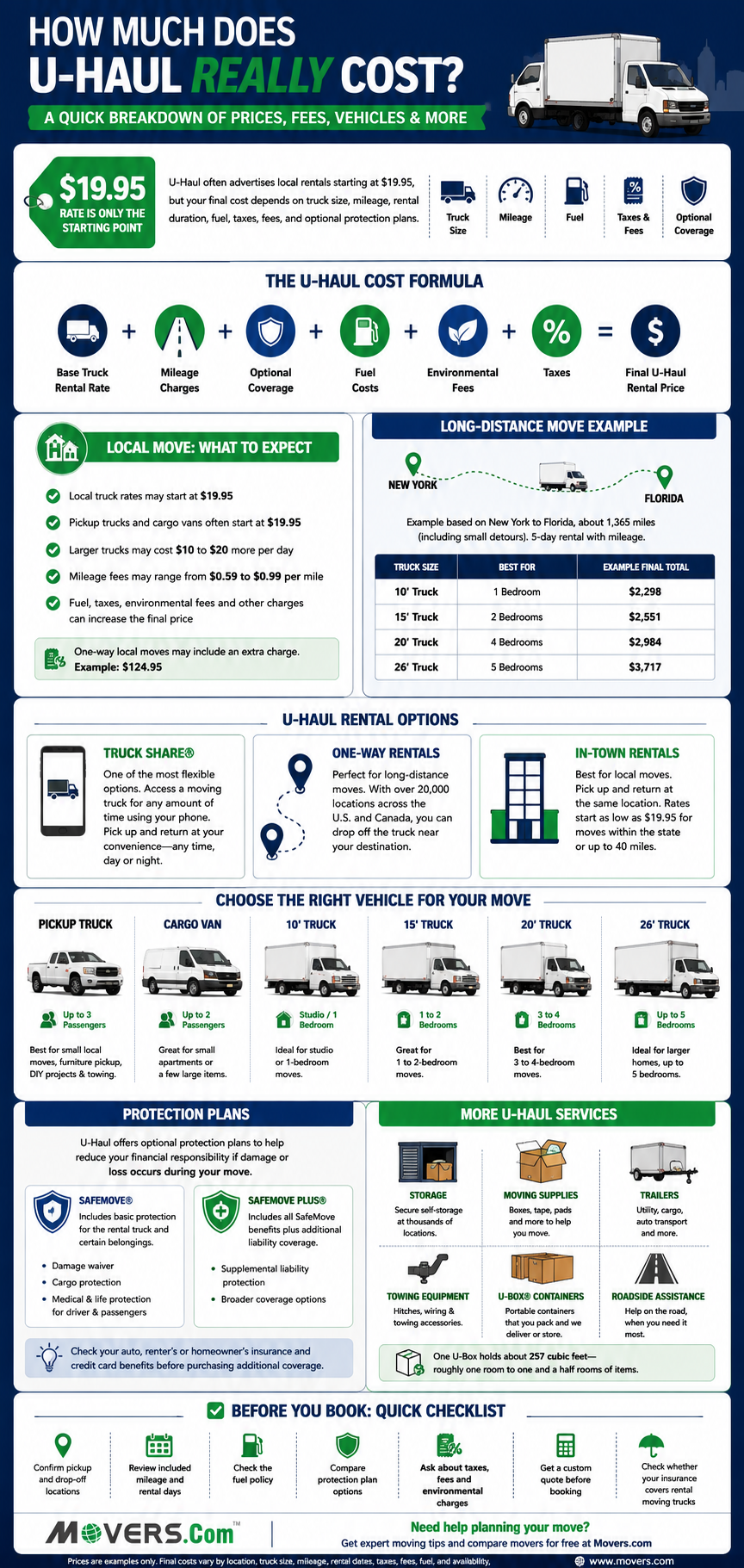
An in-town U-Haul rental may start at $19.95 per day for selected vehicles, but that price does not include mileage, fuel, taxes, fees, optional protection or equipment. Larger trucks have higher base rates, while one-way rentals are priced according to the route, date, truck size and availability.
U-Haul Starting In-Town Rental Rates by Truck Size
One of the biggest factors affecting your rental cost is the size of the truck you choose. Larger trucks typically have a higher daily rental rate, while one-way rentals are priced based on distance, truck availability, and demand rather than a flat daily fee.
The table below shows typical in-town base rental rates before mileage, fuel, taxes, optional protection, and equipment are added.
| U-Haul Truck Size |
Best For |
Starting in-town base rate |
| Pickup truck |
Small deliveries and projects |
$19.95/day |
| Cargo van |
Studio apartment or small load |
$19.95/day |
| 10-foot truck |
Studio or 1-bedroom apartment
|
$19.95/day |
| 15-foot truck |
1-bedroom home or 2-bedroom apartment |
$29.95/day |
| 20-foot truck |
2-bedroom home or 3-bedroom apartment |
$39.95/day |
| 26-foot truck |
3–4-bedroom home |
$49.95/day |
| 29-foot truck |
4–6-bedroom home |
Check local availability and pricing |
*These are starting in-town base rates. Mileage, fuel, taxes, fees, coverage and equipment may cost extra. One-way rates are based on the route, date, truck size and availability.
How much does U-Haul actually cost?
The cost of renting a U-Haul truck depends on the truck size, move distance, rental duration, pickup and drop-off locations, mileage, fuel, taxes, and optional coverage. The advertised rate is not usually the final price because additional charges may apply.
Use this formula to estimate your total U-Haul rental cost:
Base rental rate + Mileage or route charge + Fuel + Optional protection and equipment + Additional days or miles + Taxes and fees = Estimated U-Haul rental cost
For a local move:
For an in-town move, you normally return the truck to the same U-Haul location where you picked it up. Your cost generally includes the daily base rate, mileage, fuel, taxes and fees, plus any optional protection plan or moving equipment you select. Base rates start at $19.95 for selected vehicles, but the final cost varies by location and mileage.
Example: Suppose you rent a 10-foot truck with a $19.95 base rate and drive 30 miles. Your estimated total would include:
- $19.95 base rate
- 30 miles × the location's mileage rate
- Estimated fuel replacement
- Applicable taxes and fees
- Optional coverage and equipment
Because mileage rates and fees vary, enter your pickup location and date to obtain the actual amount.
For a long-distance move:
One-way U-Haul prices are route-specific. Unlike local rentals, they are generally quoted as a package that includes an allowed number of days and miles. The final rate depends on your pickup city, destination, truck size, moving date and equipment availability. Get a personalized quote before setting your moving budget.
What are the U-Haul truck rental options?
U-Haul offers three main truck rental options: Truck Share 24/7, one-way rentals, and in-town rentals. The right option depends on where you are moving and whether you plan to return the truck to the original location.
- Truck Share 24/7:This self-service option allows customers to pick up and return eligible U-Haul vehicles using a mobile device, including outside normal business hours. Customers must complete U-Haul’s mobile verification and follow the pickup or return instructions provided with the reservation.
- One-way truck rentals are designed for long-distance relocations. U-Haul has more than 25,000 rental locations across the United States and Canada, although available trucks and equipment vary by location. With a one-way rental, you pick up the truck in one location and return it to the destination specified in your reservation or rental agreement.
- In-town truck rentals are designed for moves where you pick up and return the truck at the same U-Haul location. Rates start at $19.95 for selected vehicles and normally include a base rental charge plus mileage. Special extended-mile or extended-day rates may be available for pickup trucks and cargo vans.
What Is Included and What Costs Extra?
What is included depends on whether you choose an in-town or one-way rental. In-town rentals generally have a base rental rate plus mileage, while one-way quotes normally include a set number of days and miles. Fuel, taxes, optional protection, equipment, environmental fees and additional rental time may increase the final cost.
Common costs include:
- Mileage charges for local rentals
- Damage protection coverage (optional)
- Moving equipment such as dollies or furniture pads
- Environmental or recovery fees
- Extended rental days, if needed
If you exceed the included allowance on a one-way rental, U-Haul currently charges $1 per additional mile. Prepaid additional days for U-Haul trucks currently cost $40 per day.
What size vehicles does U-Haul offer?
U-Haul offers different vehicle sizes for different types of moves. The right option depends on how much you need to move, the distance of your move, and your budget. Smaller vehicles, such as pickup trucks and cargo vans, are usually better for small local moves, while larger moving trucks are better for apartments, homes, and long-distance moves.
Pickup trucks
Pickup trucks are best for furniture pickups, home improvement projects, small deliveries, and towing. U-Haul pickup trucks start at $19.95 per day plus mileage and typically seat up to three adults. Specifications may vary by vehicle and location.
Box trucks
U-Haul’s box trucks range from 10 to 29 feet. Smaller trucks are generally suitable for apartments and one-bedroom homes, while the 26- and 29-foot trucks are designed for larger household moves.
U-Haul Truck Sizes and Capacity
U-Haul offers several moving truck sizes for apartments and homes of different sizes. The table below compares the interior dimensions, cargo capacity, and estimated fuel efficiency of each truck.
| Truck size |
Suggested move size |
Interior dimensions (L × W × H) |
Cargo capacity |
Estimated MPG |
| 10-foot truck |
Studio or 1-bedroom apartment |
9'11" × 6'4" × 6'2" |
402 cu. ft. |
Up to 12 MPG |
| 15-foot truck |
1-bedroom home or 2-bedroom apartment |
15' × 7'8" × 7'2" |
764 cu. ft. |
Up to 10 MPG |
| 20-foot truck |
2-bedroom home or 3-bedroom apartment |
19'6" × 7'8" × 7'2" |
1,016 cu. ft.
|
Up to 10 MPG |
| 26-foot truck |
3–4-bedroom home |
26'2" × 8'2" × 8'3" |
1,682 cu. ft. |
Approximately 8–10 MPG |
| 29-foot truck |
4–6-bedroom home or apartment |
29'2" × 8'1" × 8'9" |
2,057 cu. ft. |
Approximately 8–10 MPG |
The 10-foot truck is the smallest U-Haul box truck and is generally suitable for a studio apartment or one-bedroom home. The 15- and 20-foot trucks provide more space for apartments and smaller homes, while the 26-foot truck page notes that the truck may accommodate some three- to five-bedroom homes. Actual space needs depend on the amount and size of your belongings. U-Haul’s new 29-foot truck is its largest option and is intended for homes with four to six bedrooms.
U-Haul states that truck measurements are approximate because the equipment provided may vary between production models. Fuel-efficiency estimates are based on ideal driving conditions and may be lower when the truck is fully loaded or driven in traffic, bad weather, hilly areas, or at higher speeds.
What U-Haul Protection Plans Are Available?
U-Haul offers optional protection plans that can be added to your rental. These plans can increase your total rental cost, but they may help reduce your financial responsibility if the truck, your belongings, or another person’s property is damaged during the move.
Since many personal auto insurance policies and credit cards may not cover rental moving trucks, it is a good idea to check with your insurance provider before renting. If your existing policy does not cover moving truck rentals, you may want to consider U-Haul’s protection options.
U-Haul’s main protection options for moving trucks are Safemove and Safemove Plus.
| Protection plan |
Available for |
Main protection |
| Safemove |
Moving trucks, pickup trucks and cargo vans |
Damage waiver, cargo coverage and medical/life protection |
| Safemove Plus |
Moving trucks only |
Safemove benefits plus $1 million in supplemental liability coverage and a $0 deductible on accidental truck damage |
Safemove does not include liability coverage. Coverage, exclusions, and availability may vary. Review the rental agreement and check whether your personal auto policy or credit card covers moving-truck rentals before selecting a plan.
Other U-Haul protection options
U-Haul may also offer other protection options depending on what you rent. These can include a collision damage waiver for pickup trucks and cargo vans, Safetow for trailers and towing equipment, and Safetrip for roadside assistance services.
Before adding any protection plan, compare the cost with your existing auto insurance, renter’s insurance, homeowner’s insurance, or credit card benefits. This can help you avoid paying for duplicate coverage while still making sure you are protected.
Coverage, exclusions and availability may vary. Review the rental agreement and check whether your personal auto policy or credit card covers moving-truck rentals before selecting a plan.
What Other Services Does U-Haul Offer?
In addition to truck rentals, U-Haul offers self-storage, U-Box containers, trailers, towing equipment, packing supplies, dollies, furniture pads and Moving Help labor services. These services are priced separately and can increase the total cost of your move.
Is U-Box an alternative to renting a truck?
U-Box is U-Haul's portable moving and storage container service. Pricing depends on the number of containers, delivery method, storage period and shipping distance. Compare a personalized U-Box quote with the complete cost of renting, fueling and driving a truck.
How to Estimate Your U-Haul Rental Cost
To estimate your rental cost:
- Choose the truck size that fits your move.
- Decide whether your move is local or one-way.
- Estimate your mileage if renting locally.
- Add optional equipment, protection plans, moving labor or storage if needed.
- Include fuel, taxes, and other applicable fees.
Getting an online quote is the easiest way to see your estimated total based on your pickup location, destination, and moving date.
Before you book a U-Haul truck
Before confirming your U-Haul truck rental, review the payment method, pickup and return locations, rental period, local mileage rate or one-way mileage allowance, fuel-return requirement, optional protection and any additional fees. Confirm the assigned return location and return deadline shown in your rental agreement.
If a rate is not available online for certain equipment, it may be due to location availability, rental type, towing compatibility, or market-specific restrictions. In that case, contact your local U-Haul location for the most accurate options.
Editor's Note
U-Haul can be an affordable option for local and long-distance DIY moves, but the advertised base rate is only one part of the total cost. Your final price will depend on the truck size, mileage, rental duration, fuel, taxes, fees, location, and optional coverage.
Before booking, compare truck sizes, review the included mileage and days, check whether your insurance covers rental moving trucks, and get a custom quote for your exact move. This will help you avoid surprises and choose the right U-Haul option for your budget.
Get expert moving tips and compare movers for free at Movers.com
You can get free moving quotes from licensed and insured movers, compare moving companies near you, and plan your move with confidence using our step-by-step moving guides and checklists.
Whether you're planning a local move, a long-distance relocation, or need help with packing and loading, Movers.com connects you with trusted moving professionals and practical tools to make moving easier and more affordable.
Questions? Talk to our moving specialists.