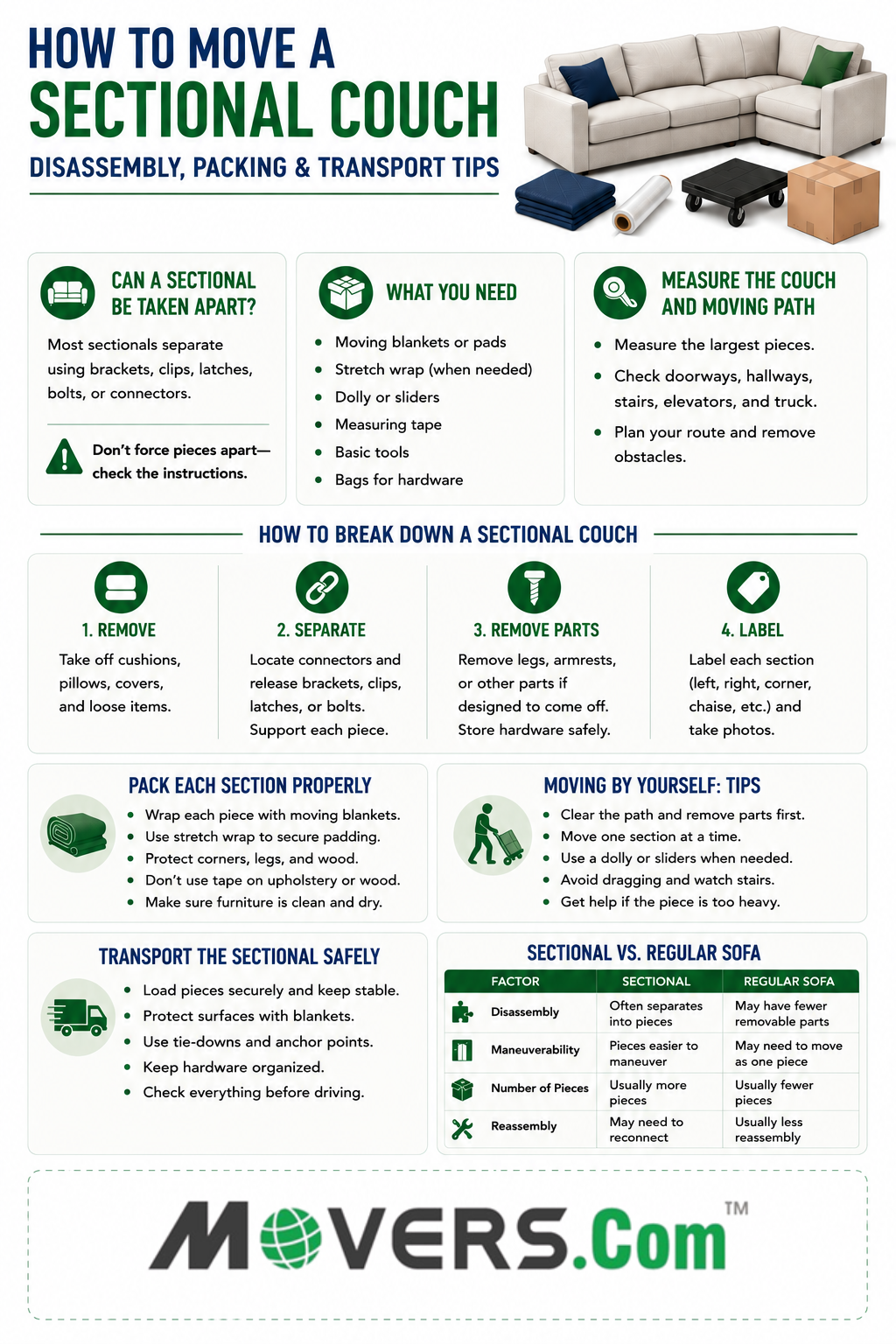
Moving a sectional couch is usually easier if you separate it into individual sections before lifting or transporting it.
Start by removing cushions and other detachable parts, then determine how the sectional pieces connect. Depending on the couch, sections may use brackets, clips, hooks, bolts, latches, or other connectors.
Once separated, protect each piece individually, measure the moving path, and plan how you'll safely get each section to the moving truck.
Can a Sectional Couch Be Taken Apart for Moving?
Many sectional couches are designed to separate into smaller pieces, but the disassembly method varies by model.
Depending on the sectional, pieces may be connected with:
- Interlocking brackets.
- Clips or hooks.
- Latches.
- Bolts or screws.
- Manufacturer-specific connectors.
Some sectionals may also have removable legs, cushions, armrests, or chaise components.
Before separating the couch, inspect underneath and behind it to determine how the pieces connect. If the connection system isn't clear, check the manufacturer's assembly or disassembly instructions.
Don't force sectional pieces apart, as this could damage the frame, upholstery, or connectors.
What Do You Need to Move a Sectional Couch?
The supplies you need depend on the sectional's size, weight, material, and design.
Useful supplies may include:
- Moving blankets or furniture pads.
- Stretch wrap.
- Furniture dolly.
- Furniture sliders.
- Measuring tape.
- Screwdrivers or other basic tools.
- Resealable bags for hardware.
Check how your sectional is constructed before deciding which tools and packing materials you'll need.
Measure the Sectional and Moving Path
Before moving the couch, determine how far it can safely be disassembled and measure the largest individual pieces you'll need to move.
Check:
- Doorways and entryways.
- Hallways and tight corners.
- Stairways.
- Elevators.
- Moving-truck opening.
Measure the height, width, and depth of the largest sectional pieces and compare those dimensions with the narrowest parts of the moving path.
A large assembled sectional may not fit through a doorway even though its individual pieces will.
Planning the route beforehand can also help you identify stairs, tight turns, low ceilings, and other obstacles before you're carrying a heavy piece of furniture.
How to Break Down a Sectional Couch for Moving
How you disassemble a sectional depends on its design. Don't assume every component is removable.
Step 1: Remove Cushions and Loose Items
Remove anything that isn't permanently attached, such as:
- Seat cushions.
- Back cushions.
- Throw pillows.
- Blankets.
- Removable covers.
Pack these items separately. Removing them can make the sectional lighter and give you better access to its connection points.
Step 2: Separate the Sections
Inspect the sectional to locate its connectors.
Depending on the model, you may need to:
- Lift a section to release an interlocking bracket.
- Release clips, hooks, or latches.
- Remove bolts or screws.
- Follow another manufacturer-specific release method.
Support each section as it is disconnected. If the pieces don't release easily, stop and determine how the connection works rather than pulling or twisting them apart.
Step 3: Remove Detachable Legs and Other Parts
Remove legs, armrests, or other components only if they are designed to come off. Doing so may reduce the dimensions of each piece and make it easier to maneuver through doors and other tight spaces.
Place screws, bolts, washers, and other hardware in a labeled resealable bag so nothing gets lost during the move.
Step 4: Label the Sections
Label the individual pieces, such as:
- Left section.
- Center section.
- Right section.
- Corner.
- Chaise.
For modular sectionals with several similar pieces, take photos before and during disassembly. These can help you reconnect the sections correctly after the move.
How to Pack a Sectional Couch for Moving
Once the sectional has been separated, protect each piece individually rather than trying to wrap the entire assembled couch.
Make sure the furniture is clean and dry before covering it. Depending on the couch material and moving conditions, you can use:
- Clean moving blankets.
- Furniture pads.
- Appropriate furniture covers.
- Stretch wrap to hold protective padding in place, when suitable.
Pay extra attention to exposed corners, wooden components, legs, and other areas that could be scratched or damaged.
Avoid applying packing tape directly to upholstery, leather, finished wood, or other delicate surfaces.
If you're using plastic wrap or another non-breathable covering, don't tightly seal damp furniture because trapped moisture can damage some materials.
How to Move a Sectional Couch by Yourself
Moving a sectional couch by yourself may be possible if it separates into lightweight, manageable pieces. However, large or heavy sections can be difficult to lift, balance, and maneuver safely without help.
If you're moving manageable sections yourself:
- Clear the entire moving path before you begin.
- Remove cushions, legs, and other detachable components first.
- Move one section at a time.
- Use a furniture dolly when appropriate.
- Use furniture sliders on suitable indoor surfaces.
- Avoid dragging upholstery directly across the floor.
- Take extra care around stairs and tight corners.
Don't attempt to carry a heavy or awkward sectional piece down stairs by yourself. If you can't safely lift, balance, or control a section, get additional help.
How to Transport a Sectional Couch
Once the sectional pieces are protected, arrange them carefully inside the moving truck or other suitable vehicle.
When loading:
- Keep each section stable.
- Protect vulnerable surfaces with moving blankets or furniture pads.
- Position pieces so they won't tip or shift.
- Use appropriate restraints and available tie-down points.
- Avoid placing heavy belongings on cushions or vulnerable upholstered areas.
- Keep detachable hardware and components organized.
Don't rely on the truck doors alone to keep furniture in place. Before driving, make sure each section is properly secured against shifting during transportation.
Is a Sectional or Regular Sofa Easier to Move?
A sectional can be easier to move if it separates into small, manageable pieces, while a regular sofa may be simpler to organize because there are fewer components.
The better option depends largely on the size and weight of the furniture and how easily it fits through your moving path.
| Factor |
Sectional |
Regular Sofa |
| Disassembly |
Often separates into multiple sections |
May have fewer removable components |
| Maneuverability |
Individual pieces may be easier to move |
Entire sofa may need to move as one piece |
| Number of pieces |
Usually more pieces to organize |
Usually fewer pieces |
| Reassembly |
Sections may need to be reconnected |
Often requires less reassembly |
| Moving difficulty |
Depends on the largest individual section |
Depends on the sofa's overall size and weight |
If you expect to relocate within the next few years, furniture designed to separate into smaller, manageable components may be easier to move than a large one-piece couch.
What Type of Sectional Is Easiest to Move?
Modular sectionals designed as separate, individually movable units are generally among the easiest sectional styles to relocate.
If you're buying a sectional and expect to move in the future, look for:
- Individual modular sections.
- Manageable module sizes and weights.
- Easy-to-release connectors.
- Removable legs.
- Removable cushions.
- Simple assembly and disassembly instructions.
Check the dimensions and weight of the largest individual module before buying, not just the assembled dimensions. Even a modular sectional can be difficult to relocate if its individual pieces are unusually large or heavy.
Is a Sofa Bed Harder to Move?
Sofa beds can be heavier and more difficult to maneuver than similarly sized standard sofas because the internal bed mechanism adds weight and moving components.
Before moving a sofa bed, remove detachable components, fully close and secure the bed mechanism according to the manufacturer's instructions, and measure both the sofa bed and moving path.
Use appropriate moving equipment and sufficient help. Don't attempt to move a heavy sofa bed alone if you can't safely control its weight and movement.
Bottom Line
The easiest way to move most sectional couches is to separate them into manageable pieces, protect each section individually, and secure the pieces during transportation.
Measure your furniture and moving path before starting, keep hardware organized, and follow the manufacturer's instructions when disconnecting or reconnecting sections.
If a section is too heavy or awkward to control safely, get additional help rather than attempting to move it alone.
Editor's Note
Our comparison reviewed by our Moving Industry Analyst team is based on publicly available pricing, customer reviews, and regular moving scenarios.
Sectional designs, weights, and connection systems vary. Check the manufacturer's instructions before disassembling, transporting, or reassembling your couch.
Get expert moving tips and compare movers for free at Movers.com.
You can get free moving quotes from licensed and insured movers, compare moving companies near you, and plan your move with confidence using our step-by-step moving guides and checklists.
Whether you're planning a local move, a long-distance relocation, or need help with packing and loading, Movers.com connects you with trusted moving professionals and practical tools to make moving easier and more affordable.
Questions? Talk to our moving specialists.