Overview of 3-Bedroom Moving Costs
Moving a three-bedroom home can cost anywhere from about $1,200 for a straightforward local move to $12,000 or more for a full-service cross-country relocation. Your final price depends on the distance, shipment size, moving date, access conditions, and services you select.
The table below provides general planning ranges for professional three-bedroom moves.
| Move Type |
Estimated professional moving cost |
| Local move under 50 miles |
$1,200–$2,500 |
| Short-distance move up to 250 miles |
$2,000–$5,000+ |
| Long-distance move around 1,000 miles |
$4,000–$8,300+ |
| Cross-country move of 2,500 miles or more |
$7,000–$12,000+ |
These are general planning ranges, not guaranteed quotes. Your actual price may be lower or higher depending on your location, shipment size, moving date, access conditions, and additional services.
What Affects the Cost of Moving a 3-Bedroom House?
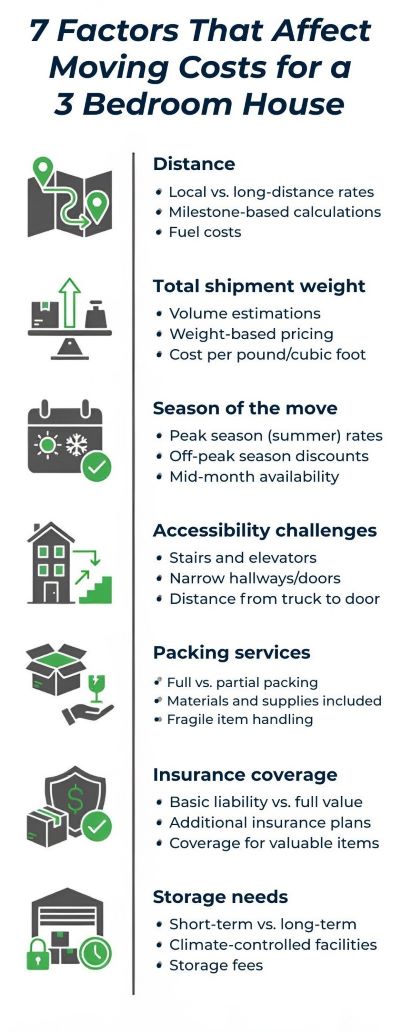
Moving prices vary based on several factors:
- Distance between the two homes
- Amount and weight of the shipment
- Number of movers and hours required
- Origin and destination locations
- Stairs, elevators and long carrying distances
- Packing, storage and specialty-item services
- Moving date and seasonal demand
- Selected valuation protection
Moves during weekends, month-end periods and the peak summer season may cost more because mover availability is limited.
Size of a Typical 3-Bedroom House
Three-bedroom homes vary widely in size, but many contain approximately 1,200 to 2,000 square feet of living space. Square footage can provide a starting point, although the amount of furniture and household goods has a greater effect on moving costs.
Many homeowners searching for the cost to move a 1,500-square-foot house are actually looking for the cost of moving a typical three-bedroom home. A 1,500-square-foot house generally falls within this category, although the final cost depends more on the weight of your belongings than the square footage alone.
Homes around 1,000 square feet often contain fewer belongings and may cost less to move. Larger homes above 2,000 square feet may require more truck space, a larger crew, and additional loading time.
How Long-Distance Moving Costs Are Calculated
Estimated long-distance cost = Transportation charge + selected services + valuation protection + applicable accessorial charges
Long-distance movers consider shipment weight or volume, distance, requested services, accessibility, moving date and the mover’s applicable pricing structure. The written estimate should explain how the charges were calculated.
How Much Does a 3-Bedroom Household Usually Weigh?
A three-bedroom household may contain approximately 7,500 to 10,000 pounds of furniture, boxes, appliances, and personal belongings. However, this is only a rough planning range.
A lightly furnished apartment may weigh much less, while a larger home with a garage, basement, outdoor furniture, appliances, or solid-wood furniture may weigh more.
Square footage alone cannot accurately determine shipment weight. For a more reliable estimate, prepare a detailed inventory and request an in-home or virtual survey from the mover.
Cost to Move a Three-Bedroom House Locally
Local movers usually charge by the hour. A three-bedroom home commonly requires three or four movers and may take approximately six to ten hours, depending on the inventory, access conditions and travel time.
A four-person crew may cost approximately $160 to $320 per hour, although rates vary by city, mover and season.
A reasonable planning range for a standard local three-bedroom move is approximately $1,200 to $2,500, excluding full packing, storage and specialty-item services.
What Affects the Cost of a Local Move?
Even within the same city, your moving cost can vary based on:
- Number of movers required
These factors explain why two local moves of similar-sized homes may receive different estimates.
Additional local charges:
- Stairs or long carry fees
- Appliance disconnection
- Specialty items such as pianos or safes
- Packing materials
- Short-term storage
For more details, see our guide to Local Movers.
Long-Distance Moving Costs for a 3-Bedroom House
Long-distance moving costs commonly depend on:
- Shipment size or weight
- Distance traveled
- Origin and destination locations
- Moving date and availability
- Valuation protection
- Packing, storage, and specialty services
- Accessorial charges
Average Long-Distance Moving Costs by Distance
| Approximate distance |
Three-bedroom professional move
|
| Up to 250 miles |
$2,000–$5,000+ |
| Around 1,000 miles |
$4,000–$8,300+
|
| Around 2,500 miles or more |
$7,000–$12,000+ |
*Costs are estimated averages and may vary based on weight, season, and additional services.
These planning ranges generally assume professional transportation and standard loading and unloading. Packing, storage, specialty handling, difficult access and higher valuation protection may increase the total.
What's Included in a Long-Distance Moving Quote?
A professional moving estimate should clearly identify the transportation charge, requested services, valuation selection, and any expected accessorial or third-party charges. What is included varies by mover and estimate type.
Common charges and services identified in a long-distance estimate include:
- Transportation charges
- Loading and unloading
- Standard furniture protection
- Packing or unpacking, if selected
- Storage, if selected
- Specialty-item handling
- Valuation protection
- Accessorial and third-party charges
Packing, unpacking, storage, crating, and specialty handling can increase the total. For interstate moves, the initial estimate must include Full Value Protection unless you waive it and select Released Value protection.
FMCSA requires written interstate estimates to identify transportation, accessorial, and advance charges. The estimate should generally be based on an in-person or virtual survey of the household goods, although the customer may waive an applicable survey requirement in writing.
Note
These planning ranges generally reflect a moderately furnished three-bedroom household with standard access, no full packing service, and no major specialty items.
For more information, visit our Long-Distance Movers resource page.
Four Ways to Move a 3-Bedroom House
| Moving option |
How it works |
Best for |
| DIY rental truck |
You pack, load, drive and unload |
Lowest upfront cost |
| Rental truck with moving labor |
Professionals load and unload; you drive |
Saving money while avoiding heavy lifting |
| Moving container or freight trailer |
You load, or hire labor; the company transports it |
Avoiding long-distance truck driving |
| Full-service movers |
Movers handle transportation and agreed-upon services |
Convenience and less physical work |
DIY Move
A DIY rental-truck budget may include:
- Truck rental rate
- Mileage or one-way route charge
- Fuel
- Tolls and parking
- Hotels and meals for a long-distance move
- Moving equipment
- Packing supplies
- Optional loading and unloading labor
Get a route-specific truck quote before comparing a DIY move with professional movers. A rental truck may have the lowest upfront price, but it requires the most time, coordination, driving, and physical work.
Hiring moving labor can reduce the physical effort while allowing you to drive the truck. Moving containers avoid long-distance truck driving, while full-service movers provide the greatest convenience.
Binding vs. Non-Binding Moving Estimates
Binding estimate: The mover agrees to charge the listed amount for the inventory and services included in the estimate.
The price may change if you add items or services or if additional work is required because of conditions not included in the original estimate. Any revised estimate should be provided in writing before loading.
Non-binding estimate: The estimate is an approximation. The final charge may be based on the shipment’s actual weight and the services provided. For interstate moves, federal rules generally limit the amount a mover can demand at delivery to 110% of the non-binding estimate, with additional lawful charges billed later.
Always review the inventory, services, valuation selection and estimate type before signing.
Learn more: Binding vs. Non-Binding Moving Estimates
Packing Tips for a 3-Bedroom Move
- Begin packing four to six weeks before moving day.
- Declutter before requesting final estimates.
- Label each box by room and contents.
- Use sturdy boxes and appropriate packing materials.
- Protect furniture with moving blankets or pads.
- Keep medications, documents and first-night essentials separate.
- Avoid overpacking boxes; keep them at a safe, manageable weight.
Organized packing can reduce loading time and lower hourly labor costs.
Common Moving Mistakes to Avoid
- Underestimating the weight of the shipment.
- Failing to compare at least three estimates.
- Waiting until the last minute to book.
- Failing to review valuation-protection options.
- Neglecting additional service fees.
- Using inadequate packing materials.
- Not measuring large furniture.
- Moving unnecessary furniture.
Proper planning can prevent unexpected expenses.
Ways to Reduce the Cost of Moving a 3-Bedroom House
Although moving costs are influenced by distance and shipment weight, there are several ways to lower your final bill:
- Move during the off-season if possible.
- Compare at least three licensed movers.
- Pack some or all of your belongings yourself.
- Reserve your moving company several weeks in advance.
- Avoid last-minute scheduling whenever possible.
Even small reductions in shipment weight or labor time can result in noticeable savings.
Bottom Line
The cost to move a three-bedroom house depends on several key factors, including the size of your home, total shipment weight, moving distance, additional services, and even the time of year you plan to move.
Professional moving costs for a three-bedroom home may range from approximately $1,200 for a straightforward local move to $12,000 or more for a full-service cross-country relocation. DIY and hybrid moving options may cost less, but require more time, coordination, and physical work.
One of the smartest steps before requesting quotes is to create a detailed inventory of everything you plan to move. A complete inventory helps movers estimate the shipment more accurately and reduces the risk of unexpected price changes.
Planning ahead, knowing your numbers, and comparing licensed movers can make a big difference in both price and peace of mind.
Editor's Note
This guide was reviewed by our Moving Industry Analyst team and is based on publicly available pricing, industry guidance, and common moving scenarios.
Get expert moving tips and compare movers for free at Movers.com.
You can get free moving quotes from licensed and insured movers, compare moving companies near you, and plan your move with confidence using our step-by-step moving guides and checklists.
Whether you're planning a local move, a long-distance relocation, or need help with packing and loading, Movers.com connects you with trusted moving professionals and practical tools to make moving easier and more affordable.
Questions? Talk to our moving specialists.