If you’re thinking about hiring a packing service, you’re probably trying to answer a few simple questions before you commit: How much is this going to cost? What exactly am I paying for? Is it worth it for my move?
That’s the right place to start, because packing is one of those moving jobs that looks manageable until you’re actually in it. One room turns into five. A few boxes turn into dozens. Fragile items, kitchenware, electronics, decor, paperwork, closets, storage bins, garage items, and random drawers. All of it adds up quickly, and once you’re close to moving day, you’re not just paying with money. You’re paying with time, energy, and stress.
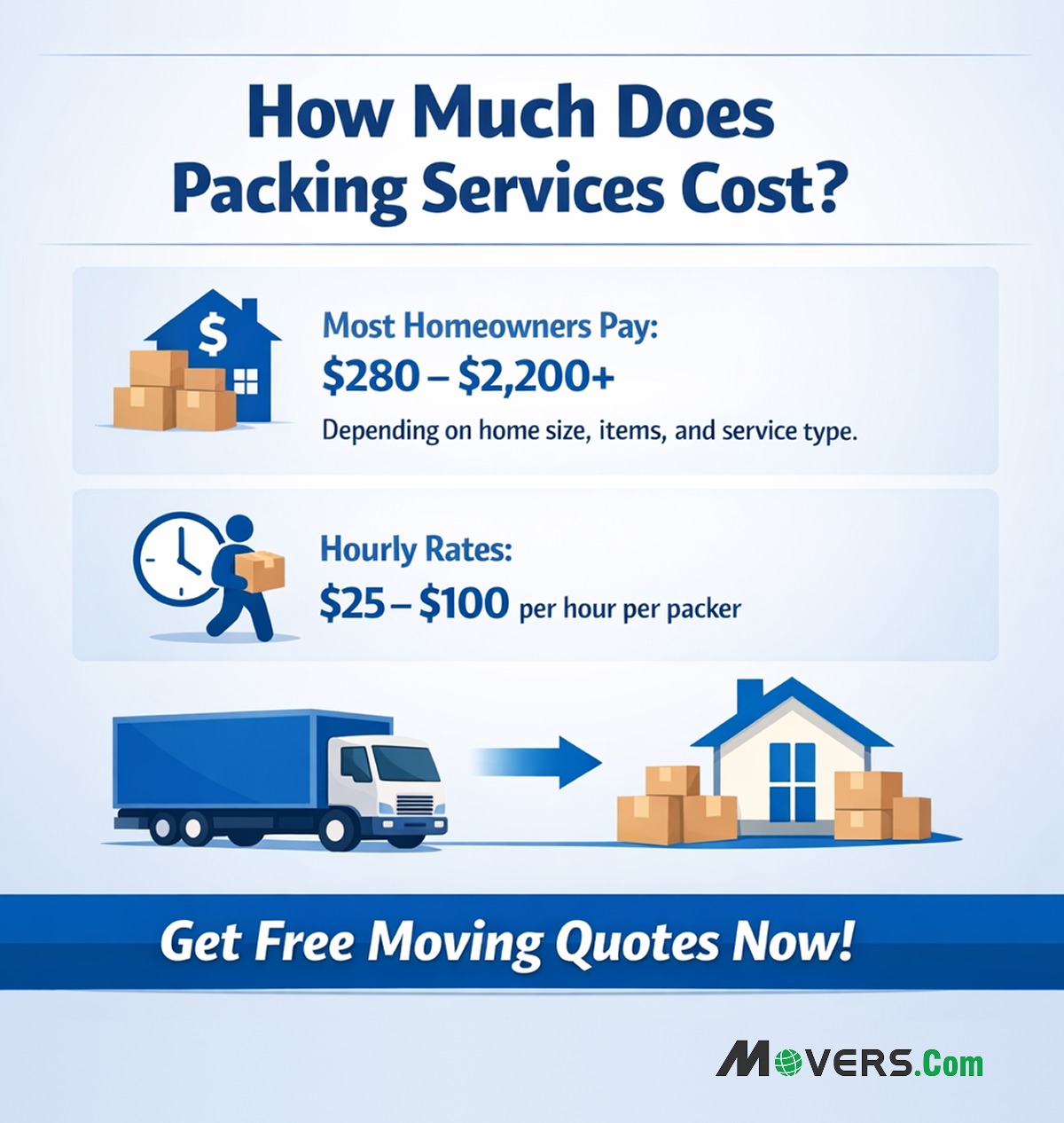
That’s where a professional packing service can make a real difference. You’re not just paying someone to put things in boxes. You’re paying for speed, organization, protection, and a smoother move overall. Packing help typically costs $25 to $100 per hour, depending on the company, your home, and what you’re packing.
This guide is here to help you plan your job properly. You’ll see what packing services cost, what drives the price up, what’s included, what’s not, and how to decide whether full packing, partial packing, or DIY makes the most sense for your move.
What You Will Learn in This Guide
- A realistic sense of what packing services cost
- A clear breakdown of hourly vs flat-rate pricing
- A practical look at what’s included and what isn’t
- Smart ways to keep your costs under control
- Guidance on when hiring professional packers is worth the cost
If you want to book packing help the smart way, this is what you need to know first.
Quick Answer: How Much Does a Professional Packing Service Cost?
Most people pay somewhere between $280 and $2,200 for professional packing services, depending on how much you need packed, whether you’re paying hourly or flat-rate, and whether packing materials are included.
That range isn’t one-size-fits-all. Packing a one-bedroom apartment is a very different job from packing a fully furnished three-bedroom home with a packed kitchen, fragile decor, storage closets, and garage items.
Here’s a simple way to think about it:
| Type of Packing Job |
Typical Cost Range |
| Small partial packing job |
$200 to $500 |
| 1-bedroom home |
$300 to $900 |
| 2-bedroom home |
$600 to $1,500 |
| 3-bedroom home |
$1,200 to $2,500 |
| Full-service home packing |
roughly $280 to $2,200+ |
These are planning ranges, not guaranteed quotes, but they give you a useful starting point.
The key thing to understand is this: your real cost depends less on the label of your home and more on how many items you have and how hard it is to pack well. If your move is simple, your price can stay on the lower end. If your home is full of fragile or time-consuming items, the price will be higher.
Want a Rough Estimate? Use This Simple Formula
Before you start requesting quotes, it helps to get a rough estimate so you know what kind of numbers make sense.
A simple formula looks like this:
Estimated packing cost = (Hourly rate × Number of packers × Hours worked) + Packing materials + Travel/trip fee + Specialty packing charges
Here’s a practical planning table you can use:
| Home Size |
Typical Crew |
Estimated Time |
Rough Planning Range |
| Studio or 1-bedroom |
2 packers |
2 to 4 hours |
$300 to $900 |
| 2-bedroom |
2 to 3 packers |
3 to 5 hours |
$600 to $1,500 |
| 3-bedroom |
3 to 4 packers |
6 to 8 hours |
$1,200 to $2,500 |
| 4+ bedroom |
4+ packers |
8 to 12+ hours |
$2,000 to $5,000+ |
These numbers work best as a budgeting tool, not a promise.
These estimates cover professional packing services. If you also hire the company to load, transport, and unload your belongings, your total moving and packing cost will be higher and should be quoted separately.
What matters most here is not just square footage. It’s volume. If your closets are full, your kitchen is packed, your garage is busy, or you have a lot of fragile or awkward items, your time and cost will go up. A tidy two-bedroom can sometimes pack faster than a cluttered one-bedroom.
So, when you estimate your packing cost, think less in terms of “How many bedrooms?” and more in terms of “How much do I actually need them to touch?”
How Movers Charge for Packing by the Hour
Hourly packing is common for local jobs and partial packing requests because it is easy for movers to scale. Need the kitchen and breakables done by pros, but not your clothes and books? Hourly billing fits that kind of job well. It is also common when the company does not want to lock into a fixed number until it sees how much there really is to pack.
The advantage of hourly packing is flexibility. The downside is uncertainty. The longer the crew takes, the more you pay. That means customers should be encouraged to ask a few simple but important questions:
- Is the rate per packer or per crew?
- Is there a minimum number of hours?
- Does the clock start at the warehouse, at the arrival time, or only when packing begins?
- Are materials included or billed separately?
- Are there additional charges for stairs, long carriages, elevators, or bulky rooms like garages and basements?
Hourly packing works best when the job is limited, organized, or easy to define. It is often the right fit for one-bedroom apartments, last-minute help, kitchen-only packing, or fragile-item-only jobs. It is less comfortable for customers who want full cost certainty.
How Flat-Rate Packing Services Work
Flat-rate packing sounds simpler because it gives customers a single number instead of an open-ended clock. Packers usually arrive at a flat price after an in-home or virtual walkthrough, during which they estimate the labor, number of cartons, material cost, and any unusual handling requirements.
The biggest benefit of flat-rate packing is predictability. If you are already juggling move-out dates, cleaning, utility transfers, and travel plans, you need cost certainty so you can plan your moving budget more easily. That is also where binding versus non-binding estimate language becomes important. Under FMCSA rules, a binding estimate means the price is guaranteed for the services and quantities listed, while a non-binding estimate is only an approximation, and the final bill can differ, subject to federal rules such as the 110% collection rule at delivery for non-binding estimates. These federal estimate rules generally apply when packing is included as part of an interstate household-goods move. Standalone packing services may follow different pricing and contract terms.
Instead of simply asking, "Is this a flat rate?", ask:
- Is it a binding estimate?
- Exactly what rooms and services are included?
- Are materials included?
- What changes the price?
- What happens if I add items after the estimate?
Before confirming a flat-rate packing service, walk through your home and make sure everything that needs packing is included in the estimate, including closets, storage areas, and fragile items. The clearer the scope of the job, the more reliable your flat-rate quote will be, and the easier it will be to compare movers and choose the right packing service.
What You Get with Professional Packing Services
Professional packing services may include: disassembling furniture, properly wrapping items, securing them with protective materials, taking pictures and art off the walls, rolling carpets, and labeling and sorting boxes by room. Packing plans can be customized, from partial packing to full packing to unpacking.
A proper packing job includes:
- room-by-room packing strategy
- fragile-item wrapping
- carton labeling
- cushioning and void fill
- dish packs and wardrobe cartons where needed
- furniture prep or limited disassembly
- inventory support for transport
- optional unpacking
Packing services are often offered as basic packing or full packing. Basic packing involves labor and standard supplies for simpler items, while full packing can extend to disassembling, wrapping, and packing everything in the home.
If a quote looks cheap, it may not be because the mover is cheaper. It may be because the scope is smaller. Customers should compare what is included, not just the number at the bottom.
What Movers Usually Will Not Pack
Professional packers typically avoid items that pose safety risks or legal restrictions.
Movers Won't Pack These Items
- Cash, jewelry, and valuables
- Passports, IDs, and legal documents
- Medications and essential medical equipment
- Perishable food from refrigerators or freezers
- Live plants in many cases
- Gasoline, propane, or lighter fluid
- Paint, solvents, and flammable chemicals
- Aerosols and certain cleaning chemicals
- Fireworks or explosives
- Firearms and ammunition, depending on company policy
Before the packing crew arrives, set up a clear “do-not-pack” area in one room, closet, or corner of the home. Put everything there that should stay with you so the packers know exactly what to leave untouched. This small step helps the packing process move faster and prevents important items from being packed by mistake.
How Much Do Packing Supplies Cost?
Packing materials can cost around $180 for a one-bedroom home and up to $750 for a three-bedroom home, including boxes, bubble wrap, tape, and packing blankets. The cost of these supplies typically ranges from $1 to $8 per box, about $12.50 per roll of packing paper, $0.10 to $0.25 per foot of bubble wrap, $3 to $7 per roll of tape, and $10 to $20 per packing blanket.
| Supply |
Typical Cost |
| Standard boxes |
$1 to $8 each |
| Packing paper |
about $12.50 per roll |
| Bubble wrap |
about $0.10 to $0.25 per foot |
| Tape |
$3 to $7 per roll |
| Packing blankets |
$10 to $20 each |
Professionals bring the right materials for the item. Dish packs, wardrobe cartons, mirror cartons, TV boxes, custom crating, paper pads, stretch wrap, and proper cushioning can mean fewer damaged items and less wasted time. Supply costs vary by company and location. Specialty boxes, wrapping supplies, and custom packing materials may cost extra.
Tip: When comparing quotes, do not just ask “Are materials included?” Ask which materials are included and whether fragile-item protection, specialty cartons, and crating are extra.
 How Much Do Movers and Packers Cost Together?
Hiring movers and packers together usually costs more than booking packing labor alone because the total may include packing materials, packing labor, loading, transportation, unloading, and other moving services.
The final price depends on:
- Home size and number of belongings
- Distance of the move
- Packing service selected
- Crew size and labor time
- Packing materials
- Stairs, elevators, and access conditions
- Specialty or fragile items
Ask each company to separate the packing cost from the moving cost in its written estimate. This makes it easier to compare quotes and understand what you are paying for.
Factors That Affect Packing Service Costs
If you’re trying to understand why one packing quote looks very different from another, it usually comes down to the actual workload inside your home. Movers look at the amount of work involved, how long it will take their crew, and what materials will be needed to pack everything safely.
In simple terms, the more time, care, and materials required to pack your belongings, the higher the total cost will be.
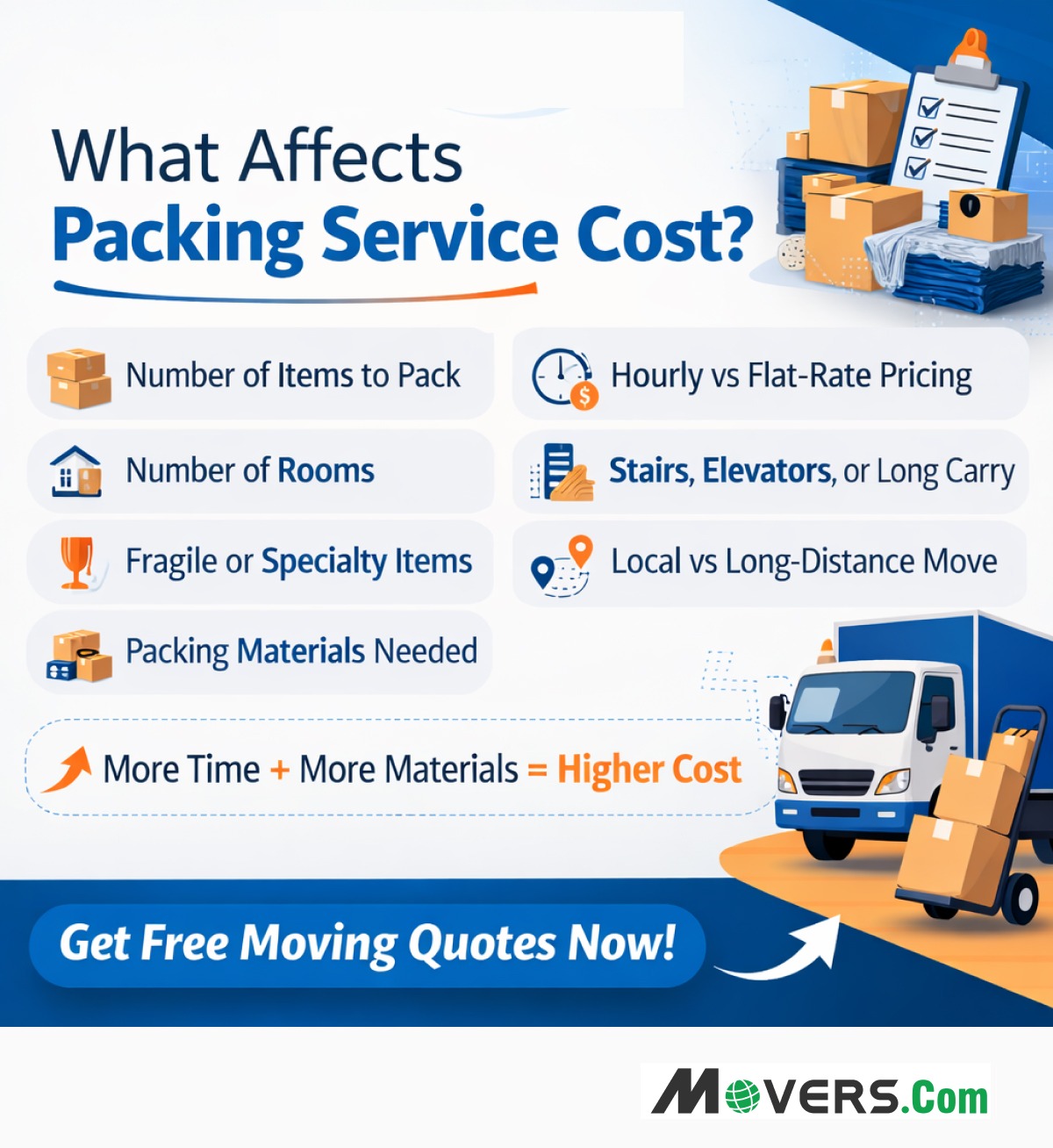
The biggest factors that influence your packing service cost include:
- How many belongings need packing
- Number of rooms involved
- Fragile or specialty items
- Whether the quote is hourly or flat rate
- Whether materials are included
- Whether the move is local or long-distance
- Season and scheduling
- Access issues like stairs, elevators, parking, or long carry
The type of items being packed also affects labor time. Clothes, linens, and books are usually faster to pack than kitchens, garages, artwork, electronics, or fragile décor. Kitchens, décor-heavy living rooms, home offices, garages, and homes with art, glass, collectibles, or children's gear usually take longer to pack, increasing both labor time and material costs.
Another overlooked cost factor is decision delay. If you do not declutter, set aside restricted items, or make clear what is being packed, the crew loses time waiting, asking, and repacking. That is not always listed as a fee, but it shows up on the clock.
Simple Ways to Reduce Packing Service Costs
The simplest savings move is partial packing. United Van Lines offers customizable packing plans from partial to full packing, and many movers structure services this way. That means a customer can save money by packing easy, low-risk categories personally and hiring pros for the rooms and items that most often go wrong.
The smart split
| Pack yourself |
Let professionals handle |
| Clothes |
Kitchen dishes and glassware
|
| Linens and towels |
Framed art and mirrors
|
| Books |
TVs and electronics
|
| Toys |
Breakables
|
| Non-breakable decor |
Antiques
|
| Pantry items being discarded |
Expensive, sentimental, or awkward items
|
That kind of split keeps labor focused on the highest-risk, highest-skill work.
Other ways to reduce packing costs include:
- declutter before the estimate
- book early enough to compare quotes
- ask if materials can be customer-supplied
- ask about minimum hours
- ask for a room-by-room scope instead of “pack everything”
- get at least three written quotes so you can compare pricing, services, and included materials
In the end, the goal isn’t to avoid professional packing altogether. It’s to use it where it makes the biggest difference. Letting professionals handle the fragile, complicated, or time-consuming parts of your home while you take care of the simpler items keeps the move efficient and affordable.
When you approach packing this way, you’re not just cutting costs, you’re spending your moving budget more wisely. The result is a smoother packing process, fewer damaged items, and a move that stays on schedule without turning the entire job into extra work for you.
Travel and Fuel Fees Movers May Charge
You may think packing is just labor plus boxes. In reality, local service quotes frequently include or exclude travel fees, trip charges, or fuel surcharges depending on the company.
Ask your provider these questions:
- Is travel time billed?
- Is there a separate trip fee?
- Is fuel included?
- Is there a warehouse-to-home charge?
- Are parking difficulties or long carry extra?
Asking about travel time, trip fees, fuel charges, parking, and long-carry fees in advance can help you avoid unexpected costs.
The Pros and Cons of Hiring Professional Packers
Pros
- The job gets done much faster than DIY packing. What can take customers days or weeks may take pros a few hours to a day, depending on home size and volume.
- Fragile items are usually better protected with professional materials and methods.
- Reduces physical and mental load during an already demanding move.
- It is easier to keep a move on schedule when packing is not dragging behind.
Cons
- It adds cost to an already expensive move.
- Some customers feel less in control if others are handling personal belongings.
- Quotes can be hard to compare if the service scope is not clear.
- Restricted items still need personal handling.
Packing services are not automatically worth it. They become worth it when the value of time, speed, protection, and reduced stress exceeds the added cost.
Should You Hire Packers or Pack Yourself?
DIY packing is usually the better fit for smaller, simpler moves, flexible timelines, tight budgets, and people who are organized enough to start early. Hiring professional packers makes more sense when the home is larger, the schedule is tight, the items are fragile or high-value, or the customer simply does not want the move to consume every spare evening for the next two weeks. That logic is consistent across cost guides and mover service pages.
| Situation |
Best Option |
| Small apartment, flexible timeline, light belongings |
DIY or partial packing |
| Family home, tight schedule, lots of breakables |
Professional packing |
| Moving elderly parents or managing a long-distance move |
Professional packing |
| You only need kitchen, art, and fragile items done right |
Partial packing |
Always hire pros and match the service to the move.
Common Mistakes When Booking Packing Services
When you’re booking packing services, it’s easy to focus only on the price or the availability of the mover. But small oversights during the booking stage can lead to higher costs, confusion about what’s included, or a packing job that doesn’t go as smoothly as you expected. Knowing where people usually go wrong can help you avoid those problems and book the service with more confidence.
1) Comparing prices without comparing scope
A cheap quote may exclude materials, fragile-item handling, or key rooms. Customers should compare exactly what is being packed and what supplies are included.
2) Not asking what kind of estimate it is
Binding and non-binding estimates work very differently. Customers should know which one they are accepting.
3) Decluttering after the estimate
If the home looks fuller on packing day than it did during the estimate, pricing and timing can change.
4) Forgetting restricted items
Hazardous, perishable, and personal valuables need a separate plan.
5) Booking too late
Last-minute booking reduces choice and makes it harder to compare services calmly.
6) Assuming all movers pack the same way
Some are stronger on local labor, some on full-service, some on specialty items, and some on long-distance coordination. Independent reviews repeatedly rank movers differently based on those strengths.
If you keep these points in mind before you book, you’ll have a much clearer idea of what you’re paying for and how the packing service will actually work on moving day. Taking a few extra minutes to ask the right questions and compare details, not just prices, can help you choose the right packing service and avoid surprises later.
When Specialty Packing is Needed
Specialty packing is where generic advice breaks down fast. A dish pack is not the same as custom crating. A standard crew is not the same as a team trained for museum pieces, pianos, or antiques.
Consider specialty packing if you are moving:
- pianos
- antiques
- fine art
- large mirrors
- chandeliers
- wine collections
- oversized electronics
- collectibles
- anything irreplaceable
Specialty packing is not just “extra care.” It is often different materials, different labor, different liability, and sometimes different trucks or climate-control needs. Specialized handling and custom crating can add substantially to standard moving costs.
Professional Packing and Moving Companies in the United States
If you start researching packing services, you will quickly come across several well-known moving companies that offer professional packing as part of their services. These companies operate across the United States and are widely recognized in the moving industry for handling local moves, long-distance relocations, and full-service packing and moving jobs. While they may differ in pricing, service coverage, and specialization, they are among the names you will most commonly see when comparing packing and moving providers.
- American Van Lines
- Allied Van Lines
- Atlas Van Lines
- JK Moving Services
- North American Van Lines
- United Van Lines
- Two Men and a Truck
- International Van Lines
- Bellhop
- Solomon & Sons Relocation Services
Big name does not automatically mean best fit. Some companies are better for long-distance coordination, some for specialized items, some for availability, some for pricing transparency, and some operate through agent networks where service can vary by location. That is exactly why comparison matters.
How to Find Affordable Professional Packing Services
The cheapest quote is not always the best value. A low estimate may exclude packing materials, specialty boxes, travel fees, or fragile-item handling.
To find an affordable service:
- Request at least three written quotes
- Compare the same packing scope
- Ask whether materials are included
- Consider partial packing instead of full packing
- Pack simple items yourself
- Book early to avoid limited availability
- Ask about minimum hours and travel fees
How to Find Reliable Packing Services
When you’re ready to hire packing help, the goal isn’t just to find a company quickly. You want a service that understands your move, prices the job clearly, and handles your belongings with care. Taking a few minutes to check the right details before you book can help you avoid surprises and choose a packing service that fits your needs.
- Start with companies that clearly offer full packing, partial packing, or specialty packing for the type of move you have.
- Check that the quote spells out labor, materials, travel/trip fees, and estimate type.
- If it is an interstate move, understand your FMCSA estimate protections and insist on written estimates.
- Compare at least three quotes.
Ask specifically about fragile items, exclusions, and what needs to be packed by the customer.
When searching for packers and movers near you, compare local availability, service scope, pricing structure, customer reviews, and licensing before booking. Prices vary by city and company, so request written estimates from several providers serving your ZIP code.
Movers.com helps you compare trusted movers and packing services, understand what's included, and choose the option that best fits your move and budget.
When Hiring Professional Packers Makes the Most Sense
Professional packers are usually worth the cost when the move has one or more of these conditions:
- The home is large or heavily furnished
- The timeline is tight
- The move is long-distance
- There are fragile, high-value, or awkward items
- The customer is juggling work, kids, travel, or multiple properties
- The cost of doing it wrong is higher than the packing bill
It is about speed, protection, efficiency, and reducing the operational burden on the customer.
Professional packers are most useful for large homes, tight schedules, long-distance moves, and belongings that require extra protection. For smaller or simpler moves, partial packing can provide professional help where it matters most without paying for a full-service package.
Editor's Note
Our comparison reviewed by our Moving Industry Analyst team is based on publicly available pricing, customer reviews, and regular moving scenarios.
Get expert moving tips and compare movers for free at Movers.com. You can get free moving quotes from licensed and insured movers, compare moving companies near you, and plan your move with confidence using our step-by-step moving guides and checklists.
Whether you’re planning a local move, a long-distance relocation, or need help with packing and loading, Movers.com connects you with trusted moving professionals and practical tools to make moving easier and more affordable.
Questions? Talk to our moving specialists.