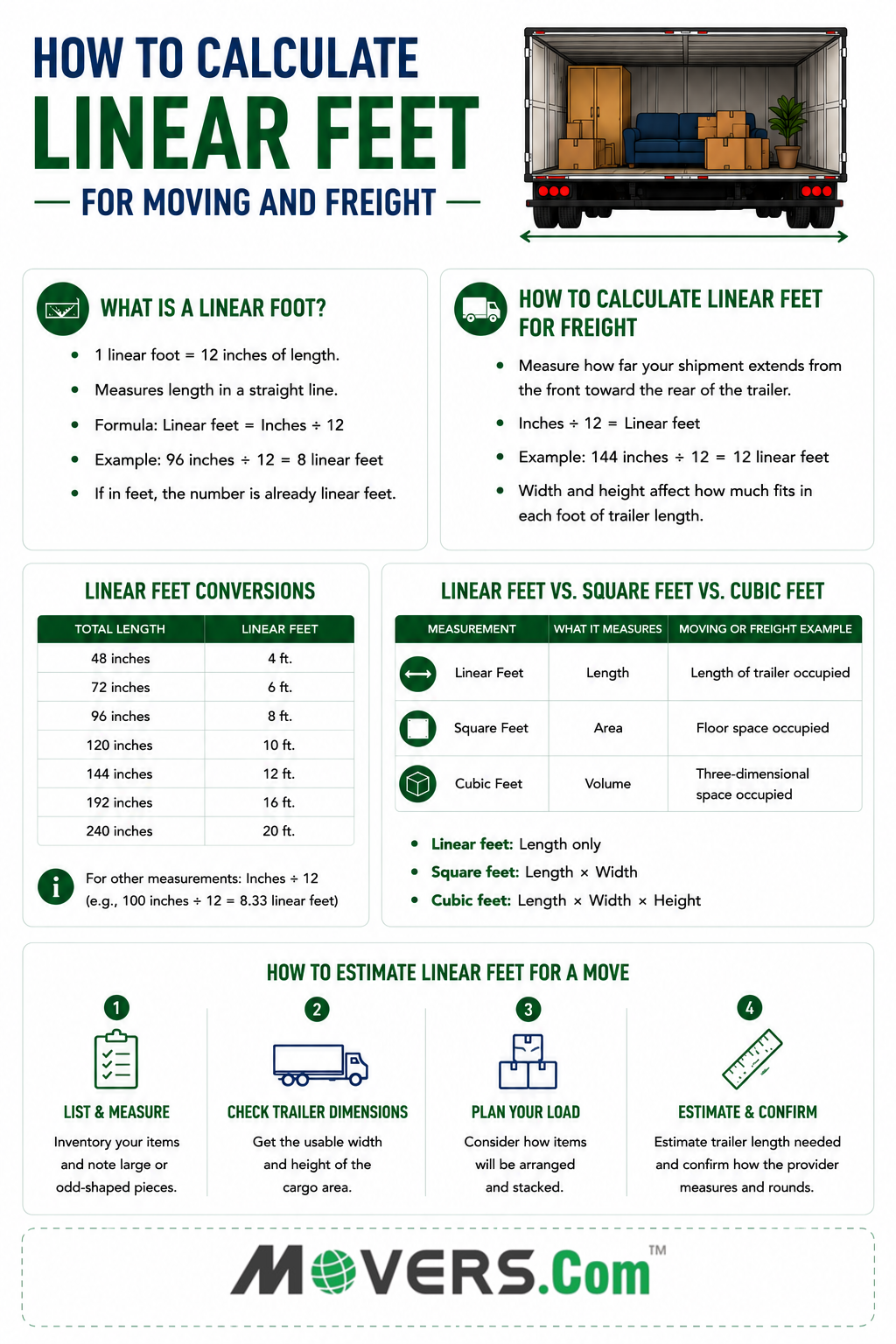
A linear foot is a measurement of length equal to 12 inches. To calculate linear feet, measure the total length an item or shipment occupies and convert that measurement to feet.
For moving and freight trailers, linear footage generally describes how much trailer length a loaded shipment occupies. For example, if your belongings extend 8 feet from the front toward the rear of a trailer, they occupy approximately 8 linear feet of trailer space.
Linear feet is different from square feet, which measures area, and cubic feet, which measures volume.
What Is a Linear Foot?
One linear foot equals 12 inches of length.
The word "linear" means the measurement is taken in a straight line. A linear foot measures length only; it doesn't measure width, height, area, or volume by itself.
If an object is 6 feet long, it is also 6 linear feet long.
If your measurement is in inches, use this formula:
Linear feet = Total length in inches ÷ 12
For example:
96 inches ÷ 12 = 8 linear feet
If the measurement is already in feet, no conversion is necessary. A length of 10 feet equals 10 linear feet.
How to Calculate Linear Feet for Freight
For moving and freight trailers, linear footage generally describes how much length of the trailer your loaded shipment occupies.
To calculate it, measure how far the shipment extends from the front toward the rear of the trailer.
If the measurement is in inches:
Trailer length occupied in inches ÷ 12 = Linear feet
For example, if freight occupies 144 inches of trailer length:
144 ÷ 12 = 12 linear feet
The number of boxes, pallets, or individual items doesn't directly determine the linear footage. What matters is how much trailer length the loaded shipment occupies.
The trailer's width and usable height still matter because they affect how much cargo can fit within each foot of trailer length. Furniture dimensions, stacking limitations, and loading configuration can therefore affect the amount of linear space a shipment uses.
Linear footage alone doesn't describe the shipment's total volume or necessarily determine its final freight charge. Measurement and pricing methods vary by provider.
Linear Feet Calculator Examples
Use this table for quick conversions:
| Total Length |
Linear Feet |
| 48 inches |
4 ft. |
| 72 inches |
6 ft. |
| 96 inches |
8 ft. |
| 120 inches |
10 ft. |
| 144 inches |
12 ft. |
| 192 inches |
16 ft. |
| 240 inches |
20 ft. |
For measurements that aren't exact multiples of 12, divide the total number of inches by 12.
For example:
100 inches ÷ 12 = approximately 8.33 linear feet
Before using this number to estimate your moving or freight cost, check how the provider measures or rounds partial linear feet.
Freight Linear Feet Example
Suppose your belongings are loaded across the usable width of a trailer and extend 8 feet from the front toward the rear.
The shipment occupies approximately:
8 linear feet of trailer space
If another shipment extends 12 feet along the trailer, it occupies approximately:
12 linear feet
Two shipments with the same number of items can use different amounts of linear footage because furniture, boxes, pallets, and other cargo vary in size and may not stack the same way.
For moving purposes, the most useful measurement is generally the amount of trailer length the shipment actually occupies after loading.
Linear Feet vs. Square Feet vs. Cubic Feet
Linear feet, square feet, and cubic feet measure different dimensions and shouldn't be used interchangeably.
| Measurement |
What It Measures |
Moving or Freight Example |
| Linear feet |
Length |
Length of trailer occupied |
| Square feet |
Area |
Floor space occupied |
| Cubic feet |
Volume |
Three-dimensional space occupied |
Linear feet measures length only.
Square feet measures area:
Length × Width = Square feet
Cubic feet measures volume:
Length × Width × Height = Cubic feet
Because these measurements describe different dimensions, one linear foot doesn't equal a fixed number of square feet or cubic feet.
Can You Convert Cubic Feet to Linear Feet?
You can't accurately convert cubic feet to linear feet without knowing the width and height of the space or shipment.
Cubic feet measures volume:
Cubic feet = Length × Width × Height
If cubic footage, width, and height are known, you can calculate a corresponding length:
Length = Cubic feet ÷ (Width × Height)
For example, if a shipment has a volume of 240 cubic feet and is arranged within a space 8 feet wide and 5 feet high:
240 ÷ (8 × 5) = 6 feet
In this simplified example, the volume would extend 6 feet in length.
However, household belongings rarely fill a trailer as a perfect rectangular block. Furniture shapes, gaps, fragile items, and stacking limitations affect how efficiently the available space can be used.
For that reason, two shipments with the same cubic footage can occupy different amounts of linear trailer space.
What Does 286 Cubic Feet Look Like When Moving?
286 cubic feet is a measurement of volume, not a specific number of boxes, rooms, or linear feet.
For perspective, 286 cubic feet is roughly the volume of a rectangular space measuring:
8 feet long × 6 feet wide × 6 feet high = 288 cubic feet
This gives you a general idea of the amount of space, but it doesn't mean 286 cubic feet of household belongings will fit perfectly into those dimensions.
Furniture, boxes, fragile items, and irregularly shaped belongings create gaps and affect how efficiently a moving trailer can be loaded.
For this reason, 286 cubic feet can't be reliably converted into a specific number of linear feet without additional dimensions and information about how the shipment will be loaded.
Why Do Some Moving Companies Use Linear Feet?
Some moving and freight services use linear footage to measure how much trailer length a shipment occupies.
With this type of service, your belongings may share trailer capacity with other shipments, and the amount of trailer space you use can affect your cost.
However, not every moving company prices moves by linear foot. Depending on the type of move and service, pricing may instead consider:
- Shipment weight.
- Cubic footage.
- Hourly labor.
- Container size.
- Distance.
- Additional services.
If a moving or freight provider uses linear footage for pricing, ask how it measures the space, whether a minimum applies, and how partial linear feet are handled.
How to Estimate Linear Feet for a Move
If your moving service allocates trailer space by linear foot, you can make a rough estimate before moving day.
Step 1: List and Measure Your Belongings
Create an inventory of the furniture, boxes, appliances, and other belongings you're moving.
Pay particular attention to large or unusually shaped items because they can affect how efficiently the trailer is loaded.
Step 2: Check the Trailer Dimensions
Ask the provider for the usable dimensions of the cargo area when available.
Trailer width and usable height affect how belongings can be arranged and how much trailer length they ultimately occupy.
Step 3: Estimate How the Shipment Can Be Loaded
Consider how your boxes and furniture can realistically be arranged.
Not every item can be stacked to the full height of a trailer. Fragile furniture, irregular shapes, heavy items, and other limitations can create unused space.
Step 4: Estimate the Trailer Length and Confirm With the Provider
Estimate how far the loaded shipment will extend along the trailer.
For example, if your belongings are expected to extend approximately 9 feet from the front toward the rear of the available cargo area, they would use roughly 9 linear feet.
Treat this as an estimate. Ask the provider:
- How is linear footage measured?
- How are partial feet handled?
- Is there a minimum amount of space?
- What happens if the shipment uses more or less space than estimated?
The provider's measurement and pricing method should be used to determine the actual charge.
Bottom Line
A linear foot equals 12 inches of length. For moving and freight, linear footage commonly describes how much trailer length a shipment occupies.
To calculate linear feet from inches:
Linear feet = Total length in inches ÷ 12
Don't confuse linear feet with cubic feet. Linear feet measures length, while cubic feet measures three-dimensional volume. You can't reliably convert between them without additional dimensions, and actual trailer usage depends on how belongings are loaded.
If your moving or freight provider uses linear footage for pricing, confirm how trailer space is measured before estimating your cost.
Editor's Note
Our comparison reviewed by our Moving Industry Analyst team is based on publicly available pricing, customer reviews, and regular moving scenarios.
Moving and freight providers may measure trailer space differently. Confirm how linear footage, minimums, and partial feet are handled before estimating your shipment.
Get expert moving tips and compare movers for free at Movers.com.
You can get free moving quotes from licensed and insured movers, compare moving companies near you, and plan your move with confidence using our step-by-step moving guides and checklists.
Whether you're planning a local move, a long-distance relocation, or need help with packing and loading, Movers.com connects you with trusted moving professionals and practical tools to make moving easier and more affordable.
Questions? Talk to our moving specialists.