Finding the right moving insurance sometimes can be overwhelming, because it's tough to figure out the right value of your belongings.
When moving, most people tends to be unsure of what type of insurance to purchase.
In such scenario how can you ensure the insurance coverage you choose will adequately cover valuables?
Picking the right insurance coverage for your move requires careful consideration, and it's important to correctly estimate the value of your belongings.
This guide will help you to break down the process of determining how much your belongings worth.
So that you will be able to pick the right insurance for your move.
Determine the Value of Your Goods Before You Pack to Move
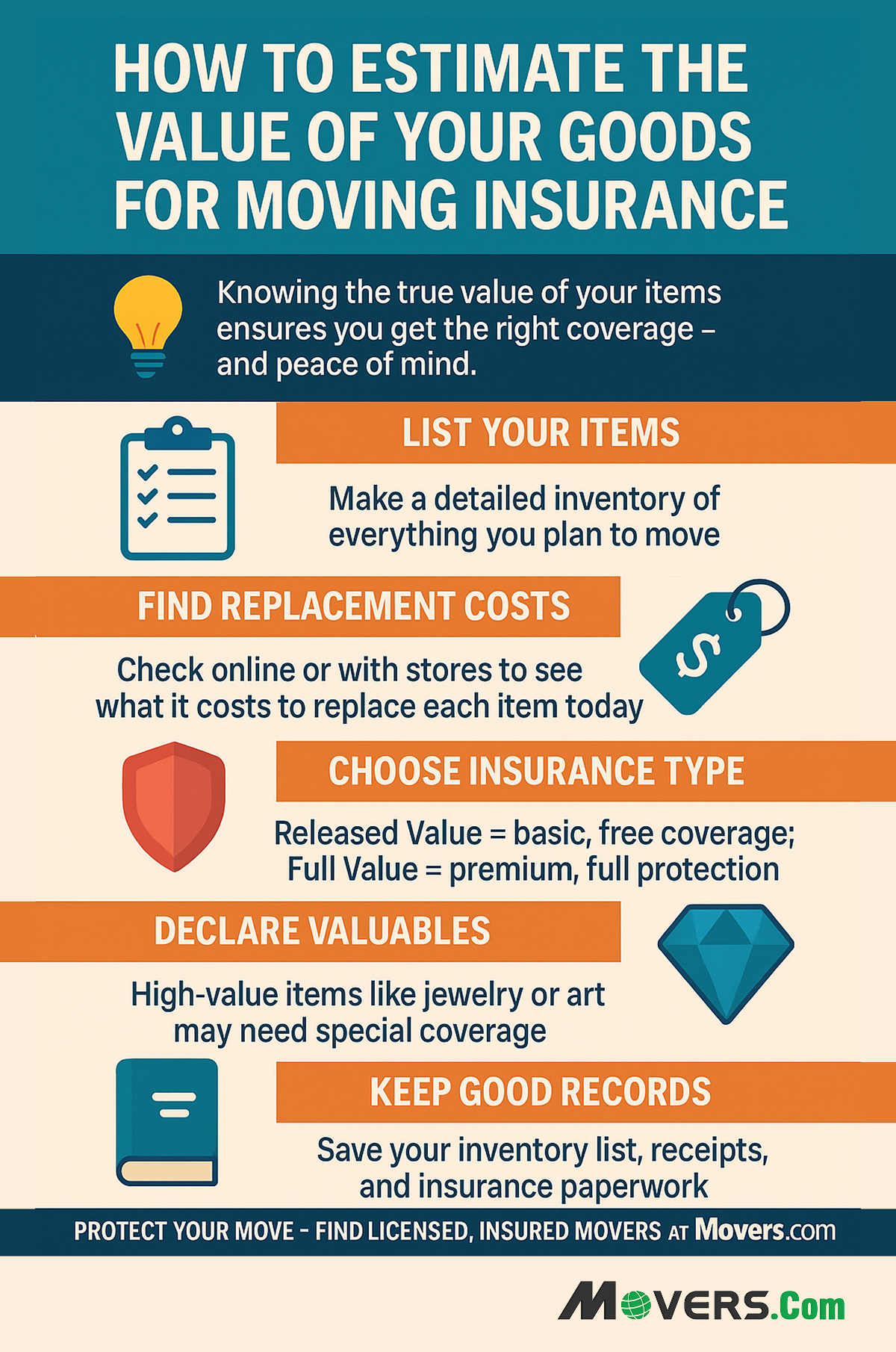
If you're having trouble figuring out what is the value of a certain item, there are several methods you can use:
-
Estimate the value of electronics, clothing, and furniture by finding similar products online and accounting for condition.
-
Jewelry can be appraised either online or through a local jewelry shop.
-
For items like antiques and collectibles, determine the current value by getting the advice of an antique dealer or expert.
As you determine the value of your items, make an inventory of your goods.
TIP: When tackling a comprehensive project such as valuating your belongings, spreadsheets are your best option.
Spreadsheets help you keep things organized and allow you to stay on top of the inventory process.
It helps to divide your inventory into three distinct categories:
-
Current replacement value of the item.
-
Original cost of the item.
-
Your best estimate for how much the item is worth in its current state.
Choose the Proper Type of Moving Insurance
Before choosing the level of coverage, it's important to be familiar with the different insurance plans offered by moving companies.
There are usually four main types of moving insurance, but your options can vary depending on your moving company.
Basic carrier liability
Basic carrier liability is the lowest coverage you can purchase.
All licensed movers will have basic carrier liability built into their standard moving fee; it is the minimal amount of liability that must be provided to you free of charge by law when transporting your items.
Basic carrier liability is known as the released value, and is limited to $0.60 per pound per article (interstate).
Declared value protection
Declared value protection is based on the depreciated value of that item.
Your entire shipment is given a dollar amount (declared by the customer) with an additional charge of $1.25 times the overall weight.
While you may have to pay a bit more money for this type of coverage, your belongings would be protected.
Full replacement liability
Full replacement liability is the most inclusive type of insurance, and you'll receive full cash value for any belongings that are lost or damaged.
This will be the most expensive option, but it is recommended for those who have many expensive items that need to be moved, and want the most security.
The mover is responsible for the first part of the coverage, which can cost up to $0.60 per pound per article.
Anything above that amount is then covered through the insurance company to meet the replacement cost of your item.
You will be responsible for a deductible amount in the case of loss or damage.
High value items
High value items require their own insurance.
Movers are allowed to limit their liability to articles of high value, so it's recommended to identify all packed items which are considered as such.
You should also tell your moving agent (in writing) that these items are contained in your shipment.
Alternative insurance options
There are also alternatives when insuring your belongings for a move.
You can purchase lump sum insurance (also called assessed value), which is similar to declared value protection.
Instead of setting a per-pound amount, you set it by value.
This would be a good choice for people moving lots of high-value but light items.
Conclusion
To choose the right moving insurance and protect what's most important, you need to know how much your belongings worth.
You can choose the right level of protection for your move with confidence if you make a detailed list of items, look up their current values, and have a clear perspective about your coverage options.
movers.com can help you move with confidence and peace of mind by giving you more expert advice and letting you compare free quotes from reliable movers.