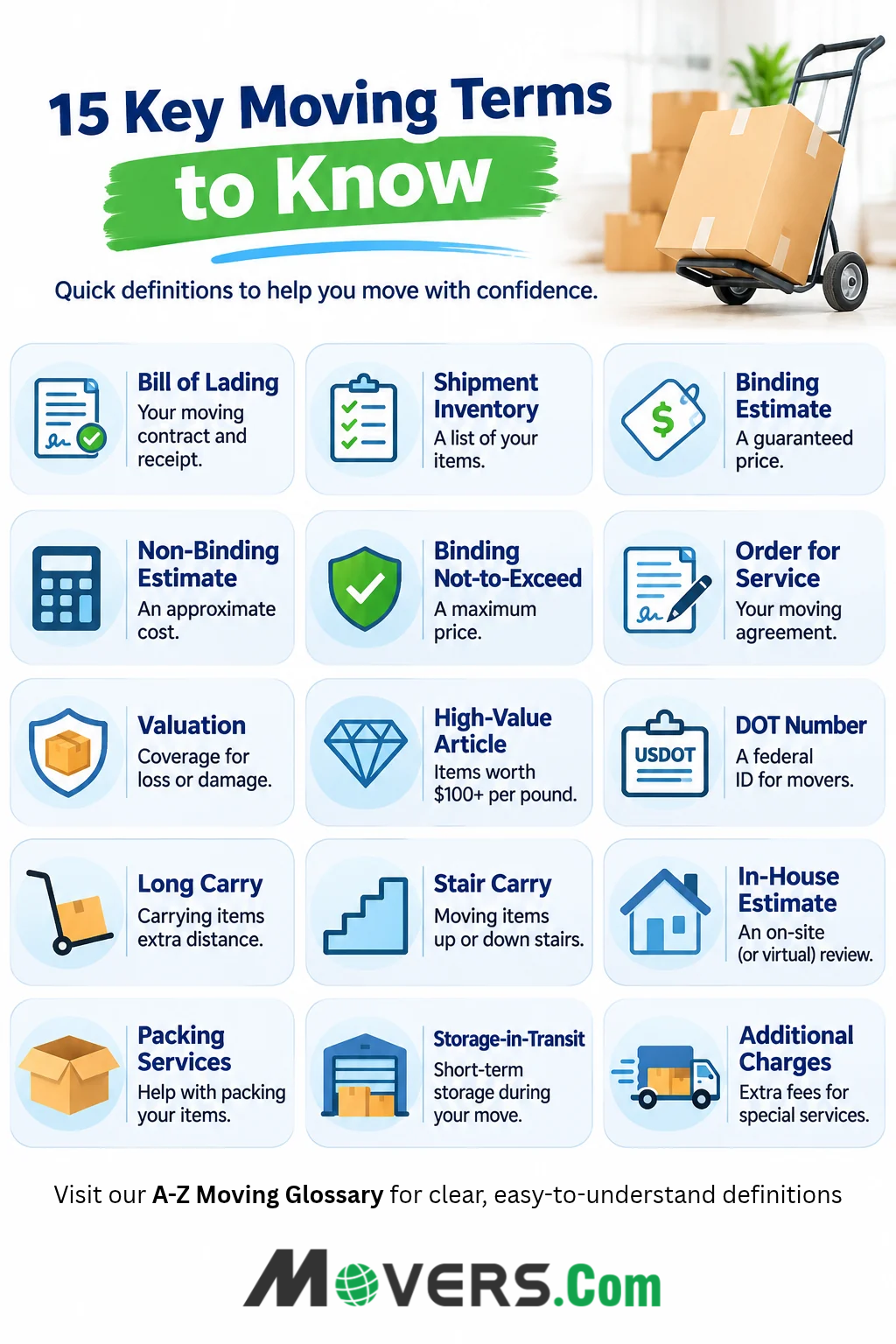
When hiring a moving company, you'll come across terms that aren't always easy to understand. What's the difference between a binding and non-binding estimate? What does valuation cover? And why might movers charge extra for stairs or long carries?
Knowing these terms can help you understand your moving estimate, avoid unexpected charges, and make better decisions before signing a contract.
Want to understand more moving terms? We've covered the essentials here, but there's more moving terminology you may come across when planning your move. Visit our complete A-Z Moving Glossary for clear explanations of moving costs, estimates, contracts, packing, storage, and more.
Here are 15 important moving terms worth knowing before your move.
Bill of Lading
The bill of lading is an important legal document that serves as the contract between you and your moving company.
It ensures that your belongings will be picked up, transported, and delivered to your new home under the conditions illustrated in the contract.
It contains all the details of the move and ensures that your goods are being carried legally.
Your moving company's name, address, and phone number should appear on the bill.
Also, your method of payment, proof of purchased insurance, and your shipment's inventory.
Before signing the bill of lading, be sure that everything included is accurate, and there is no damage to your moving items.
Inventory
This is a comprehensive list of items in your shipment and their pre-move conditions.
Upon delivery, you will be expected to sign for your items after ensuring everything has arrived intact and without damage.
Before signing the document, be sure to thoroughly inspect your goods and make note of any damages on the inventory sheet.
Failing to do so might create complications filing a claim later when you discover items are damaged or misplaced.
Binding Estimate
A binding estimate is a written agreement that guarantees the price of your move based on the items and services listed in the estimate.
For an interstate move, the moving company generally cannot charge more than the agreed amount for the services covered by that estimate.
However, if you add more belongings, request additional services, or change your moving arrangements, the price may change.
What to check: Make sure everything you're moving is included in the inventory and confirm which services are covered before signing.
Non-Binding Estimate
A non-binding estimate gives you an approximate moving cost, but it doesn't guarantee the final price.
For interstate moves, the actual cost is generally calculated using your shipment's weight, the mover's rates, and any additional services.
Under federal rules, movers generally cannot require you to pay more than 110% of the non-binding estimate at delivery for the services covered by that estimate. Any remaining balance may be billed later, and different payment rules can apply to additional services.
What to check: Ask how the final cost will be calculated and which charges could increase your bill.
Binding Not-to-Exceed Estimate
A binding not-to-exceed estimate sets a maximum price for the moving services listed in your agreement.
If your shipment weighs less than expected and the agreement allows a lower charge, you pay the reduced amount. If it weighs more, the price generally won't exceed the agreed maximum for the covered services.
Keep in mind that additional belongings or services outside the original agreement may result in extra charges.
What to check: Confirm what the maximum price includes and whether changes to your inventory could affect it.
In-house Estimate
An in-house estimate, also called an in-home estimate, is prepared after a moving company reviews the belongings you plan to move.
A representative may visit your home to assess furniture, boxes, appliances, and other items. Some companies also offer virtual surveys through video calls.
For interstate moves, federal rules generally require a physical survey, conducted in person or virtually, unless you waive that requirement in writing.
What to check: Show the mover everything you plan to transport, including items in closets, garages, basements, and storage areas. Mention any stairs, parking restrictions, or specialty items that could affect the estimate.
DOT Number
A USDOT number is a unique identification number issued by the Federal Motor Carrier Safety Administration (FMCSA).
Moving companies that transport household goods across state lines generally need a USDOT number. You can use it to look up a company's registration details and available safety information.
Before hiring an interstate mover, check its registration and operating authority through the FMCSA's Protect Your Move website.
What to check: Make sure the company's registration details match the business you're hiring. Having a USDOT number doesn't automatically mean a mover is trustworthy.
Rogue Mover
A rogue mover is a term used for moving companies that usually scam their customers by offering bait and switch estimates, holding goods hostage, and other unethical business practices.
You can avoid moving scams by conducting a thorough background check on any potential moving company, asking important questions, verifying their US DOT number on the FMCSA website, reading online reviews, checking if they are accredited by the Better Business Bureau and requesting customer references.
Accessorial Services
Accessorial services are any extra services you may require in your move, such as packing or unpacking services, furniture assembly or disassembly, long carries, stair carries, shuttle service, hoisting services, or the transport of a specialty item such as a piano or pool table.
When you receive your in-house estimate, it’s recommended to be sure and ask detailed questions about the services you may require and the extra charges for them.
Inform the moving company representative of services you believe you may need, and make sure they are aware of the goods that will be transported (for example, if you have a large basement filled with furniture or a backyard shed stuffed with tools, be sure they are surveyed and included in your estimate).
Long Carry
A long carry happens when movers must carry your belongings farther than the distance included in their standard service.
For example, if the moving truck can't park near your apartment building or the entrance to your home, the crew may have to carry furniture and boxes across a parking lot or down a long driveway.
Some moving companies charge an additional fee for this extra distance.
Stair Carry
A stair carry means moving furniture and boxes up or down stairs during loading or unloading.
Depending on the moving company and your agreement, this may involve an additional charge, especially when movers need to handle several flights of stairs.
For example, moving into a third-floor apartment without an elevator may take more time and effort than moving into a ground-floor home.
Auxiliary / Shuttle Service
If you live in a residence with a lack of imminent parking (such as an apartment building) or on street too narrow for your moving truck, you may incur extra charges for a shuttle service.
A smaller, secondary vehicle will be used to shuttle your belongings to the larger moving van, which will be parked at a distance from your home.
Order for Service
An order for service is a document that outlines the moving arrangements you've agreed to with your moving company.
For interstate moves, it includes details such as your pickup and delivery information, requested services, estimated charges, and payment arrangements.
You should receive this document before the movers begin loading your belongings.
What to check: Review the addresses, dates, services, and charges. If something doesn't match what you agreed to, ask the mover to correct it before loading begins.
Valuation
Valuation determines how much responsibility a moving company accepts if your belongings are lost or damaged during a move. It's different from traditional insurance.
For interstate moves, there are two main options:
-
Full-Value Protection: The mover is responsible for repairing, replacing, or providing an appropriate settlement for lost or damaged items, subject to the agreement's terms.
-
Released-Value Protection: The mover's liability is limited to $0.60 per pound per item. For example, if a 20-pound item is damaged, the maximum payment under this option would generally be $12, regardless of what the item originally cost.
Full-Value Protection is the default for interstate moves unless you waive it in writing.
What to check: Understand the protection you're selecting, including the cost, exclusions, and how claims are handled.
High Value Article
A high-value article is an item worth more than $100 per pound. Jewelry, artwork, antiques, collectibles, and certain electronics may fall into this category.
When moving interstate, you should tell your moving company about these items before moving day. You may need to list them separately on a high-value inventory form.
If you don't declare an item of extraordinary value, the mover's liability may be limited if it's lost or damaged.
Claim
If anything is damaged or missing when your shipment arrives, you will have to file a written claim with your moving company.
Before hiring a moving company, you should ask about their claims process.
Usually they will have a form on their website you can either print out or submit digitally.
If your movers do not cooperate or respond to your claim, you can contact organizations such as the FMCSA, BBB, and AMSA to help resolve the matter.
Full Service Movers
If you are looking for a moving company to assist you in every aspect of the move from packing, furniture disassembly, loading truck, transporting shipment, unloading truck, unpacking boxes, and reassembling your furniture, this is known as full-service moving.
While it may cost a little more than simply hiring moving professionals to load boxes into your rental truck, it is an optimal option if you have a large home and a busy schedule.
Conclusion
At movers.com, our experts can help you to begin comparing quotes from full-service movers in your area today, simply fill out our fast and easy quote form!
You'll receive up to seven estimates from reliable full-service movers to aid you in your relocation.