A long-distance moving shipment can take anywhere from several days to a few weeks to arrive, depending on the distance, route, shipment size, moving company's schedule, and whether your belongings share truck space with other customers' shipments.
Your moving documents should specify a delivery date or delivery window. For interstate moves, federal regulations do not give every moving company a single fixed number of days to deliver your belongings. Instead, movers must provide service with reasonable dispatch and follow the agreed pickup and delivery dates or periods, subject to circumstances beyond their control.
How Long Do Moving Companies Take to Deliver?
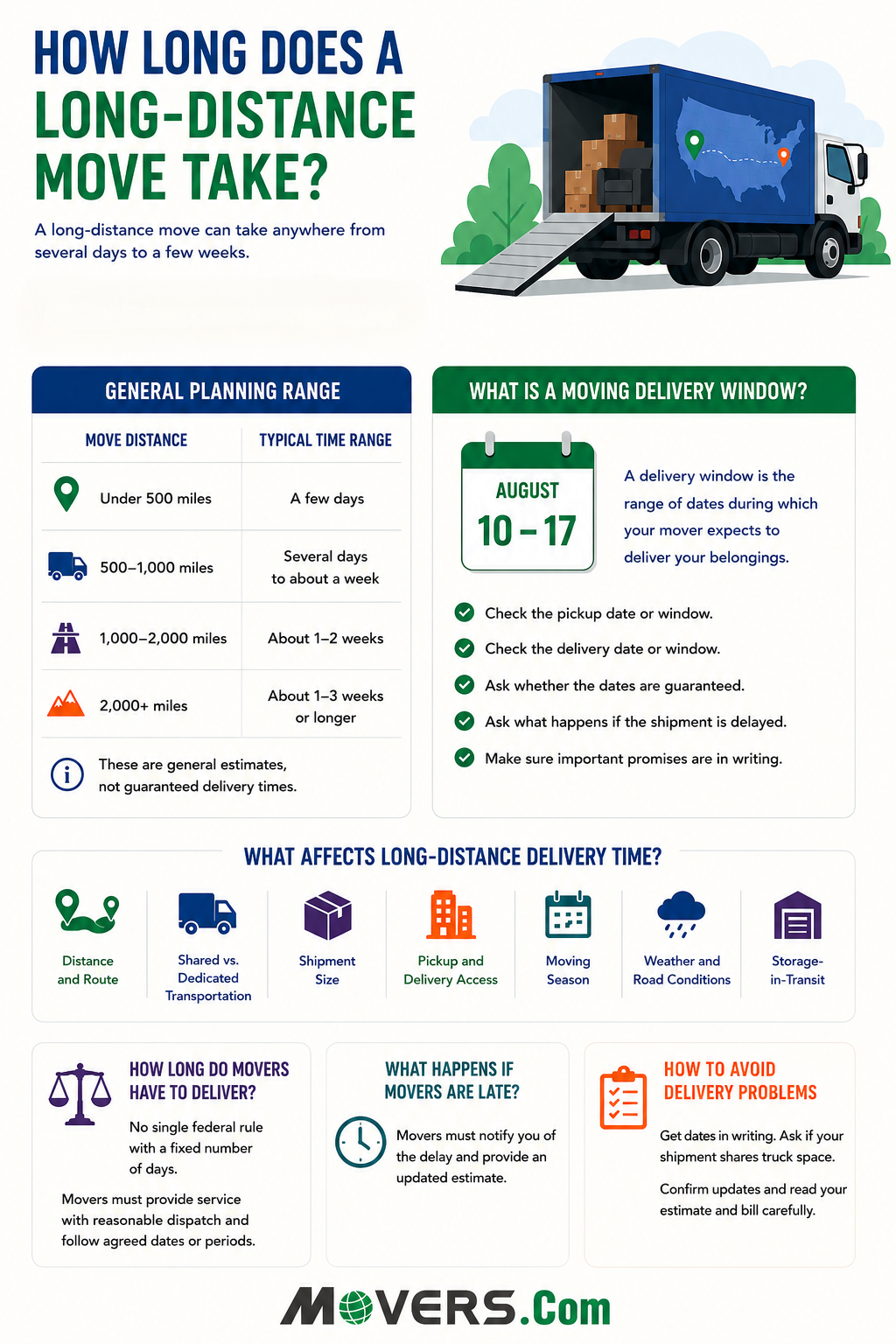
For planning purposes, a long-distance shipment may take anywhere from a few days to several weeks.
| Move Distance |
General Planning Range |
| Under 500 miles |
A few days |
| 500–1,000 miles |
Several days to about a week |
| 1,000–2,000 miles |
About 1–2 weeks |
| 2,000+ miles |
About 1–3 weeks or longer |
These are general estimates, not guaranteed delivery times. Your actual delivery schedule depends on your mover, route, service type, and shipment.
The delivery date or window provided in your moving documents is more important than a general mileage estimate.
If you need your belongings by a specific date, ask whether the mover offers guaranteed, expedited, or dedicated transportation and what additional terms or costs apply.
How Long Does a Moving Company Legally Have to Deliver?
For an interstate household-goods move, there is no single federal rule stating that every moving company has 21 days, 30 days, or another fixed number of days to deliver your shipment.
Instead, federal regulations require interstate movers to provide service with reasonable dispatch.
In practical terms, reasonable dispatch generally means transporting your shipment on the dates or during the period agreed upon and shown in your moving documents. Certain circumstances outside the mover's control may affect this requirement.
Review the delivery dates or window in your bill of lading and other moving documents before your belongings are loaded. Don't rely solely on a verbal promise about when your shipment will arrive.
Note: These federal requirements apply to interstate household-goods moves. Moves entirely within one state may be governed by different state rules.
What Is a Moving Delivery Window?
A delivery window, sometimes called a delivery spread, is the range of dates during which your moving company expects to deliver your belongings.
For example, if your delivery window is August 10–17, your shipment may arrive on any date within that period. August 10 isn't necessarily a guaranteed delivery date unless your agreement specifically says so.
Before signing your moving documents:
- Check the pickup date or pickup window.
- Check the delivery date or delivery window.
- Ask whether the dates are guaranteed.
- Ask what happens if the shipment is delayed.
- Make sure important promises are included in writing.
A clearly defined delivery period gives you a better understanding of when to expect your belongings.
What Affects Long-Distance Moving Delivery Time?
Several factors can affect how long it takes a moving company to deliver your shipment.
Distance and Route
Longer moves generally require more transportation time. Road conditions, route changes, and the number of stops along the way can also affect delivery.
Shared vs. Dedicated Transportation
Many long-distance movers combine shipments from multiple customers traveling along similar routes. The truck may make several pickups and deliveries before reaching your destination.
Dedicated or expedited transportation may provide a faster or more predictable schedule, but it can cost more.
Shipment Size
The size of your shipment can affect how your belongings are assigned to a truck and scheduled for transportation.
Pickup and Delivery Access
Apartments, elevators, narrow streets, limited truck access, long carries, or the need for a smaller shuttle vehicle can add time to pickup or delivery.
Moving Season
Summer and other high-demand periods can affect truck availability and delivery schedules.
Weather and Road Conditions
Severe weather, flooding, snow, accidents, road closures, and other transportation disruptions can cause delays.
Storage-in-Transit
If your belongings require temporary storage before reaching your new home, the overall delivery timeline may be longer.
If timing is especially important, ask your mover whether your shipment will be consolidated and whether dedicated, expedited, or guaranteed delivery options are available.
What Happens If Your Movers Are Late?
If an interstate mover cannot deliver your shipment on the agreed date or within the agreed delivery period, federal regulations require the mover to notify you of the delay at the mover's expense.
The mover should provide information about the delay and when it reasonably expects to deliver your shipment.
If your delivery window passes:
- Contact the moving company.
- Ask why the shipment is delayed.
- Request an updated estimated delivery date.
- Keep important communication in writing when possible.
- Save your bill of lading, estimate, and other moving documents.
- Keep receipts for reasonable expenses caused by the delay.
A delayed delivery doesn't automatically mean every additional expense will be reimbursed. Reimbursement can depend on the circumstances, your moving agreement, and the applicable claims process.
Can You File a Claim for a Delayed Moving Shipment?
If your interstate shipment is delivered after the agreed delivery period, you may be able to file a delay or inconvenience claim with the moving company.
Keep receipts and records for reasonable expenses you would not otherwise have incurred because of the delay. Whether a particular expense is reimbursable depends on the circumstances, applicable law, and the mover's claims process.
To support a claim:
- Keep your bill of lading and moving agreement.
- Save written communication with the mover.
- Keep receipts for expenses related to the delay.
- Document the original delivery window and actual delivery date.
- Follow the mover's instructions for submitting a claim.
Whether an expense is reimbursed depends on the circumstances, your moving agreement, and the mover's claims process.
How to Avoid Long-Distance Delivery Problems
You can't prevent every delay, but careful planning can reduce the risk of unexpected problems.
Before booking your move:
- Get the pickup and delivery da tes or windows in writing.
- Ask whether your shipment will share truck space with other customers.
- Ask whether guaranteed or expedited delivery is available if timing is important.
- Confirm how the mover will contact you with delivery updates.
- Make sure the mover has your correct phone number and destination address.
- Read your estimate and bill of lading carefully before signing.
- For interstate moves, verify the mover's USDOT information and operating authority when applicable.
Avoid choosing a mover based solely on the fastest promised delivery time. A very short verbal promise means little if the delivery commitment isn't reflected in your moving documents.
What Should You Keep With You During a Long-Distance Move?
Because your belongings may be in transit for several days or longer, don't pack essential items in the moving truck.
Keep these items with you:
- Medications and important medical supplies
- Identification and important documents
- Wallet, keys, and valuables
- Phones, laptops, and chargers
- Several changes of clothing
- Basic toiletries
- Essential items for children
- Essential pet supplies
Pack as though you may be without your household shipment for longer than the earliest estimated delivery date.
 Bottom Line
A long-distance move can take several days to a few weeks, but there is no universal delivery timeline that applies to every shipment.
For interstate moves, the most important dates are the pickup and delivery dates or periods stated in your moving documents. Federal regulations require interstate movers to provide service with reasonable dispatch rather than giving every mover the same fixed number of days to deliver.
Before booking, ask how your shipment will be transported, confirm the delivery window in writing, and understand what happens if your shipment is delayed.
Editor's Note
This guide was reviewed by the Movers.com Moving Industry Analyst team using publicly available FMCSA regulations and consumer guidance for interstate household-goods moves.
Delivery times vary by mover, route, shipment size, service type, weather, and other circumstances. State rules may apply to moves performed entirely within one state.
Get expert moving tips and compare movers for free at Movers.com.
You can get free moving quotes from licensed and insured movers, compare moving companies near you, and plan your move with confidence using our step-by-step moving guides and checklists.
Whether you're planning a local move, a long-distance relocation, or need help with packing and loading, Movers.com connects you with trusted moving professionals and practical tools to make moving easier and more affordable.
Questions? Talk to our moving specialists.