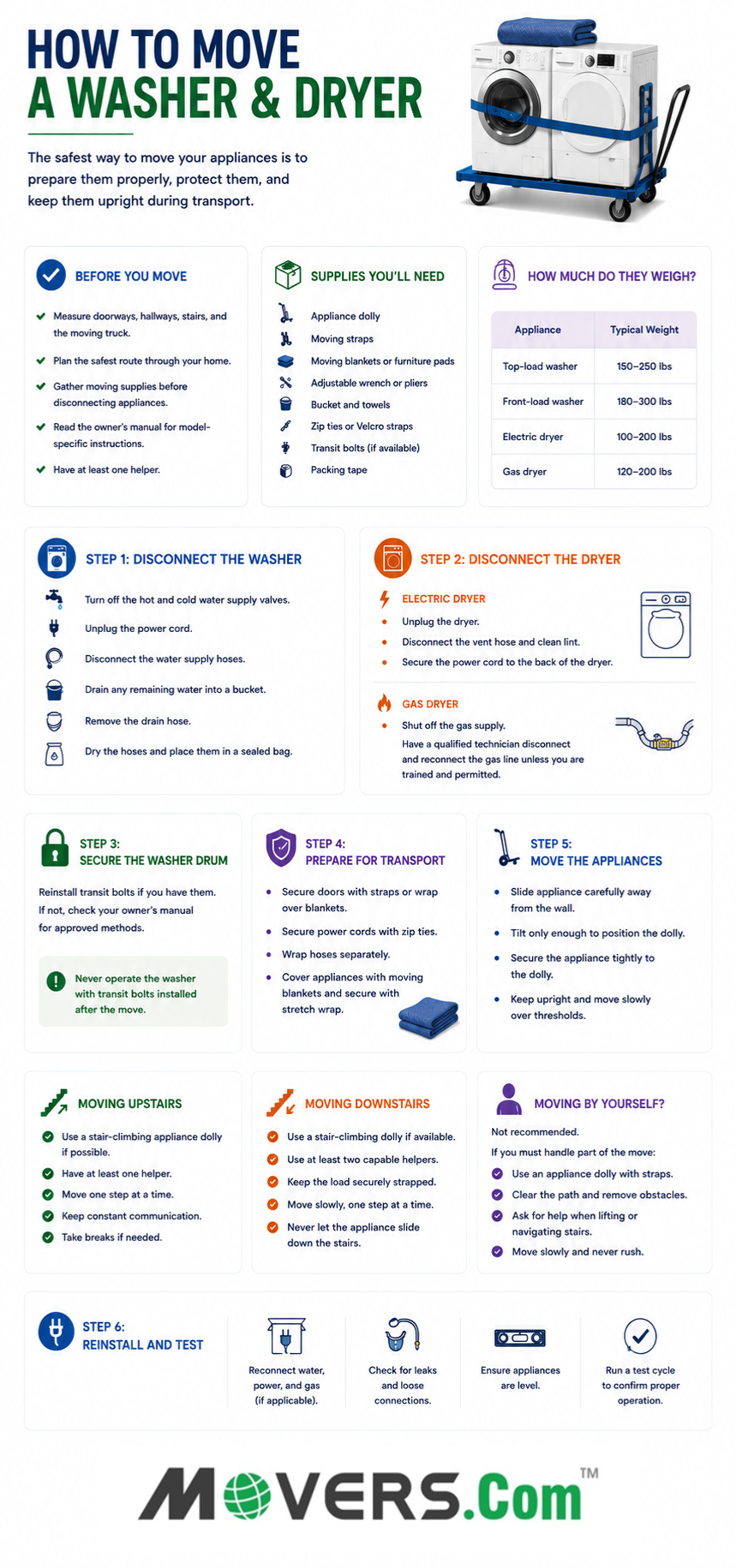
The safest way to move a washer and dryer is to disconnect the utilities, drain the washer, secure the washer drum, protect both appliances with moving blankets, and transport them upright using an appliance dolly whenever possible. Because washers and dryers are heavy, having at least one helper is strongly recommended.
This guide explains how to prepare, lift, transport, and reinstall a washer and dryer, including tips for moving them upstairs, downstairs, or without a dolly.
Washer and Dryer Moving Steps at a Glance
| Step |
What to Do |
| 1 |
Disconnect the water, power, and gas (if applicable). |
| 2 |
Drain any remaining water from the washer. |
| 3 |
Secure the washer drum with transit bolts or shipping materials. |
| 4 |
Remove and secure hoses, cords, and dryer vents. |
| 5 |
Protect both appliances with moving blankets. |
| 6 |
Move them using an appliance dolly whenever possible. |
| 7 |
Keep both appliances upright during transport. |
| 8 |
Reconnect utilities and test both appliances after moving. |
Before You Move a Washer and Dryer
Preparing ahead of time helps prevent injuries and reduces the risk of damaging your appliances.
Before moving your washer and dryer:
- Measure doorways, hallways, staircases, and the moving truck.
- Plan the safest route through your home.
- Gather all the moving supplies before disconnecting the appliances.
- Read the owner's manual if it's available for model-specific moving instructions.
- Arrange for at least one helper, especially if stairs are involved.
Supplies You'll Need
Having the proper equipment makes moving safer and easier.
You'll typically need:
Transit bolts (if available)
How Much Do Washers and Dryers Weigh?
| Appliance |
Typical Weight |
| Top-load washer |
150–250 lbs |
| Front-load washer |
180–300 lbs |
| Electric dryer |
100–200 lbs |
| Gas dryer |
120–200 lbs |
Step 1. Disconnect the Washer
Before disconnecting the washer, run the final spin cycle if possible to remove excess water.
Then:
- Turn off the hot and cold water supply valves.
- Unplug the power cord.
- Disconnect the water supply hoses.
- Drain any remaining water into a bucket.
- Remove the drain hose.
- Dry the hoses and place them in a sealed plastic bag.
Leaving water inside the washer can cause leaks and increase the appliance's weight during the move.
Step 2. Disconnect the Dryer
The steps vary depending on whether you have an electric or gas dryer.
Electric Dryer
- Unplug the dryer.
- Disconnect the vent hose.
- Clean any lint from the vent before packing.
- Secure the power cord to the back of the dryer.
Gas Dryer
Shut off the gas supply. Have a qualified appliance technician disconnect and reconnect the gas line unless you are trained and permitted to perform the work.
Step 3. Secure the Washer Drum
The washer drum should be secured before transporting the appliance to help reduce movement that could damage internal components.
If you still have the original transit bolts that came with your washing machine, reinstall them according to the manufacturer's instructions.
If the transit bolts are no longer available, check your owner's manual for alternative recommendations. Some manufacturers provide approved methods for transporting the washer without the original shipping hardware. Never operate the washer with the transit bolts installed after the move, as they can damage the suspension system.
Step 4. Prepare the Appliances for Transport
Before moving either appliance:
- Secure the washer and dryer doors with stretch wrap, moving straps, or tape placed over a moving blanket rather than directly on the appliance finish.
- Secure power cords with zip ties or tape.
- Wrap hoses separately.
- Cover both appliances with moving blankets.
- Secure the blankets with stretch wrap or moving tape.
Step 5. Move the Washer and Dryer
Washers and dryers are extremely heavy, so proper lifting techniques are essential.
When moving them:
- Slide the appliance carefully away from the wall.
- Tilt it only enough to position the appliance dolly.
- Secure the appliance tightly to the dolly with moving straps.
- Keep the appliance upright whenever possible.
- Move slowly over thresholds and uneven surfaces.
Never rush or attempt to catch a falling appliance.
How to Move a Washer and Dryer Upstairs
Moving appliances upstairs requires extra planning because of the additional weight and balance involved.
For safer lifting:
- Use an appliance dolly designed for stairs whenever possible.
- Have at least one helper.
- Move one step at a time.
- Keep constant communication throughout the move.
- Take breaks if needed rather than rushing.
If the staircase is narrow or has sharp turns, professional movers may be the safer option. If the staircase has tight turns or limited headroom, measure both the appliance and the stairwell before starting the move.
How to Move a Washer and Dryer Downstairs
Moving downstairs can be just as difficult because gravity increases the risk of losing control of the appliance.
For a safer move:
- Use a stair-climbing appliance dolly if available.
- Use at least two capable helpers positioned according to the dolly manufacturer's instructions and the staircase layout.
- Keep the load securely strapped to the dolly.
- Move slowly, one step at a time.
- Never allow the appliance to slide freely down the stairs.
Large appliances can cause serious injuries or property damage if they become uncontrollable.
Can You Move a Washer and Dryer by Yourself?
Moving a washer or dryer by yourself is not recommended because both appliances are heavy, bulky, and difficult to control. Many residential washers weigh well over 100 pounds, and some models weigh considerably more, and the risk increases when stairs, narrow hallways, or uneven surfaces are involved.
If you must handle part of the move yourself:
- Use an appliance dolly with straps.
- Clear the entire route before moving.
- Wear closed-toe shoes and work gloves.
- Move slowly and avoid twisting while lifting.
- Ask at least one person to help guide and stabilize the appliance.
Do not attempt to move a washer or dryer alone on stairs. Hiring professional movers is usually the safest option when access is difficult.
Can You Move a Washer Without a Dolly?
You may be able to move a washer a very short distance without a dolly, but it is not the safest method. Washers are heavy and can be difficult to grip, so using furniture sliders or lifting straps is generally better than trying to carry the appliance.
For short, level moves:
- Place furniture sliders under the appliance.
- Use lifting straps with a helper.
- Keep the washer upright.
- Protect floors with cardboard or hardboard sheets.
- Move slowly and avoid dragging the appliance directly across the floor.
Do not try to move a washer downstairs, upstairs, or into a truck without suitable moving equipment.
Avoid tipping the washer excessively, as this may allow residual water to enter internal components.
How to Load a Washer and Dryer Into a Moving Truck
A washer and dryer should be loaded upright and positioned where they are less likely to shift during transportation.
When loading:
- Use the truck ramp or liftgate if available.
- Keep the appliances strapped to the dolly until they are inside the truck.
- Position the appliances upright near the front of the cargo area, against a sturdy wall when possible, to support balanced weight distribution.
- Place moving blankets between the appliances and nearby items.
- Secure both appliances with ratchet straps or truck tie-downs.
- Avoid stacking heavy objects on top of them.
Keep hoses, transit bolts, cords, and installation hardware together in a labeled box or bag.
How to Transport a Washer and Dryer
Washers and dryers should generally remain upright during transport. Laying a washer on its side or back can place stress on the drum, suspension system, and internal components.
If your appliance must be transported in another position, follow the manufacturer's instructions for your specific model. Some manufacturers specify whether the appliance may be laid on its side temporarily and how long it should remain upright before use after transport.
During transportation:
- Secure the washer and dryer separately.
- Prevent movement with straps and padding.
- Avoid placing sharp or heavy items against the appliances.
- Drive carefully over turns, bumps, and uneven roads.
- Keep the washer's transit bolts installed until it reaches the new home.
How to Reinstall a Washer and Dryer
Before reconnecting the appliances, place them in their final positions and inspect the cords, hoses, and connections for damage.
Reinstalling the Washer
- Remove the transit bolts according to the owner's manual.
- Reconnect the drain hose.
- Attach the hot and cold water supply hoses.
- Turn on the water valves slowly.
- Check each connection for leaks.
- Plug in the washer.
- Level the appliance if needed.
- Run a short test cycle.
- Watch closely for leaks around the hose connections during the first cycle.
Do not operate the washer with the transit bolts still installed.
Reinstalling an Electric Dryer
- Connect the vent hose.
- Confirm that the vent is not crushed or blocked.
- Plug the dryer into the correct outlet.
- Level the dryer.
- Run a short test cycle.
Reinstalling a Gas Dryer
A gas dryer requires a properly connected gas line and leak testing. If you are not qualified or comfortable performing the installation, hire a qualified appliance technician.
Common Mistakes to Avoid
Avoid these common mistakes when moving a washer and dryer:
- Forgetting to shut off the water supply.
- Leaving water inside the washer or hoses.
- Moving the washer without securing the drum.
- Operating the washer before removing the transit bolts.
- Leaving cords, hoses, or vents loose.
- Using the appliance door as a lifting point.
- Dragging the appliances across finished floors.
- Laying the washer down without checking the owner's manual.
- Moving heavy appliances alone.
- Disconnecting or reconnecting a gas dryer without the proper experience.
- Failing to measure doorways, stairs, and hallways before moving.
- Forgetting to clean the dryer vent before reinstalling.
Bottom Line
The safest way to move a washer and dryer is to disconnect the utilities, drain the washer, secure the drum, protect both appliances, and move them upright with an appliance dolly and at least one helper.
Stairs, tight turns, gas connections, and limited access can make the job much more dangerous. If you don't have the proper equipment, enough help, or experience moving heavy appliances, hiring professional movers may be the safest and most cost-effective option.
Before moving day, review the owner's manual, gather the correct supplies, and plan the route from the laundry room to the moving truck.
Editor's Note
This guide was reviewed by the Movers.com Moving Industry Analyst team using publicly available appliance-manufacturer guidance, moving safety practices, equipment recommendations, and common residential moving scenarios.
Washer and dryer designs, transit-bolt requirements, utility connections, and installation instructions vary by manufacturer and model. Always review the owner's manual before moving or reinstalling an appliance.
Gas appliances should be disconnected and reconnected according to local safety requirements. Hire a qualified professional if you are unsure how to work with a gas line.
Get expert moving tips and compare movers for free at Movers.com.
You can compare licensed and insured movers, request free moving quotes, and explore step-by-step moving guides, checklists, and practical resources to plan your move with confidence.
Whether you need help moving appliances, packing furniture, or completing a long-distance relocation, Movers.com connects you with trusted moving professionals and useful planning tools.
Questions? Talk to our moving specialists.