The best place to raise a family depends on your priorities. Schools, housing affordability, safety, healthcare, childcare, job opportunities, and quality of life can all influence whether a city is a good fit.
In WalletHub's latest comparison of more than 180 U.S. cities, Fremont, California; Overland Park, Kansas; Irvine, California; Plano, Texas; and Columbia, Maryland ranked as the top five places to raise a family. The study compared cities across 45 metrics covering family fun, health and safety, education and childcare, affordability, and socioeconomics.
Rankings are a useful starting point, but they shouldn't be the only reason to relocate. Housing costs, school districts, commute times, childcare availability, and other conditions can vary significantly within the same city.
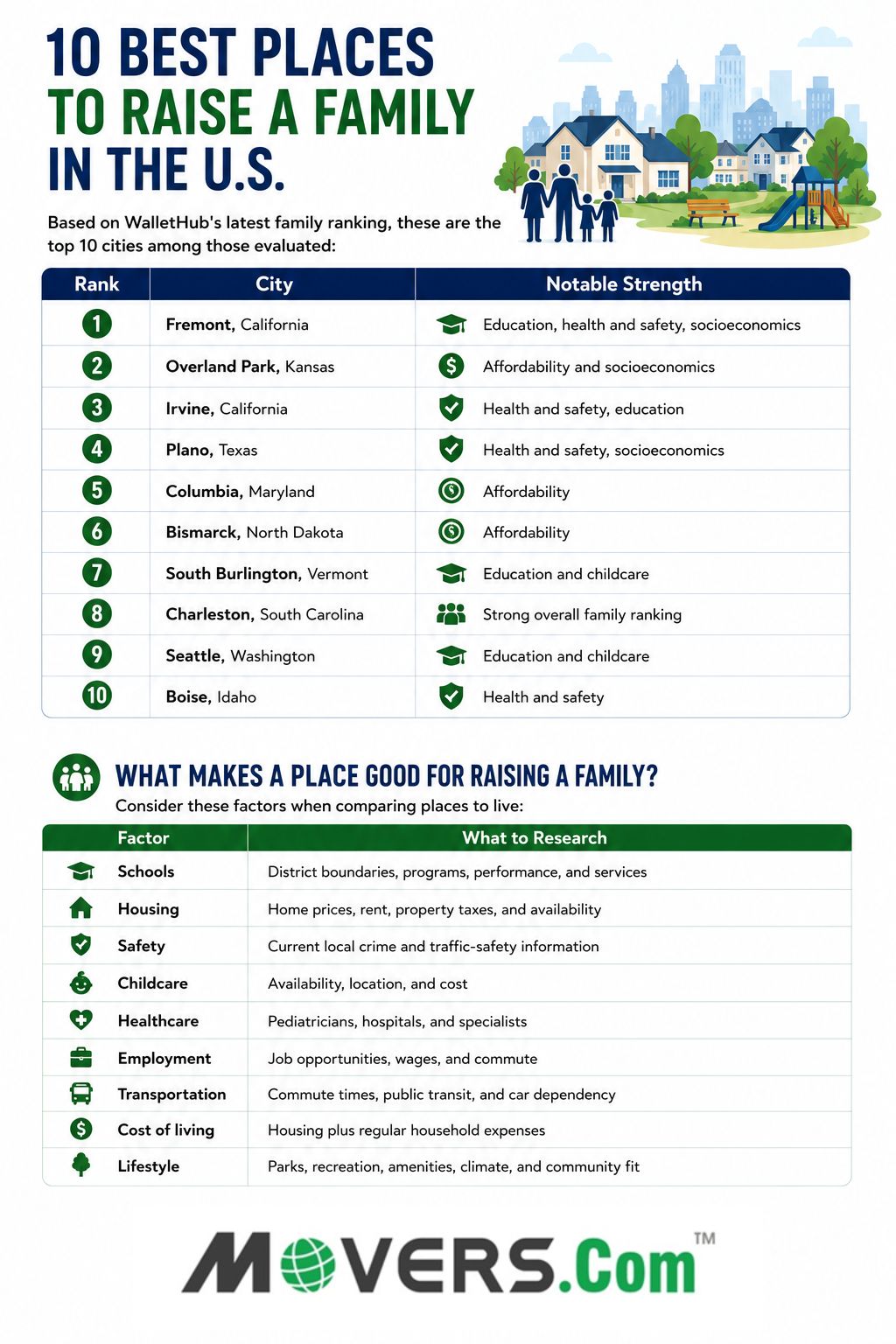
10 Best Places to Raise a Family in the U.S.
Based on WalletHub's latest family ranking, these are the top 10 cities among those evaluated:
| Rank City |
Notable Strength |
| Fremont, California |
Education, health and safety, socioeconomics |
| Overland Park, Kansas |
Affordability and socioeconomics |
| Irvine, California |
Health and safety, education |
| Plano, Texas |
Health and safety, socioeconomics |
| Columbia, Maryland |
Affordability |
| Bismarck, North Dakota |
Affordability |
| South Burlington, Vermont |
Education and childcare |
| Charleston, South Carolina |
Strong overall family ranking |
| Seattle, Washington |
Education and childcare |
| Boise, Idaho |
Health and safety |
A higher ranking doesn't automatically make a city the best choice for your family. Consider your budget, employment, children's needs, preferred lifestyle, and the specific neighborhood where you would live.
1. Fremont, California
Fremont ranked first overall in WalletHub’s latest comparison, performing particularly well in education and childcare, health and safety, and socioeconomics.
Its San Francisco Bay Area location also provides access to a major employment region, but families should carefully evaluate housing and overall living expenses.
Best for: Families prioritizing education, safety, and strong socioeconomic indicators.
Consider: Housing and overall cost of living.
2. Overland Park, Kansas
Overland Park ranked second overall and performed especially well in affordability and socioeconomics.
Located in the Kansas City metropolitan area, it may appeal to families looking for a suburban environment with access to a larger regional job market.
Best for: Families seeking a balance of affordability and strong socioeconomic conditions.
Consider: Commute and transportation needs for your specific neighborhood.
3. Irvine, California
Irvine ranked third overall and stood out particularly for health and safety and education and childcare.
Its Southern California location provides access to a large regional economy and metropolitan amenities. However, families should weigh these advantages against housing and other living costs.
Best for: Families prioritizing health, safety, and education.
Consider: Housing and overall living expenses.
4. Plano, Texas
Plano ranked fourth overall and performed particularly well in health and safety and socioeconomics.
Its location within the Dallas-Fort Worth metropolitan area may appeal to families who prefer suburban living while remaining connected to a major employment market.
Best for: Families seeking strong economic indicators and access to the Dallas-Fort Worth region.
Consider: Commute, transportation needs, and climate.
5. Columbia, Maryland
Columbia ranked fifth overall and performed especially well in affordability in WalletHub's comparison. It also had the highest median family salary after adjustment for cost of living among the cities evaluated.
Located between Baltimore and Washington, D.C., Columbia may appeal to families who want access to employment opportunities throughout the broader region.
Best for: Families seeking access to the Baltimore-Washington region with strong affordability indicators.
Consider: Housing and commuting costs for your specific location.
6. Bismarck, North Dakota
Bismarck ranked sixth overall and performed particularly well in affordability.
Its smaller-city environment may appeal to families looking for a different pace than a major metropolitan area.
Best for: Families prioritizing affordability and a smaller-city environment.
Consider: Winter climate and local employment opportunities.
7. South Burlington, Vermont
South Burlington ranked seventh overall and performed especially well in education and childcare.
Its smaller size may appeal to families who prefer a less urban environment while remaining close to Burlington's employment, healthcare, and recreational opportunities.
Best for: Families prioritizing education and childcare.
Consider: Housing availability and whether a smaller-city environment fits your family's lifestyle.
8. Charleston, South Carolina
Charleston ranked eighth overall in the family comparison.
The Charleston area provides access to cultural attractions, outdoor recreation, beaches, and metropolitan amenities.
Best for: Families looking for recreation, cultural amenities, and a warmer climate.
Consider: Housing, insurance costs, commute, and coastal weather risks.
9. Seattle, Washington
Seattle ranked ninth overall and performed well in education and childcare in the comparison.
As a major metropolitan area, Seattle provides access to employment opportunities, healthcare, cultural attractions, and outdoor recreation.
Best for: Families prioritizing employment opportunities and big-city amenities.
Consider: Housing, childcare, transportation, and overall living costs.
10. Boise, Idaho
Boise ranked tenth overall and performed particularly well in health and safety.
It may appeal to families looking for a smaller metropolitan area that combines urban amenities with access to outdoor recreation.
Best for: Families seeking a smaller metropolitan area with access to outdoor activities.
Consider: Current housing affordability and local employment opportunities.
Is Minnesota a Good Place to Raise a Family?
Minnesota can be a strong option for families, but the right choice depends on the specific city, suburb, and your priorities.
Compare Minnesota communities based on:
- Schools.
- Housing costs.
- Employment opportunities.
- Childcare.
- Healthcare.
- Commute.
- Parks and recreation.
- Winter climate.
The Minneapolis-St. Paul metropolitan area provides access to major employers, healthcare, education, recreation, and cultural amenities, while smaller Minnesota communities may offer a different balance of housing, commute, and lifestyle.
Research individual communities and school districts rather than evaluating Minnesota as a single housing market.
What About Small Towns and Suburbs for Raising a Family?
The best place to raise a family doesn't have to be a major city. Smaller towns and suburbs may offer more space, a quieter environment, shorter local trips, or convenient access to schools and recreation.
However, small towns aren't automatically more affordable or better for families. Before relocating, compare:
- Housing costs and property taxes.
- School options.
- Childcare availability.
- Healthcare access.
- Employment opportunities.
- Commute times.
- Transportation needs.
- Access to shopping, recreation, and everyday services.
If you're considering a community outside a major metropolitan area, also determine how often your family would need to travel elsewhere for work, specialized healthcare, airports, or other services.
What Makes a Place Good for Raising a Family?
National rankings can help narrow your options, but your family's priorities should guide the final decision.
Consider these factors when comparing places to live:
| Factor |
What to Research |
| Schools |
District boundaries, programs, performance, and services |
| Housing |
Home prices, rent, property taxes, and availability |
| Safety |
Current local crime and traffic-safety information |
| Childcare |
Availability, location, and cost |
| Healthcare |
Pediatricians, hospitals, and specialists |
| Employment |
Job opportunities, wages, and commute |
| Transportation |
Commute times, public transit, and car dependency |
| Cost of living |
Housing plus regular household expenses |
| Lifestyle |
Parks, recreation, amenities, climate, and community fit |
Don't assume that a highly ranked city will perform equally well in every category. A city with excellent schools and employment opportunities, for example, may also have housing costs that don't fit your budget.
How to Choose the Best Place for Your Family
Start by identifying your family's three to five most important priorities. These might include schools, affordability, employment, childcare, healthcare, commute, climate, or proximity to relatives.
Compare potential cities using the same criteria, then research individual neighborhoods and school districts.
If practical, visit your top choices before relocating. Pay attention to the commute, housing, schools, parks, healthcare, shopping, transportation, and other places your family would regularly use.
Don't choose a city solely because it ranks highly on a national list. A lower-ranked city that better fits your budget, employment situation, and family needs may be the better place for your household.
 Bottom Line
There isn't one best place to raise a family in the United States.
Fremont, Overland Park, Irvine, Plano, Columbia, and other cities that perform well in current family-focused rankings can be useful starting points, but the best place for your family depends on your budget, employment, schools, childcare, healthcare, lifestyle, and other priorities.
Before relocating, compare individual neighborhoods and current local conditions rather than making a decision based on a national ranking alone.
Editor's Note
Our comparison reviewed by our Moving Industry Analyst team is based on publicly available pricing, customer reviews, and regular moving scenarios.
City rankings, housing costs, school information, and other local conditions can change over time. This guide uses the latest available family-focused ranking information as a starting point, but families should verify current housing, schools, childcare, employment, and other local conditions before relocating.
Get expert moving tips and compare movers for free at Movers.com.
You can get free moving quotes from licensed and insured movers, compare moving companies near you, and plan your move with confidence using our step-by-step moving guides and checklists.
Whether you're planning a local move, a long-distance relocation, or need help with packing and loading, Movers.com connects you with trusted moving professionals and practical tools to make moving easier and more affordable.
Questions? Talk to our moving specialists.