Rental moving trucks don't always have to stop at weigh stations. Whether you need to stop depends on the state you're driving through, the truck's size or weight, how the vehicle is being used, and the instructions posted at the weigh station.
If you're driving a rental truck such as a U-Haul to move your own household belongings, you typically aren't treated the same as a commercial moving carrier. However, state rules vary, and some states require certain rental or noncommercial trucks to enter weigh stations based on vehicle type or weight.
Always obey posted weigh-station signs and check the current requirements for every state on your route before driving. If you're unsure whether you need to enter, follow the posted instructions. U-Haul advises its customers to stop when in doubt.
This guide explains when rental moving trucks may need to stop at weigh stations, how vehicle weight affects the rules, and what to check before driving a U-Haul or other rental truck across state lines.
Do Rental Moving Trucks Have to Stop at Weigh Stations?
There isn't one nationwide rule requiring every personal-use rental moving truck to stop at every weigh station.
The requirement can depend on:
- The state you're driving through.
- The wording on the weigh-station sign.
- The truck's GVWR or other applicable weight threshold.
- Whether the vehicle is being used for personal or commercial purposes.
- The type of truck or vehicle combination you're driving.
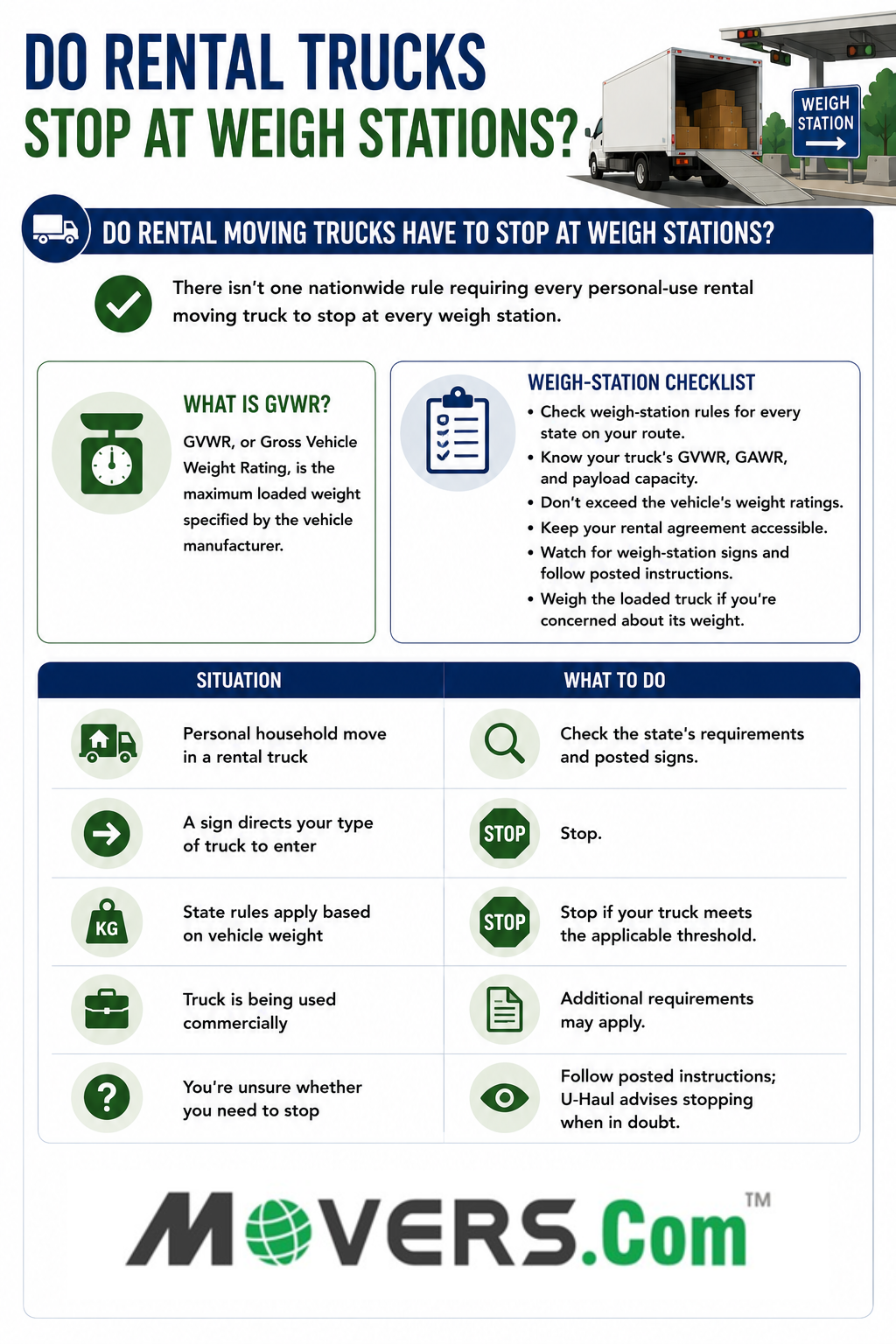
A practical guide is:
| Situation |
What to Do |
| Personal household move in a rental truck |
Check the state's requirements and posted signs |
| A sign directs your type of truck to enter |
Stop |
| State rules apply based on vehicle weight |
Stop if your truck meets the applicable threshold |
| Truck is being used commercially |
Additional requirements may apply |
| You're unsure whether you need to stop |
Follow posted instructions; U-Haul advises stopping when in doubt |
Don't assume that a rental truck is automatically exempt simply because you're using it for a personal move.
Do U-Hauls Have to Stop at Weigh Stations?
Not always.
U-Haul states that customers moving their own household goods normally aren't required to stop at weigh stations because the move isn't commercial. However, U-Haul also notes that state laws vary and some states require trucks to stop.
If you're driving a U-Haul:
- Check the requirements for each state on your route.
- Pay attention to weigh-station signs.
- Don't assume the same rule applies after crossing a state line.
- Enter the station if posted instructions or state requirements apply to your truck.
- If you're uncertain whether you need to stop, U-Haul advises stopping rather than assuming you're exempt.
The size and weight rating of the U-Haul can also matter because some states use vehicle type or weight thresholds when determining which vehicles must enter a weigh station.
What Determines Whether a Rental Truck Has to Stop?
Several factors can determine whether your rental moving truck must enter a weigh station.
State Law
Weigh-station requirements aren't identical across the United States.
Some states focus primarily on commercial vehicles, while others may require certain trucks to stop based on weight or vehicle classification regardless of whether you're moving your own household belongings.
If your route crosses several states, check the requirements in each state, not just your origin and destination.
Posted Weigh-Station Signs
Roadside signs are especially important.
A weigh station may display instructions applying to:
- Commercial vehicles.
- Trucks over a specified weight.
- All trucks.
- Vehicles over a specified GVWR.
- Particular vehicle types.
Follow the posted instructions that apply to your vehicle rather than relying solely on a general online summary.
Vehicle Weight
Some state requirements depend on the truck's weight rating, actual weight, or vehicle classification.
This is why you should know the specifications of the specific truck you're renting rather than relying only on descriptions such as "15-foot truck" or "26-foot truck."
Different models of the same general truck size can have different weight ratings.
Personal vs. Commercial Use
A person renting a truck to move their own household belongings may be treated differently from a business transporting property commercially.
However, personal use doesn't automatically exempt a rental moving truck from every state weigh-station requirement.
What Is GVWR?
GVWR, or Gross Vehicle Weight Rating, is the maximum loaded weight specified by the vehicle manufacturer.
It accounts for the vehicle and the weight it carries within the manufacturer's rating. It isn't the same as the truck's empty weight.
When checking a rental truck, you may encounter several weight terms:
| Term |
What It Means |
| GVWR |
Maximum loaded weight specified by the vehicle manufacturer |
| Empty or curb weight |
Approximate weight of the truck without your household cargo |
| Payload capacity |
Amount of additional weight the truck can carry within its limits |
| GAWR |
Maximum allowable weight for a particular axle |
U-Haul states that its trucks have GVWR and GAWR information posted on a label inside the driver's door opening and instructs renters not to exceed those ratings.
How Do You Know How Much Your Rental Truck Weighs?
Check the actual truck rather than relying solely on a general website description for that truck size.
Look for the manufacturer's certification or weight-information label around the driver's door area. The rental company can also provide specifications for the truck assigned to you.
If you're concerned that the loaded truck may be too heavy, consider having it weighed at an appropriate public or commercial vehicle scale.
U-Haul advises renters not to exceed the truck's GVWR or GAWR and recommends weighing the loaded truck at a commercial or state scale if they're unsure about its weight.
What Should You Ask About Rental Truck Payload Capacity?
Before renting a truck, don't just ask whether your belongings will physically fit inside it. A truck can run out of safe payload capacity before it runs out of cargo space.
Ask the rental company:
- What is the GVWR of the specific truck?
- What is its approximate empty or curb weight?
- What is the maximum payload capacity?
- What are the front and rear GAWRs?
- How does towing affect the truck's allowable load?
- Where can I weigh the loaded truck if necessary?
Truck size alone doesn't tell you how much weight you can safely carry.
How to Avoid Overloading a Rental Moving Truck
Overloading can affect handling, braking, tires, suspension, and vehicle stability.
To reduce the risk:
- Check the weight ratings and payload capacity of the actual truck.
- Don't estimate safe capacity based only on available cargo space.
- Account for passengers and cargo when evaluating the loaded vehicle.
- Follow the rental company's loading instructions.
- Load heavier items low and toward the front of the cargo area when instructed.
- Secure belongings so they don't shift during transportation.
- Don't exceed the truck's GVWR or GAWR.
- Weigh the loaded truck if you're uncertain about its total weight.
U-Haul's truck instructions advise loading heavier items first, toward the front and on the floor, and not exceeding the vehicle's listed GVWR or GAWR.
A moving truck having enough space for your belongings doesn't necessarily mean it has enough payload capacity for their weight.
Do Rental Truck Weigh-Station Rules Vary by State?
Yes. Weigh-station requirements vary by state, and there isn't one nationwide rule that applies to every rental moving truck.
A state may determine whether a truck must stop based on:
- Vehicle type or classification.
- GVWR or another weight threshold.
- Actual vehicle weight.
- Personal or commercial use.
- Posted weigh-station instructions.
Because these rules can change, check the current requirements for every state on your route before your trip. Don't rely on a general state-by-state list without verifying the information with the state's transportation or enforcement agency.
California Rental Truck Rule
California is an important example because its rules specifically address rental moving trucks.
According to Caltrans, rental trucks such as U-Haul, Budget, Ryder, and Enterprise moving trucks are required to stop at weigh stations when applicable. California weigh stations may also display signs specifically directing daily rental and moving trucks to enter when the station is open.
Qualifying pickup trucks are generally treated differently and may not be required to stop. However, a rental box truck shouldn't be assumed to qualify for the pickup-truck exception.
If you're driving a rental moving truck through California, follow the posted signs and current Caltrans requirements.
How to Check Weigh-Station Requirements for Your Route
If your move crosses state lines, research weigh-station requirements before leaving.
For each state:
- Visit the official state department of transportation, motor vehicle, highway patrol, or commercial vehicle enforcement website.
- Look for weigh-station or truck-scale requirements.
- Check whether the rules apply based on vehicle type, GVWR, actual weight, or commercial use.
- Confirm the GVWR and other weight ratings of your specific rental truck.
- Follow posted weigh-station signs while driving.
You can also ask the rental company whether it provides guidance for your route, but state agencies and posted roadway instructions should be your primary sources for current requirements.
What Happens at a Weigh Station?
If your rental truck is required to enter, reduce your speed and follow the posted lane markings, traffic signals, electronic signs, and instructions from enforcement personnel.
At a traditional weigh station, you may be directed onto a scale where the vehicle's weight or axle weights are measured. Some facilities also use weigh-in-motion systems that measure vehicle weight while the truck is moving.
If directed into a weigh station:
- Follow the posted speed limit.
- Stay in the designated lane.
- Follow signs and signals.
- Stop where instructed.
- Follow enforcement personnel's directions.
What Happens if Your Rental Truck Is Overweight?
An overloaded rental truck can create both safety and compliance problems.
If the truck exceeds an applicable vehicle or axle weight limit, state enforcement requirements and potential penalties can vary. You may be required to correct an overweight condition before continuing.
More importantly, exceeding the truck's GVWR or GAWR can affect:
- Braking distance.
- Steering and handling.
- Tire performance.
- Suspension.
- Vehicle stability.
If you're unsure whether your belongings are within the truck's safe weight capacity, weigh the loaded vehicle before beginning a long trip.
Can You Weigh a Rental Moving Truck Yourself?
Yes. You can use an appropriate public or commercial vehicle scale to verify your rental truck's loaded weight.
This can be useful if you're transporting unusually heavy belongings, the truck is loaded close to capacity, or you're uncertain about the total or axle weight.
Compare the scale results with the GVWR and applicable axle ratings for your specific vehicle.
Weigh-Station Checklist
Before your trip:
- Check weigh-station rules for every state on your route.
- Know your truck's GVWR, GAWR, and payload capacity.
- Don't exceed the vehicle's weight ratings.
- Keep your rental agreement accessible.
- Watch for weigh-station signs and follow posted instructions.
- Weigh the loaded truck if you're concerned about its weight.
Bottom Line
Rental moving trucks don't automatically have to stop at every weigh station.
Whether you need to stop depends on the state, vehicle type and weight, how the truck is being used, and posted weigh-station instructions. Personal-use rental trucks may be exempt in some situations, while other states, including California, specifically require certain rental moving trucks to stop.
Before a long-distance move, check the requirements for every state on your route, know the weight ratings of your specific truck, and don't exceed its GVWR or GAWR.
When approaching a weigh station, follow the posted instructions. If you're driving a U-Haul and aren't sure whether you need to stop, U-Haul advises stopping when in doubt.
Editor's Note
Weigh-station laws and vehicle-weight requirements vary by state and can change. This guide provides general information and isn't legal advice.
Before driving a rental moving truck, verify current requirements with the appropriate state transportation or enforcement agency and follow all posted roadway instructions.
Get expert moving tips and compare movers for free at Movers.com.
You can get free moving quotes from licensed and insured movers, compare moving companies near you, and plan your move with confidence using our step-by-step moving guides and checklists.
Whether you're planning a local move, a long-distance relocation, or need help with packing and loading, Movers.com connects you with trusted moving professionals and practical tools to make moving easier and more affordable.
Questions? Talk to our moving specialists.