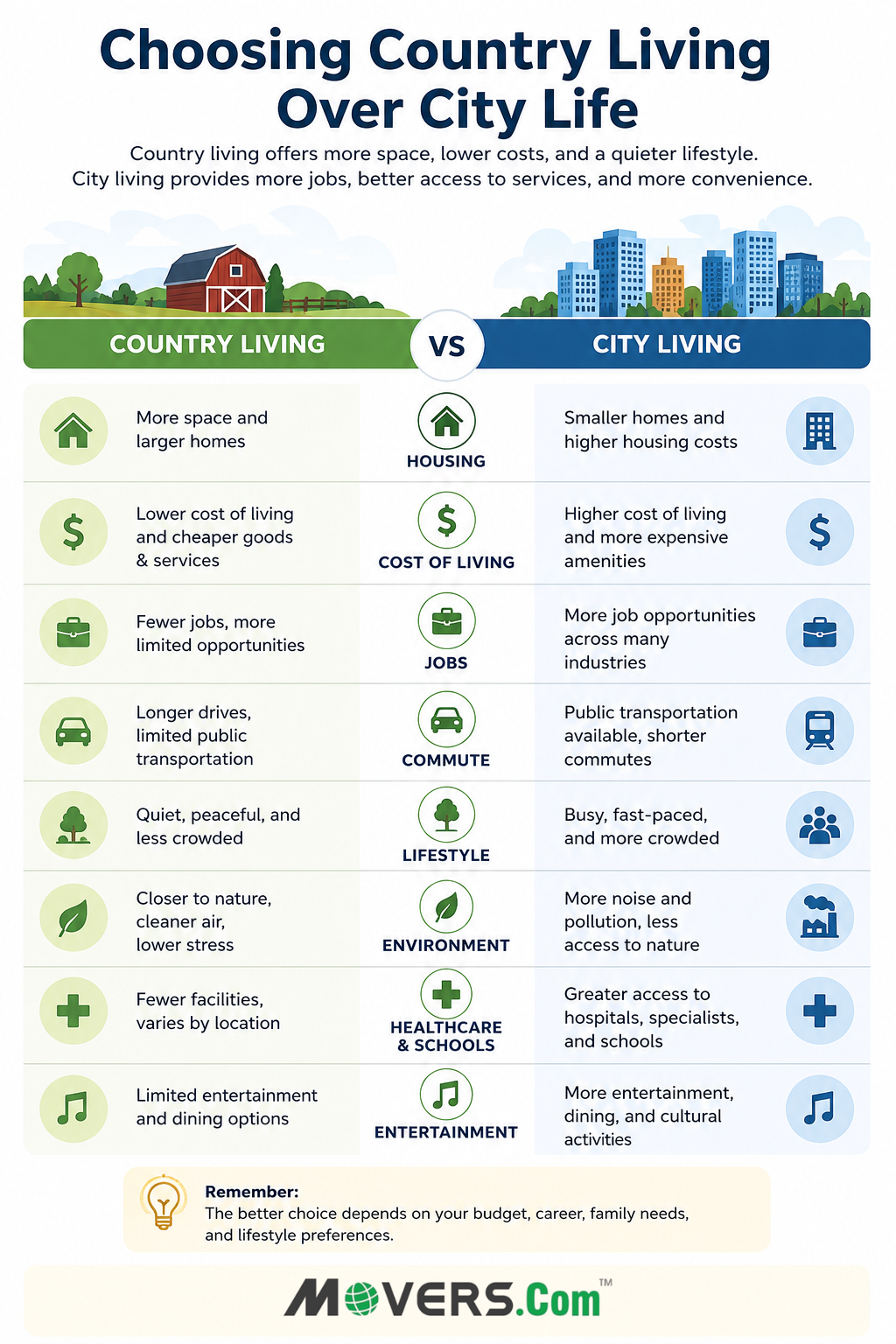
Country living generally offers more space, lower housing costs, less traffic, and a quieter lifestyle, while city living provides better access to jobs, healthcare, schools, entertainment, and public transportation. The better choice depends on your budget, career, family needs, and lifestyle preferences.
If you're deciding between living in the country or the city, this guide compares the costs, benefits, challenges, and key lifestyle differences to help you choose the right place to call home.
Country vs. City Living at a Glance
| Feature |
Country Living |
City Living |
| Housing |
More space, often lower cost |
Higher prices, smaller homes |
| Jobs |
Fewer opportunities |
More career options |
| Commute |
Longer drives |
Public transportation available |
| Noise |
Quiet |
Busy |
| Entertainment |
Limited |
More options |
| Healthcare |
Fewer facilities |
Greater access |
| Schools |
Varies by location |
More choices |
| Lifestyle |
Slower pace |
Fast-paced |
What Is Country Living?
Country living means residing in a rural or low-population area where homes are typically farther apart and surrounded by open land, farms, or natural landscapes. Compared with city living, country life often offers more privacy, larger properties, and a slower pace of life.
Why Do People Prefer Country Living?
Many people choose country living because it offers more space, greater privacy, cleaner air, less traffic, and a slower pace of life. For families, retirees, and remote workers, living in the countryside can provide a quieter environment, lower housing costs in many areas, and closer access to nature.
The growth of remote and hybrid work has also made country living more practical for many professionals who no longer need to commute daily.
Pros of country living
There are many benefits to living in the countryside including huge open spaces, cleaner air, lower cost of living, and intimacy with nature.
Health Benefits of Country Living
Living in the countryside may support both physical and mental well-being through cleaner air, greater access to nature, and a quieter environment. Some potential benefits include:
Purified air
- Living in the countryside often means cleaner air because rural areas generally have fewer sources of pollution than densely populated cities.
- Air quality in the countryside is better compared to that in urban areas since the countryside is filled with lots of greenery and few sources of pollution.
- Purified air can support finer breathing and reduce your chances of getting respiratory illnesses, heart diseases, or allergies.
- When choosing a place to live specifically in the countryside, we suggest you look for a place with no factories nearby so that you don’t lose out on health benefits that are caused by lack of exposure to pollution.
Intimacy to nature
- The countryside will greet you with an abundance of greenery every time you step out of your house.
- You get more than just visual satisfaction however since living close to nature can foster your immune system, improve your vitality, and calm down your nerves.
- Moreover, you will be able to more easily enjoy outdoor activities which will further enhance your mental and physical wellbeing.
Easier access to organic food
- You will find plentiful farms in the countryside where you can directly buy fresh vegetables, fruits, milk, and even meat.
- It’s also easier to grow your food in the countryside since land scarcity won’t be a problem.
Reduced stress
-
The slower pace of country life can help reduce everyday stress for many people. With less traffic, fewer crowds, and quieter surroundings, many residents find it easier to relax and enjoy a better work-life balance.
- You also won't be under any major expectations or even social pressures due to the more isolated nature, and you will be able to work at a better pace, overcome your anxieties, and focus on personally important things more easily.
Less traffic
- You can travel more distance in less time because of fewer traffic signals and lower amounts of traffic jams.
- Additionally, you won’t have to waste your time looking for empty parking spaces which will reduce the time it takes to reach your destination.
- You will feel more relaxed on the streets since less cars mean there will be little chance of an accident.
- Also, less traffic will cause less noise and pollution which in turn will be beneficial for your health.
Increased safety
A higher level of safety is another great benefit of living in the countryside.
Many rural communities report lower crime rates than large metropolitan areas, although safety varies significantly by location.
Moreover, in the countryside people will likely know each other well, so any suspicious activity will be immediately notified.
If you choose country living, you will come across less theft, robbery, homicide, or any other criminal activity.
Here’s what you should know:
- You won’t have much to worry about the security of your property or your loved ones.
- There is less need to feel reluctant about allowing your children to play outside or roam around in the dark. Many residents feel comfortable allowing children to spend more time outdoors, although safety depends on the specific community.
- Due to lesser traffic, you can let your children go along to school and ride their bikes without much to worry about.
Overall, your kids will grow up in a sound and healthy environment, and you will be able to enjoy a low stress life.
Larger spaces
Land is cheaper in the countryside when compared to the city.
This will allow you to buy a larger house with a huge outdoor area. You will have enough space to plant flowers and make a summer kitchen or organize a workshop in the backyard of your house.
Moreover, large yards are great for children and will be big enough to allow other kids to easily socialize in them.
You can also enjoy big barbeques in those large yards.
To sum up, living in the countryside can give you a breath of fresh air and allow you to be yourself.
Your children will enjoy a happy life, and you will be able to save lots of stress because of the lower finances.
Friendly community
Smaller rural communities often have a stronger sense of community than large cities. Neighbors may know each other better, making it easier to build relationships and receive local support.
- People in rural areas are generally more kind, supportive, and friendly to each other due to the smaller population and more laid-back nature.
- It’s easier to make friends in the countryside compared to large cities.
- In many rural communities, neighbors often know one another and are more likely to offer support or assistance.
Personal freedom
Many people appreciate the quieter environment of the countryside because it offers fewer distractions and a greater sense of privacy. Whether that's an advantage depends on your personal preferences and lifestyle.
Urban environments typically have more commercial development and traffic, while rural areas often feature more open landscapes and natural surroundings.
To relocate to the countryside, you can hire professional movers if you have the budget, or else you can make a DIY move with a proper plan in hand.
Is It Cheaper to Live in the Country?
In many parts of the United States, country living is more affordable than city living, especially when it comes to housing and property costs. However, transportation expenses and longer commutes may offset some of those savings depending on where you live.
Here’s what you need to know about cost of living in the countryside:
- Houses in the countryside are more affordable than those in the cities.
- If you rent a property in the countryside, the cost you will need to pay will be half the price you would have paid for renting a property in the major cities.
-
Utility costs vary by location. While housing is often less expensive in rural areas, some homeowners may pay more for heating, propane, well maintenance, or septic systems.
-
Property taxes, income taxes, and other living expenses vary by state, county, and municipality. Some rural areas have lower overall tax burdens, but this is not true everywhere.
-
Overall living costs may be lower in many rural areas, particularly for housing, although total expenses vary depending on location, commuting costs, and local services.
Country Living Pros and Cons
Pros
- More space
- Less traffic
- Lower housing costs
- More privacy
- Cleaner air
- Lower noise levels
Cons
- Longer commute
- Fewer jobs
- Limited healthcare
- Fewer shopping options
- Longer travel for shopping and services
- Less public transportation
- Internet availability may vary in some rural areas.
Country Living vs. City Living: Which Is Better?
Neither country living nor city living is universally better. Country living is ideal for people who value space, privacy, and a slower pace, while city living is often better for those who prioritize convenience, career opportunities, and access to amenities.
|
Country Living May Be Better If
|
City Living May Be Better If
|
| You want more land |
You want shorter commutes |
| You work remotely |
You work in an urban area |
| You enjoy outdoor activities |
You enjoy restaurants and nightlife |
| You prefer peace and quiet |
You want more services nearby |
| You want lower housing costs |
You want more job opportunities |
Is It Better to Grow Up in the City or the Countryside?
Children can thrive in both environments, but each offers different advantages. Rural areas often provide more outdoor space and quieter neighborhoods, while cities typically offer greater access to schools, extracurricular activities, healthcare, and cultural experiences.
Conclusion:
Choosing between country living and city living ultimately depends on your lifestyle, budget, career goals, and personal preferences. While country living offers more space and a quieter environment, city living provides greater convenience, employment opportunities, and access to services.
Before making your move, consider both your current needs and your long-term plans to find the location that's the best fit for you and your family.
Editor's Note
This guide was reviewed by the Movers.com Moving Industry Analyst team using publicly available housing, cost-of-living, demographic, and relocation resources, along with common residential moving scenarios.
Housing costs, job opportunities, healthcare access, schools, and local amenities vary by region. This guide provides general comparisons to help you evaluate the advantages and challenges of country living versus city living before making your move.
Get expert moving tips at Movers.com.
Compare licensed and insured movers, request free moving quotes, and explore practical moving guides, checklists, and relocation resources to help you plan your move with confidence.
Questions? Talk to our moving specialists.